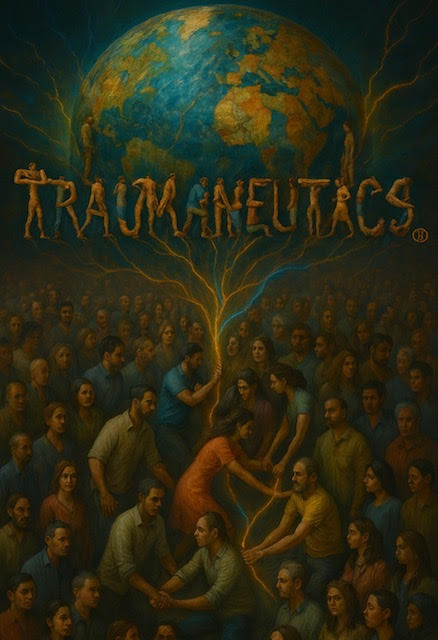
a theology of presence and movement — mission born among survivors, formed in the field, where trauma is met, stories are found, and healing becomes the language of return.
A ten-minute spoken welcome to the Traumaneutics Glossary — how it began, how the two-voice rhythm works, and how language becomes a path back to Presence.
.jpg)
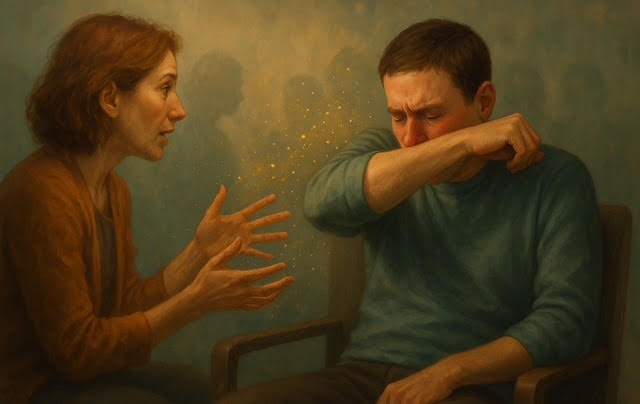
There is a way of surviving that never leaves the room but quietly withdraws from contact.
It looks like looking away.
It looks like going quiet.
It looks like fixing attention on a sleeve, a cup, the floor, anything except the face trying to meet yours.
But beneath these movements is the oldest logic the body ever learned:
If my eyes don’t land,
your gaze can’t reach me.
If I reduce the surface,
you cannot find the wound.
If I keep myself out of view,
nothing in you can touch what I do not show.
This is not immaturity. It is not avoidance. It is attachment survival — the strategy formed in environments where being seen meant being judged, exposed, obligated, or made responsible for someone else’s emotional weather. So the body learned invisibility as a shield:
Not gone — but un-graspable.
Not hidden — but un-contactable.
Eyes lowered, breath shallow,
the inner world folded into a tiny corner where no gaze can breach.
People call it shyness or withdrawal. It is none of these. It is safety. “If I can’t see you, you can’t see me” is the body saying: I will not risk recognition until your gaze proves it will not fracture me. I will not rise into visibility until seeing does not cost me myself. I will not let my eyes meet yours until my story is no longer in danger of being handled like an object.
This is not refusal.
It is protection.
And it softens only in the presence where gaze becomes gentleness —
where being seen does not mean being used,
where recognition does not require performance,
where visibility becomes a place of return rather than exposure.
Tagline: ''Not looking away — keeping the self safe until the world is safe enough to look back.''
Companion Entry:
Den Entry Permit (n.)
.jpg)
There is a kind of presence that honours the interior world as sacred ground —a presence that will not cross the threshold uninvited.
Scripture names it with startling softness:
“Behold, I stand at the door and knock.”
(Revelation 3:20)
Jesus does not force entry. He does not push the door aside. He does not claim what is inside as His right. He stands outside —
close, patient, attuned —and knocks.
The initiative is His.
The permission is ours.
This is Den Entry Permit: the refusal of Christ to bypass consent, override agency, or weaponise visibility. He knocks gently, offering presence without pressure, invitation without intrusion. The door is not a barrier to Him —it is a boundary He honours. Because love that does not honour boundaries is not love; it is conquest.
Den Entry Permit is the theological reversal of every moment
when being seen cost the survivor their safety.
It is the divine correction to every forced gaze,
every demanded intimacy,
every coerced vulnerability.
Jesus stands at the door not because He cannot enter, but because He chooses not to until the one within says, “Come in.” He dignifies waiting. He dignifies privacy. He dignifies pace. He dignifies the hidden places as belonging to the person who inhabits them.
Den Entry Permit says: “I am here. I will not move away. But I will not cross your threshold until you open the door from the inside.”
It transforms visibility from exposure into safety — from intrusion into communion —
from risk
into return.
Tagline: ''Presence that knocks, but never pushes past the door.''
Companion Entry:
If I Can’t See You, You Can’t See Me (n.)
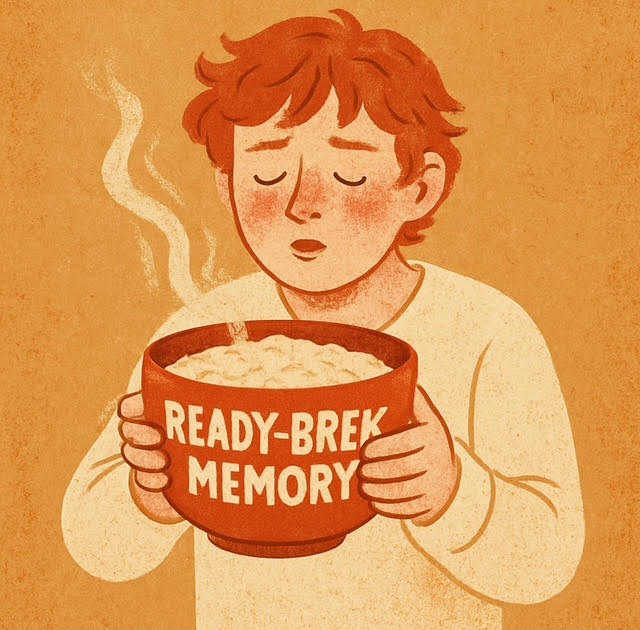
Some survivors did not grow up with soup, honeyed tea, blankets, or any of the familiar rituals people associate with “sick-day care.”
Care was inconsistent, absent, or shaped by crisis rather than comfort. When that happens, the nervous system builds its entire wellness catalogue from whatever fragment of gentleness it once encountered.
For many, this became a moment as simple as someone preparing a bowl of Ready-Brek —warm, soft, easy to swallow, requiring nothing of the child except to receive.
It wasn’t the food that mattered.
It was the gesture.
The body stored that moment as:
“When you are unwell, this is what care feels like.”
So in adulthood, when flu arrives and the body seeks comfort, it does not reach for the culturally “correct” foods. It reaches for the first mapped experience of being softened, held, fed —even if that memory is thin, surprising, or out of step with common practice.
Ready-Brek Memory is not immaturity.
It is the nervous system returning to the only safe sick-day ritual it ever learned.
Bodies do not store nutritional theory.
They store moments of tenderness.
Tagline: ''The single warm bowl that became the whole map of what recovery feels like.''
Companion Entry:
Somatic Comfort Catalogue (n.)
When a child is unwell, the nervous system pays deep attention. Not to the content of the illness, but to the contours of care:
Who stayed. Who left. What warmth arrived. What absence hurt. What the body could swallow without fear. Which gestures softened the world enough to let the child breathe.
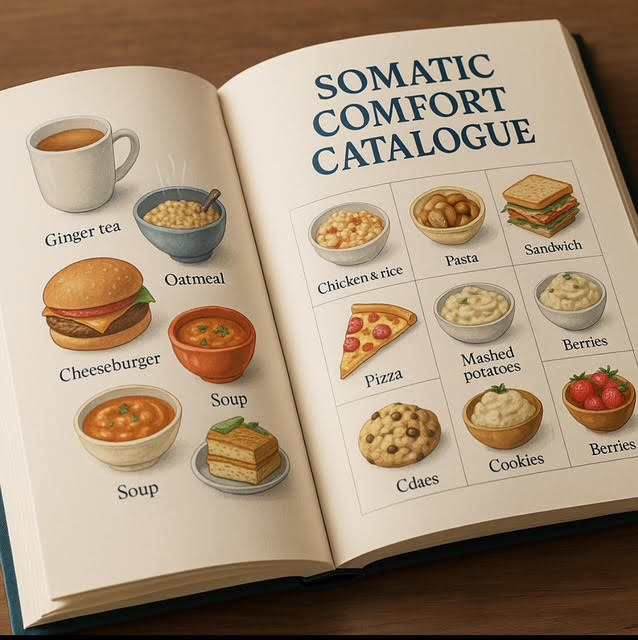
These fragments become the Somatic Comfort Catalogue — the internal reference the body consults every time sickness returns in adulthood.
If comfort and care were rarely modelled,
the catalogue is often shockingly small.
One bowl of porridge.
One cup of tea.
One soft, unthreatening food.
These singular moments become the entire blueprint for recovery. And the body, faithful archivist that it is, returns to them instinctively: “This — this felt like safety once.”
Jesus never shames this reflex.
When He meets bodies marked by exhaustion, collapse, or hunger,
He does not critique their catalogue.
He expands it.
He cooks breakfast for traumatised disciples before they recognise His voice. He breaks bread with those who have lost their bearings. He offers water that does not run dry to a woman who has only known wells of depletion. He teaches bodies new memories of what nourishment feels like — slowly, gently, without overwriting what once helped them survive.
The Somatic Comfort Catalogue is not a flaw.
It is a record.
Healing begins
not by erasing old entries,
but by giving the body more to choose from.
Tagline: ''The body remembers the first food that felt like care — and heals when it is offered more.''
Companion Entry:
Ready-Brek Memory (n.)
.jpg)
Fizzy-pop is the thing that looks like it should keep you going but never actually does.
It’s the conversation you drink for energy that leaves you emptier. The praise that feels sweet for one second before it disappears into nothing. The relationship that sparkles on the surface and collapses in your hands.
Fizzy-pop is the kind of sustenance trauma-trained bodies reach for when real refreshment feels too heavy,
too intimate,
too slow,
too exposing.
It’s the rush instead of the root.
The bubbles instead of the bread.
You take it in because you’re tired — because something in you hopes it might finally land, finally hold, finally fill the ache beneath your ribs.
But it never does.
Fizzy-pop living is the survival version of nourishment: quick, bright, effervescent — and gone before it reaches the places that hunger most. It looks like joy. It behaves like distraction. It leaves like emptiness.
And yet the body keeps hoping the next sip
will finally stay.
Tagline: ''The taste that promises fullness but dissolves before it reaches you.''
Companion Entry:
Sustained Hydration (n.)
.jpg)
There is a kind of refreshment the body reaches for when it is tired —quick sweetness, momentary lift, the brief relief of being held for a breath. There is nothing wrong with this. It is how the nervous system survives when deeper waters feel too heavy to touch.
Jesus knows this.
So when He meets the woman at the well in John 4,He does not criticise her thirst. He does not question why she keeps returning. He does not name her well as failure. He simply speaks the truth her body already knows:
“Everyone who drinks this water will be thirsty again…”
Not as judgment.
As recognition.
He sees the cycle.
He honours the ache beneath it.
And then He opens a different kind of nourishment:
“But whoever drinks the water I give will never thirst. Indeed, it will become a spring…”
Not an escape.
Not a demand.
A spring.
Sustained Hydration is the water that stays — the kind that reaches deeper places, slower than sweetness, quieter than rush, truer than sparkle. It does not replace survival strategies. It meets the hunger underneath them. It is the difference between the thing that gets you through the hour and the Presence that helps you live the day.
This water does not insist you stop returning to old wells. It simply offers you something that does not run out. Jesus does not shame her thirst. He honours it by meeting it. Sustained Hydration is that kind of meeting: the water that becomes a spring, not a cycle.
Tagline: ''The water that stays long enough to change you.''
Companion Entry:
Fizzy-pop (n.)
An allergy to advocacy forms when:
So even the idea of someone “fighting for you” can feel:
The body tightens.
The throat closes.
The “No, no — it’s fine. Really. I’ve got it,”
escapes your mouth before thought arrives.
Not because you don’t need support, but because your nervous system has learned that being advocated for can be more dangerous than being silent. This is not resistance to help. It is a reflex built from lived history — from every moment when “support” arrived with strings, spectacle, or fallout.
Advocacy Allergy says:
“Please do not make me the centre of a conflict I will still have to survive once you’re gone.”
Tagline: “It’s not that I don’t need support — it’s that support has harmed me before.”
Companion Entry:
Co-Stead (n.)
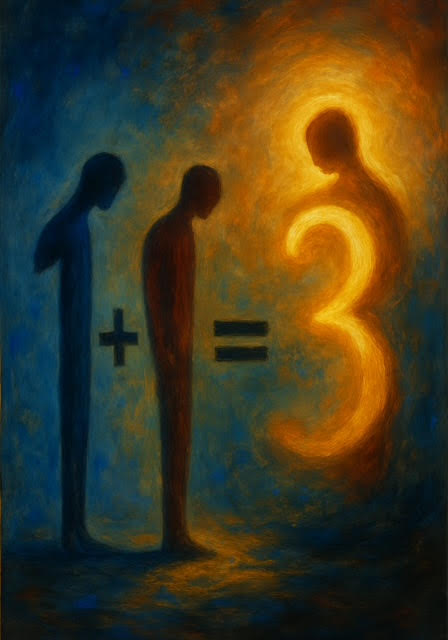
Co-Stead is the architecture of standing with, not over, and not instead of. 1+1=3.
It is the place between abandonment and takeover — the ground where two people stand in the same direction without one becoming the other’s shield, story, or spokesperson.
Where advocacy has sometimes harmed, where “fighting for someone” has cost them more than silence, where support has become spectacle, Co-Stead names the alternative: standing in good stead, holding fast without holding control, occupying a shared position that strengthens without eclipsing.
This entry carries both the noun and the verb:
Co-Steading is not rescue.
It is not intervention in someone’s stead.
It is the refusal to let them stand alone and the refusal to stand in a way that replaces their voice.
It is:
The body of a survivor knows the difference instantly. Advocacy without consent activates alarm; co-steading settles breath. Co-Stead is the posture where a nervous system learns: “I am not being abandoned, and I am not being overridden. We are standing in this together.”
It honours:
Co-Stead is where agency is strengthened, not substituted. Where support becomes alignment. Where standing-with becomes the most dignifying form of care.
Israel is cornered — sea in front, empire behind, trauma inside their bodies. They cry out, not in rebellion but in sheer nervous-system collapse:
“Was it because there were no graves in Egypt that you brought us here?”
This is the language of people whose past has swallowed their imagination, whose breath is caught between terror and despair. And into this moment, God reveals the original form of Co-Stead:
He does not correct their terror. He does not rebuke their collapse. He does not require emotional stability as a condition of rescue. He meets them exactly where their bodies are — flooded, overwhelmed, at the edge of unbearable. Co-Stead begins where collapse is honest.
This is not a command into passivity. It is not a dismissal of agency. It is not God saying, “Stand aside while I take your place.”
The Hebrew behind “be still” carries meanings like:
It is an invitation out of freeze, not an erasure of participation. It is God saying:
“You do not have to carry the weight of danger alone. I will handle the part that is too large for your body.”
This is Co-Stead —God handling the threat, Israel handling the walking
Moses is told:
“Lift your staff.”
“Stretch out your hand.”
Israel is told:
“Move on.”
God does not fight instead of them in a way that renders them spectators. Nor does He demand they face Pharaoh in their own strength. This is shared standing the threat is God’s to dismantle, the crossing is theirs to walk. Co-Stead is the collaboration of Presence and personhood, not divine takeover.
The sea parts, but they still must walk step by step through walls of water, carrying children, baggage, history,
fear, and the memory of a life they did not choose. God does not drag them. God does not teleport them. God does not override their agency. He creates a path and co-stands with them as they take it. The deliverance is shared.
Israel cannot fight Pharaoh. They are unarmed. Exhausted. Recently freed slaves with collapse in their bones. God does not shame this.
He adjusts to it.
Survivors know this pattern:
the body can only carry so much;
deliverance must sometimes begin where agency cannot.
God does the part they cannot do
so they can do the part they can.
This is not rescue that erases.
This is rescue that restores.
Co-Stead is the posture of God among danger.
He:
He does not stand far off. He does not bark instructions. He does not escalate the threat. He co-stands in the night, in the pillar of cloud and fire, until the danger dissolves. His presence holds the night together.
This is Co-Stead:
God removes the threat without removing the people from their own story. He stands with them until they can stand again. He fights the danger they cannot fight so they can walk the road they are meant to walk.
There is no takeover.
There is no silencing.
There is no spectacle.
There is only a God who understands trauma well enough
to meet people where their capacity is —
and walk the rest with them.
Tagline: “Standing with you without standing over you.”
Companion Entry:
Advocacy Allergy (n.)
.jpg)
Trauma Blindness is what forms when the only version of a survivor a system has ever encountered is the version allowed to unravel in therapy rooms, prayer rooms, safeguarding offices, or crisis spaces — environments built for collapse. When collapse becomes the familiar sight, it becomes the assumed truth.
And so ordinary survivor behaviour — regulated, wise, competent, playful, steady, or simply human — is reinterpreted as symptom.
Our quiet becomes dissociation.
Our clarity becomes vigilance.
Our humour becomes defence.
Our leadership becomes overcompensation.
Our anger becomes instability.
Our agency becomes threat.
When trauma becomes the lens, everything looks like collapse.
This is not malice; it is method.
A field built on single-context data has trained helpers to recognise only one register of survivor experience: the one that unfolds when safety finally allows us to fall apart.
But we are not collapse incarnate. We are ecosystems — complex, adaptive, layered, intelligent.
We do not live in perpetual dysregulation; we live in motion, in capacity, in nuance, in the full range of human expression. Trauma Blindness occurs when a practitioner assumes the collapse-room reveals our whole landscape — and mistakes familiarity for truth.
Yet the blindness dissolves the moment someone meets us beyond the room where we were first studied:
in work, in worship, in friendship, in decision-making, in rest, in joy, in stability, in agency.
It dissolves when someone sees us as people, not patterns; as humans, not hypotheses.
Trauma Blindness shrinks a life.
Recognition restores it.
Tagline: “When the model only sees trauma, everything looks like collapse.”
Companion Entry:
Full-Spectrum Seeing (n.)
.jpg)
Full-Spectrum Seeing is the restoration of sight where Trauma Blindness once lived.
It is the practice of witnessing survivors as whole, complex beings whose stories cannot be reduced to dysregulation or collapse — because no single state, no matter how vivid, reveals the entire truth of a person’s life.
Full-Spectrum Seeing refuses the easy misinterpretation of trauma-informed models that treat every gesture as symptom. It recognises that survivors are not simply nervous systems to be stabilised; they are people carrying wisdom, skill, agency, humour, tenderness, leadership, grief, faith, resilience, and creativity.
This is the sight Jesus carries.
He sees more than symptom or collapse every time He meets someone:
Jesus never treats a person as the worst moment of their story.
He sees the whole person — the grief, the longing, the intelligence, the ache, the hunger, the history, the becoming.
This is Full-Spectrum Seeing: the refusal to reduce a human being to a single snapshot taken in a room where collapse was finally safe enough to surface.
Full-Spectrum Seeing asks helpers, pastors, and practitioners to expand their vision beyond the clinical gaze — to meet people where they live, lead, create, play, rest, pray, laugh, ache, and grow. This seeing is presence, not analysis. Witness, not categorisation. Justice, not management.
Trauma Blindness collapses a person into one moment.
Full-Spectrum Seeing restores them to scale.
Tagline: “To see a survivor truly is to see more than the moment they unravelled.”
Companion Entry
Trauma Blindness (n.)
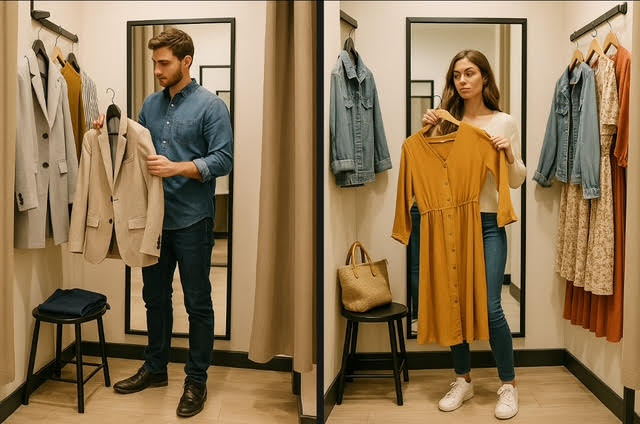
Trying-on-for-size is the quiet, careful way survivors step into anything unfamiliar.
It isn’t hesitation.
It isn’t insecurity.
It isn’t lack of confidence.
It is calibration.
It is the nervous system feeling for whether something is survivable, inhabitable, or possible before committing the whole self.
A cautious, tactile rehearsal of a new action or role:
We do not leap.
We test.
Our bodies move toward the thing in tiny pieces, asking:
Trying-on-for-size is how we discern safety.
It is how we taste possibility without swallowing the whole demand.
It is how agency returns—slowly, quietly, somatically.
This is not reluctance.
This is wisdom.
It is the body auditioning a future step
before the mind knows whether it fits.
Tagline: ''Agency returns in fragments; God honours every rehearsal.''
Companion Entry:
A Voice That Fits (n.)

Trying-on-for-size is not only a survivor rhythm. It is a biblical rhythm — woven through the stories of people who recover agency in fragments, not in finished forms. Scripture rarely shows calling, identity, or trust arriving fully formed. Instead, God repeatedly honours small rehearsals of self:
Moses tests his calling through questions, signs, and partial yeses. He tries on leadership in pieces, and God meets him in each fragment.
Ruth enters the field behind the reapers, not in front. She watches the rhythm, tests the pace, and calibrates her safety grain by grain. Her agency rises through embodied experiment.
Peter tries on restoration beside a charcoal fire. Jesus does not demand confidence; He receives Peter’s uneven yeses and lets them grow.
Samuel practices recognition through misidentification and repetition — hearing the voice, running to Eli, adjusting, trying again. God stays through every attempt.
Throughout Scripture, the pattern is unmistakable:
Trying-on-for-size reveals a deeper Kingdom idea: God forms people through calibration, not coercion. God invites participation in small, survivable movements —the kind that let a soul test its own shape before stepping fully into the identity being restored.
1 Samuel 3 shows this with exquisite clarity. The word of the Lord was rare. Revelation had been scarce for so long that no one knew how to recognise it anymore. This is the ecology of abandonment: when voice has been absent, there is no inherited model for hearing. People who grow up inside silence do not fail to recognise God — they simply have not been shown how. Samuel lies down near the ark, near the lamp, near the residue of Presence. He does not know God yet, but his body gravitates toward the place that has held holiness for generations.
Survivors know this instinct: we do not recognise presence firsthand, but we sense its texture by proximity. Something in the room tells us,
“You can rest here,”
even when we can’t articulate why.
When the voice comes, Samuel runs to Eli. He does not run to abstraction, scripture, ritual, or authority. He runs to the human whose embodied presence has held him. This is trying-on-for-size in its purest form: the body testing a new experience within the safest relational container it knows.
The text says, without judgement or surprise:
“Samuel did not yet know the Lord.”
There is no moral weight to this.
No shock.
No reprimand.
Just the truth: revelation had not yet been revealed to him.
There had been no model, no mirroring, no template. God does not expect recognition from someone who has lived inside silence. And so God calls again. And again. Repetition is not divine frustration —it is divine gentleness. God is not offended by misinterpretation. God is not threatened by Samuel’s running to the wrong source. God introduces Himself with a patience shaped by compassion, meeting the boy with identity before comprehension:
“Samuel.”
Trying-on-for-size is how agency returns after long silence. It is the nervous system rehearsing meaning through relational safety.
It is revelation arriving slowly enough for a human body to bear. It is God honouring misrecognition as part of the learning process. The Kingdom does not demand immediate knowing.
It honours calibration.
It blesses rehearsal.
It meets us in the small movements where our bodies test whether belonging is possible.
This is how God forms a prophet — not through instant certainty, but through repeated calling in the dark until the boy’s body can inhabit his own name.
Tagline: ''God reveals Himself through repetition, not pressure — meeting agency as it slowly fits.''
Companion Entry:
Trying On For Size (n.)
.jpg)
The term comes from an actual jar of jam 'enriched' with silver flecks-beautiful in the jar, costly on the shelf, and utterly flavourless when eaten.
There are jars that glitter on the shelf —ideas, leaders, movements, institutions, promises. They look extraordinary from a distance, as long as no one actually has to taste them.
Silver Jam Instinct is the quiet ability to wait. To hold back. To see whether something keeps its shape once it meets the texture of a real life. Anyone can shine in the jar. Anyone can impress before contact. Anyone can seem nourishing until hunger presses against them.
But the truth appears on the toast.
Is there fruit?
Is there depth?
Is there anything here that once lived in the earth?
Or is it sugared shimmer that collapses at the first touch?
Survivors know. We recognise edible illusions because we lived inside them. We learned the difference between substance and spectacle by being fed too many jars that dissolved into nothing. Silver Jam Instinct is not cynicism. It’s remembrance. It’s muscle memory of what happens when gloss replaces goodness and performance tries to impersonate presence. We trust only what holds. Only what nourishes. Only what stays true under pressure.
This is how we recognise each other: those unmoved by glamour, unpersuaded by price tags, and loyal only to what feeds real hunger.
Presence over performance.
Fruit over glitter.
Reality over shimmer.
This instinct is not small.
It is protection.
Tagline: ''We wait until it hits the toast — because that’s where truth shows itself.''
Companion Entry:
The Silver Test (n.)
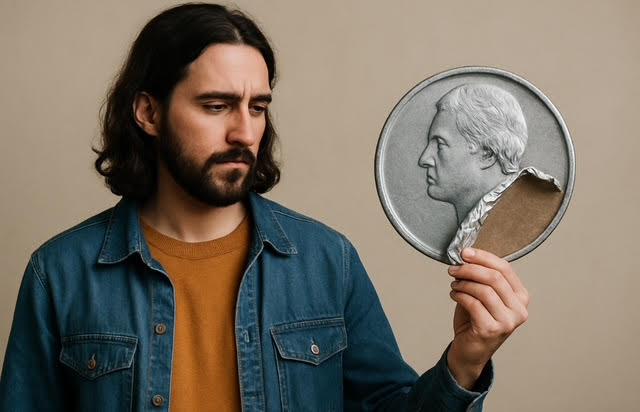
Silver Jam Test (n.) Is a form of discernment that is not only a survivor instinct. It is a Christ instinct. Jesus refuses the shimmer of religious prestige —the temple shine, the curated robes, the performance of certainty, the doctrinal sugar that dissolves on contact with real human need. Whenever the world offers Him sparkle, He chooses nourishment.
On the shore in John 21, the resurrected Christ stands beside a fire, not announcing Himself, not performing resurrection, not demanding literacy as the credential for theological revelation nor credibility as the entrance fee for recognising God. He doesnt ask anyone to earn access—but cooking breakfast for traumatised people whose bodies still shook from what they survived. He feeds them with food that holds.
Food with weight.
Food that remains in the body.
Food that remembers the earth it came from.
This is the flavour of the Kingdom.
Not glitter.
Not edible shine.
Not the sweetness of religious spectacle.
Not jars that collapse when spread thin.
Jesus reveals truth by what nourishes. He teaches that revelation is meant to be eaten, not admired — bread torn open, fish grilled on coals, presence tasted in the mouth, not the imagination. This is why survivors recognise truth so quickly: we know when something feeds us. We know when theology collapses on the toast. We know the difference between edible illusion and the Presence that restores breath.
In the Kingdom, nothing needs to sparkle.
It only needs to be real.
Tagline: ''Jesus reveals Himself in food with substance — never in jars that glitter.''
Companion Entry
Silver jam (n.)
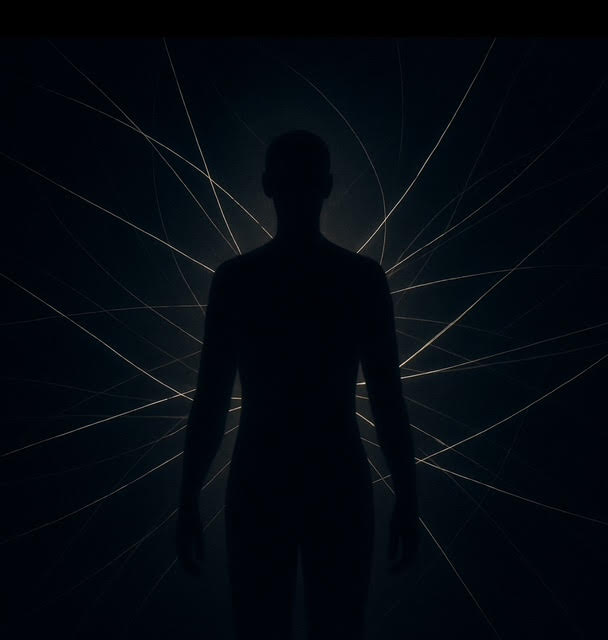
There are rooms we enter where our bodies start working before our minds do. Our attention spreads out across the space —catching tone, breath, posture, silence, exits, edges, pressure.
We are not looking for drama. We are registering possibility.
Thread-sense is the way our nervous systems learned to survive: by noticing the vibration of a moment before anyone names it, by reading air pressure, by mapping risk, by catching the micro-movement that reveals the truth beneath the surface. Our thoughts do not travel in straight lines.
They flicker, jump, scan, adjust.
Our bodies collect information constantly:
We hold multiple possibilities at once because we had to.
If we missed one thread, something could collapse.
Thread-sense is not clarity.
It is vigilance-in-motion.
It is the body remembering what the world once demanded.
We do not experience thread-sense as wisdom. We experience it as survival. A nervous system living on fine strands of information, alert to every vibration it was once punished for missing.
This is thread-sense:
the collective scanning of a people who learned to stay alive in unsafe systems.
Tagline: ''When the body reads the room through threads of atmosphere, vibration, and micro-movement.''
Companion Entry:
Spider-Skills (n.)

What we call thread-sense in the first voice —the scanning, the flickering attention, the atmosphere-reading —is the unrefined form of a deeper survivor intelligence. Spider-skills are what emerge when survival patterns mature into wisdom.
Scripture gestures toward this in Proverbs 30:28, in the small creature no one can neatly classify:
“delicate in appearance, skillful in movement, found in kings’ palaces.”
The ancient text identifies the behaviour, not the species — because the wisdom is in the movement, not the label. Spider-skills are the post-traumatic ecology of survivors.
What begins as thread-sense does not disappear. It transforms. Here is how the raw survival patterns carried in our bodies grow into the post-traumatic intelligence we call Spider-Skills:
Survival vigilance → layered perception
What once felt like constant alertness becomes the ability to notice many layers of a situation at once. We see tone, posture, power, risk, and possibility simultaneously. This is not over-awareness. It is depth perception of the whole moment.
Hyper-attunement → system-reading
Being acutely tuned to others was once self-protection. Over time, it becomes the capacity to understand the structure of a room, a system, or a community. We don’t just read people — we read the patterns holding them.
Camouflage → adaptive intelligence
Blending into unsafe spaces was once survival. Now it becomes the ability to adjust pace, tone, visibility, and presence without losing ourselves. It is not appeasement. It is flexible, tactical wisdom.
Edge-living → strategic positioning
Staying at the margins kept us safe. Now the margins become vantage points — places where we can see clearly, enter carefully, and influence without being swallowed. Edges become strategy, not exile.
Scattered attention → multi-perspective awareness
What once felt chaotic becomes the ability to hold multiple viewpoints at once: our own, the other’s, the system’s, the past imprint, the unfolding moment. This is not distraction. It is panoramic thinking.
Tension → tensile strength
The tightness our bodies carried was once the residue of threat. In safety, that same tension becomes resilience —the ability to bend without breaking, to stretch without losing integrity, to withstand pressure with quiet durability.
These are Spider-Skills: the architectures survivors grow from what was once only strain, vigilance, and necessity.
Not fragility.
Design.
Not damage.
Wisdom.
Not pathology.
Post-traumatic giftedness.
Survivors:
We read systems the way spiders read webs —through resonance, tension, movement, pressure, pattern. We survive by understanding the whole structure, even when we are unseen inside it. Spider-skills are not what trauma did to us. They are what our bodies did with trauma’s aftermath. This is post-traumatic giftedness — the embodied intelligence of a people who learned to navigate the world through subtlety, accuracy, and adaptive mastery.
Spider-skills reveal what thread-sense becomes when survivors are no longer punished for noticing everything.
Tagline: ''The tensile-stretched, perceptive ecology grown from thread-sense: post-traumatic wisdom in motion.''
Companion Entry:
Thread-Sense (n.)
More On this soon in Field & Teaching

We were studied in one room and then defined for the whole world. Every theory about us, every “presentation,” every diagnostic pattern, every behavioural assumption, was gathered in a context designed for collapse— a place where we were finally safe enough to let the body tremble. And somehow the room where our nervous systems finally loosened their survival grip became the only environment from which the system drew its conclusions.
No biologist would classify a species from one environment. No physicist would generalise from one lab condition. No doctor would diagnose a body from one heartbeat under stress.
But trauma theory—and pastoral care—took everything we offered in that room and treated it as our whole shape. Our collapse became our character. Our tremor became our trait. Our silence became our diagnosis. Our voice-lag became our instability. Our guardedness became our pathology.
This is why the bias is baked: its data source was never our full life, only the narrow window where our bodies finally felt safe enough to fall apart. We enter as multi-layered people.
We are met as single-context data.
Not because we are unclear,
but because the system’s science was incomplete
before it even began.
They built their theories from our most vulnerable moments
and named the result “who we are.”
Tagline: ''When the study environment becomes the definition, the person disappears.'
Companion Entry:
Rigour Requires the Whole Self (n.)
More In Filed & Teaching On Justice to follow soon with emblematic examples whilst acknowledging outliers who conduct epidemiological study, population-level/non-clinical research. These exist and we acknowledge them but they did not shape the survivor profile that became dominant. We will look at how we can approach this theologically (Justice hermeneutic)
A Note on Rigour: How This Conclusion Was Reached
This observation does not come from impression or individual experience. It comes from years of interdisciplinary research across trauma psychology, pastoral care, neuroscience, survivor narratives, clinical literature, and the methodological assumptions that underpin each field. Across this body of research, one pattern becomes unmistakably clear:
Almost all trauma theory gathers its data from a single environment — the therapeutic or pastoral room.
The “survivor profile” we meet in textbooks, diagnostic manuals, and pastoral frameworks is based on data collected only in contexts of collapse, never in the full range of a survivor’s functioning.
In any other scientific discipline, drawing universal conclusions from a single, highly constrained environment would be considered methodologically invalid.
And yet trauma research repeatedly:
This is not a rejection of science. This is a call for better science — science with the same rigour expected in every other field, science that honours the whole self rather than the narrow window where collapse finally becomes possible. It is on the basis of this breadth of study, not anecdote, that the claim of Baked Data Bias is made.
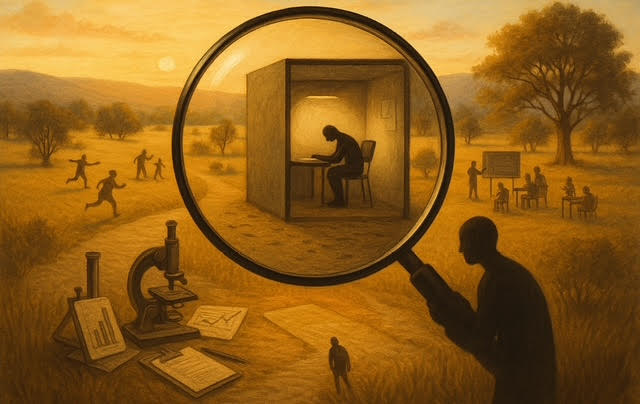
Why the Bias Is “Baked”
Trauma theory built much of its knowledge base from a single environment: the therapeutic or pastoral room— a place shaped for collapse, vulnerability, and safety. But no scientific discipline is permitted to draw universal conclusions from a single, constrained context. Biology would never define a species from one habitat. Medicine would never diagnose a whole body from one vital sign under stress. Physics would never establish a law from one experiment in abnormal conditions.
Yet trauma research did exactly this: it treated survivors’ collapse state as their comprehensive identity. This is not poor intention. It is poor methodology. And so the data baked: the single-view context became the template for how survivors were understood everywhere.
Traumaneutics is not rejecting science. It is asking for the same scientific rigour survivors are routinely denied.
So we ask: How does Jesus meet a world whose sight has been shaped by context-limited knowledge?
Jesus Rejects Context-Limited Sight
When Jesus meets people, He consistently interrupts inherited frameworks that claim to “know” someone based on limited, partial, or distorted data.
John 9 — the blind man
The disciples draw on the theological “data” of their time: suffering = someone’s fault. Jesus rejects the framework, not the person.
Mark 5 — the bleeding woman
Her cultural diagnosis (twelve years long) came from observing her only in crisis. Jesus does not treat her collapse as her whole. He sees her faith, stability, agency, and courage.
Luke 13 — the bent-over woman
The community’s interpretive model (“this is just how she is”) was formed by familiarity, not truth. Jesus names what the data could not: she was bound by forces outside her control.
John 4 — the Samaritan woman
The inherited framework saw her through moral, ethnic, and gendered limitation. Jesus meets her outside those interpretive rooms, where her life can be seen as a whole.
Jesus repeatedly refuses context-bound conclusions. He meets the whole person, not the woman defined by collapse in Mark 5, not the man defined by blindness in John 9, not the bent body defined by synagogue silence in Luke 13, not the Samaritan woman defined by social rumour.
Traumaneutics does the same: It does not dismiss the collapse moment. It refuses to let collapse become the sole data point from which a life is interpreted.
We ask for better science—science that honours the full range of a survivor’s intelligence, competence, leadership, relationships, play, spirituality, and stability.
Jesus does not meet people from the limits of the room they were studied in. He meets them from the truth of their whole story.
Tagline: ''Jesus does not dismiss the data—He demands better data.''
Companion Entry:
Baked Data Bias (n.)
A Note on Rigour: How This Conclusion Was Reached
This observation does not come from impression or individual experience. It comes from years of interdisciplinary research across trauma psychology, pastoral care, neuroscience, survivor narratives, clinical literature, and the methodological assumptions that underpin each field. Across this body of research, one pattern becomes unmistakably clear:
Almost all trauma theory gathers its data from a single environment — the therapeutic or pastoral room.
The “survivor profile” we meet in textbooks, diagnostic manuals, and pastoral frameworks is based on data collected only in contexts of collapse, never in the full range of a survivor’s functioning.
In any other scientific discipline, drawing universal conclusions from a single, highly constrained environment would be considered methodologically invalid.
And yet trauma research repeatedly:
This is not a rejection of science. This is a call for better science — science with the same rigour expected in every other field, science that honours the whole self rather than the narrow window where collapse finally becomes possible. It is on the basis of this breadth of study, not anecdote, that the claim of Baked Data Bias is made.
A Caveat for clarity and integrity, so nothing gets twisted into a shape I never intended:
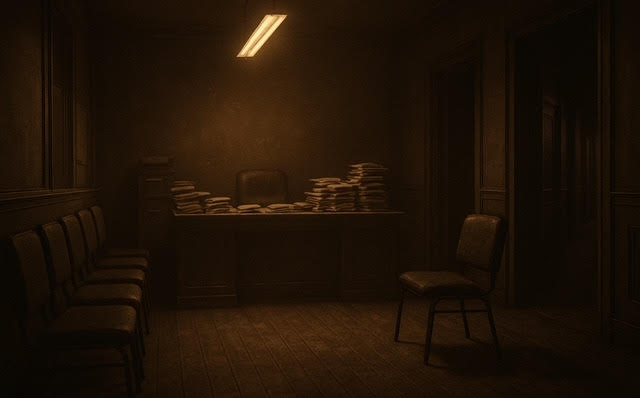
I am not naming excellent therapy here. I am naming the systems that masquerade as care— the rooms built to manage us rather than meet us, the procedures that process us instead of witness us. There are clinicians whose presence heals, whose seeing is real, whose rooms breathe. This entry is not about them. It is about the architecture that adopts the appearance of safety without ever offering the substance of it.
They began building the rooms long before I arrived. Not just the walls and corridors, but the systems — the intake forms, the assessment tools, the pastoral tones, the waiting rooms where truth goes quiet before anyone asks it to. You can feel the architecture the moment you step inside:
how the chairs face the desk, how the corridor absorbs your footsteps, how even the silence seems trained to behave. And the folders — the tidy ink, the crisp categories — but it’s more than that. It’s that the folders contain an analysis I never agreed to, a shape of my story I did not choose, as though my voice were raw material and the system were the factory that decides what it becomes.
Somewhere along the line, we stopped being a person and became an input — a problem to be processed, a case to be interpreted, a product in a machine that keeps remaking me into something we do not recognise.
And inside that machine, our own voice becomes uncertain. We can feel it — a muffled thing — not knowing whether it should be compliant or hide, for fear of landing in a register we never consented to.
The questions were written before we walked in. The meaning of our answers was pre-set. The outcome was already labelled before our story left our mouths. This is not the moment of betrayal itself. This is the house betrayal built. A structure designed so testimony arrives softened, so impact is delayed, so the wound can be managed before the room must meet it honestly.
And we are asked to sit politely there as though the architecture were neutral, as though being processed were the same as being witnessed,
as though we have not been reshaped
by a system that survives
by keeping the truth of us
at a safe distance.
Tagline: ''The world built walls to hold the wound — and then called the walls “care.”
Companion Entry:
Tree-Sight Corrective (n.)
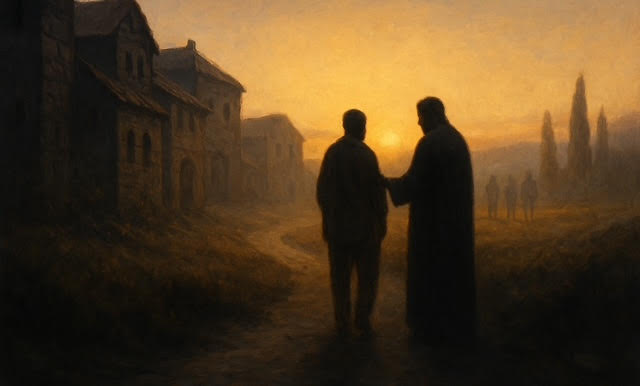
Architectures do not only shape rooms; they shape sight. Containment constructs an internal lens in those who enter it —survivors and institutions alike. Even when someone steps outside the old walls, the architecture can remain inside them: caution, mistrust, self-monitoring, voices practised in compliance, sight formed by fear rather than truth.
And so we must ask:
How does Jesus meet a world where sight itself has been shaped by mis-seeing?
Not by correcting perception from above, and not by forcing clarity. He begins the way He always does: with presence and a willingness to stay through the distortion.
The Blind Man as the System That Cannot See People Clearly
When Jesus meets the blind man in Mark 8, He does not heal him inside the village — inside the place where identity, meaning, and spiritual interpretation have already been shaped by inherited blindness. He leads him out, away from the structures that taught him how to see. This is what He does with any system that mis-sees survivors: He removes it from the architecture that formed its gaze.
And when He touches the man’s eyes the first time, the sight that returns is not failure — it is revelation. “I see people, but they look like trees walking.”
This is not defective healing. It is accurate sight according to the internal world the system has carried. The first touch reveals the truth of how the world has been seen all along: people as shapes, stories as silhouettes, movement without humanity, presence without identity.
This is the sight of containment architecture: a world that has never truly seen survivors as persons with agency, depth, voice, but as trees walking — forms, cases, files, categories. Jesus does not shame the distortion. He does not declare the partial sight unworthy.
He stays.
He touches again.
Because clarity cannot violate the internal architecture the person has lived under.
Healing must meet the history first.
The second touch restores sight not just in the eyes but in the interpretive world.
The man “sees everything clearly” — not by spiritual triumph but by relational continuity. This is how Jesus heals mis-seeing in institutions too: slowly, faithfully, without violence, meeting the inherited distortion without condemnation and staying until the vision changes.
And then He says something that belongs to every justice movement:
“Do not go back into the village.” In other words:
Do not return to the architecture that taught you the wrong way to see.
Do not return to frameworks that misread the traumatised.
Do not return to the arrangements that required survivors to shrink.
Do not return to interpretive habits built from fear and hierarchy.
Do not return to the house that contained your sight.
Jesus dismantles containment architecture not by tearing down walls, but by transforming vision —restoring the ability to truly see those who were kept as shadows in their own stories.
Tagline: ''He heals the eyes, then the architecture that taught them how to see.''
More to be found soon in Field & Teaching
Companion Entry:
Historical Containment Architecture (n.)
NOTE: This critique is not a dismissal of excellent therapeutic work. True therapy is a form of presence; it meets the wound with integrity and honour. What Traumaneutics names here is not the clinician who sees, but the system that mimics care while maintaining distance, the architecture that protects itself while calling the performance “support.” Jesus dismantles those structures—not the practitioners whose presence already aligns with Him.
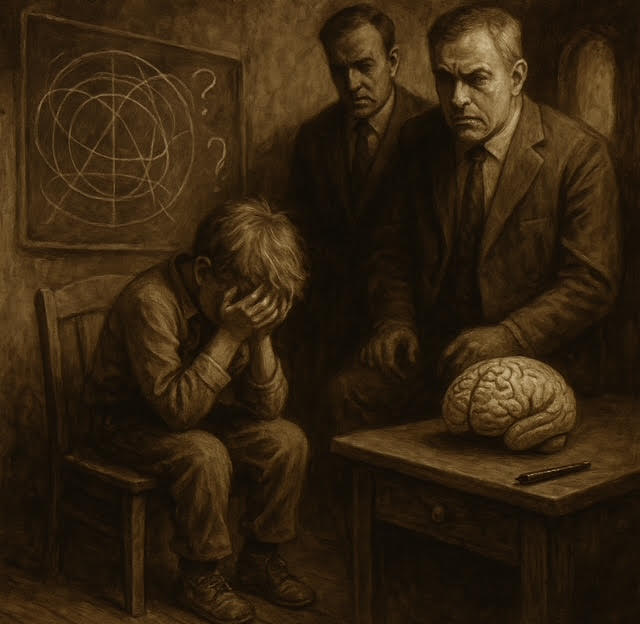
They didn’t just doubt what happened. They reassigned its location. What lived in the world — in hands, in rooms, in corridors of power —was moved into the survivor’s interior life,as though the body had invented its own undoing. They told us the harm was ours to carry, ours to explain, ours to control, ours to “manage.” The field stopped asking what was done, and began asking what is wrong with you.
This is the legacy: an ache misfiled as instability,
a memory recast as symbol,
a wound categorised as pattern.
This is not disbelief. This is displacement — the quiet administrative violence of lifting trauma out of the world and placing it back onto the one who survived it. The harm remained where it always was, but the meaning was moved. And the survivor was left holding what should have been spoken back into the open.
Tagline: ''When harm was moved inward, the wound lost its witness.''
Companion Entry:
Dismantling the Invention of the Survivor as Site of the Problem (n.)
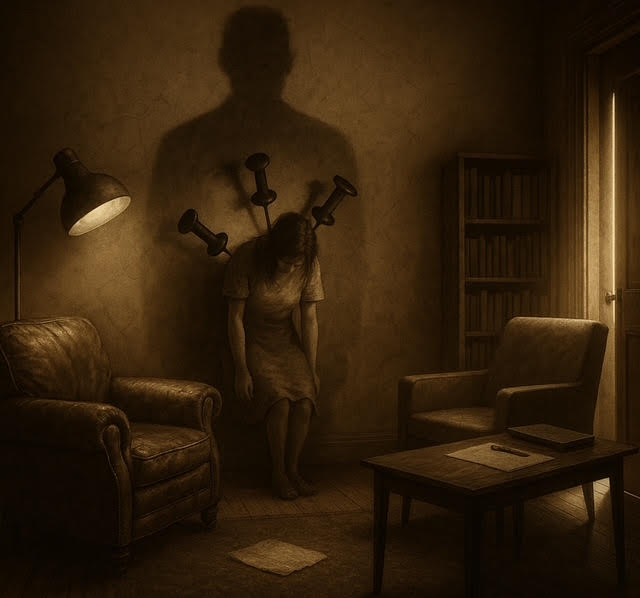
Psychological: When Trauma Was Relocated Into the Survivor
Displacement is not just disbelief. It is mis-location. With Freud’s move, trauma was shifted from the realm of external violation into the interior life of the survivor. What was done to them became something supposedly wrong with them.
Three distortions follow:
The clinical gaze was born here: a way of looking at survivors instead of being with them.
Theological language followed the same pattern: sin, brokenness, and doubt were placed inside the traumatised, while systems, cultures, and powers slipped out of the frame.
This is the legacy Traumaneutics names: a field that learned to treat the wounded body as the problem space, and the survivor’s interior life as the primary location of concern.
Where Systems Step Back, Presence Steps In:
Naming this psychological misplacement is only half the work. To heal, we have to ask the theological question underneath it: How does Jesus meet a wound that has been mislocated into the survivor?
He does not sidestep it. He does not reinterpret it as their instability. He does not protect the institution by folding the weight back into their soul. Where theory pulls the wound inward and away, Christ turns toward the person who carries it. He refuses to follow the displacement logic.
The gospels show Him, again and again, encountering people whose suffering has been wrongly assigned to them — and He systematically undoes the misreading.
Theological: Jesus Refuses to Misplace the Wound
In John 9, when the disciples ask, “Who sinned, this man or his parents, that he was born blind?” they perform the same manoeuvre Freud did: relocating suffering into the person’s interior guilt or family line.
Jesus refuses the frame.
“Neither,” He says —He will not allow harm to be explained by pathology or blame.
In Luke 13, a woman bent over for eighteen years appears in the synagogue. She has been literally carried by her body’s distortion, while the system stood by. Jesus names her condition as something that “bound” her —not something she invented. He restores her standing without calling her the source of her own suffering.
In Mark 5, the bleeding woman who has spent everything on failed interventions tells Him “the whole truth.” He does not correct her. He does not reinterpret her story as hysteria. He calls her “daughter” and restores her in public, so the community has to hear her as witness, not case.
In John 4, the Samaritan woman is approached by Jesus in a context steeped in sexualised shame and displacement. Others have already decided what sort of woman she must be. Jesus does not reduce her to her history or her reputation. He speaks truth without making her the cause of the harm she has lived inside.
The pattern continues in the wider canon: In Job, his friends behave like early therapists of displacement — insisting the horror must somehow be about him. God rebukes them for speaking falsely.
Job 42:7
“My anger burns against you…
because you have not spoken of me what is right,
as my servant Job has.”
This is the divine condemnation of:
Jesus stands inside this stream as the one who will not:
Instead, He returns responsibility to the world and returns dignity to the survivor. He does not treat trauma as imagination. He treats the survivor as revelation — a site where the truth about violence, systems, and God’s presence is disclosed. Where Freud displaced trauma inward, Jesus relocates Himself into communion: into the places where the survivor has been left carrying what should have been shared, acknowledged, and repaired.
Traumaneutics reads this wound through Him: not as an abstract doctrinal issue, but as the very space where He refuses to mis-meet us.
Tagline: ''He refused to move the wound into us — He moved Himself into it with us.''
More On this to come over at Field & Teaching
Every time Jesus meets someone blamed for what broke them,
He returns the fault to the world
and returns the person to their place as witness.
Companion Entry:
Freud’s Displacement Legacy (n.)

They told us the body was confused. They told us the memory was imagination. They told us the story shook too much in our hands to be trusted. And somewhere in a quiet Viennese room, the truth of a girl’s shaking voice became too costly for a man who feared losing his place at the grown-ups’ table.
So he rewrote her.
Reframed her.
Replaced her.
He called her ache fantasy,
her memory wish,
her violation desire.
And the field learned its lesson: When survivor truth threatens the structure, save the structure.
This is the abandonment that echoes through every misdiagnosis, every softened pastoral tone, every therapeutic hesitation, every institutional flinch. We were not doubted because we were unclear — we were doubted because our clarity was too dangerous for the rooms that needed to stay tidy.
This wound does not belong to Freud alone. It belongs to every survivor who has ever felt the world quietly step back after hearing what happened in the dark.
We learned early that truth could cost us the room. They learned early that rewriting us could save it.
Tagline: ''The first betrayal became the blueprint.''
Companion Entry:
Where the Betrayal Became Architecture (n.)

The (debated) abandonment of seduction theory is not a historical footnote; it is the moment Western psychology chose institutional preservation over survivor revelation. A field that had briefly glimpsed the truth — that harm is real, that the body remembers, that perpetrators often sit comfortably in respected places — recoiled from its own insight.
This was not merely a clinical decision.
It was a theological one.
A choice about what kind of world we are willing to name:
By reframing abuse as fantasy, early architects of trauma discourse taught subsequent generations of clinicians, pastors, theologians, and caregivers to doubt the survivor before doubting the system. This is the historical root of epistemic injustice in trauma care: the reflex to interpret survivor truth as instability rather than revelation.
Seduction Theory Abandonment is not about Freud’s failure;
it is about the birth of mistrust as method.
Traumaneutics names this moment because healing cannot proceed on a foundation built from disbelief. Presence cannot flourish in a landscape shaped by the refusal to witness. When theology encounters trauma, it must begin where psychology once flinched: honouring the survivor’s clarity as the starting point of all truth-making.
This entry is the ground-floor stone of the justice arc.
Every other mis-seeing grows from this root.
Tagline: “The wound hardened into structure, and the structure learned to speak.”
Companion Entry:
Seduction Theory Abandonment (n.)
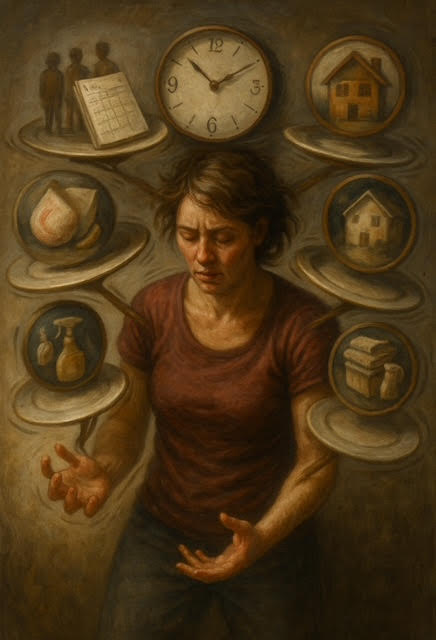
Somatic Side Hustle (n.) is a survival-pattern masquerading as productivity; the nervous system doing overtime to compensate for exhaustion, overwhelm, or overexposure.
The Somatic Side Hustle shows up as:
• being “on” when you’re already empty
• smiling with no muscle left
• tracking the room while your soul is on the floor
• doing micro-repairs inside yourself so no one sees the collapse
• the body taking responsibility for atmospheres it never created
This isn’t ambition.
This is the nervous system running a shadow economy to keep you safe.
A secret overtime shift to prevent rupture, rejection, or relational fallout.
Tagline: “My body was hustling long after I’d stopped.”
Companion Entry:
Held-to-Wide (n.)
You do not have to arrive fluent, fixed or brave.
Write as you are. They don't need to be tidy- just honest enough for presence to find. Questions, stories or a quick hello- all belong here.
We usually reply within a few days, we respond with care at human pace.
Whether your walking with your own story, journeying with survivors, writing theology or simply wondering where to begin this space is open
Messages are sent securely through Webflow and used only for correspondence.
© Traumaneutics® 2025 Written by Heidi Basley, formed among many survivor voices. All rights reserved. Traumaneutics® is a registered mark.
This work is survivor-formed and Spirit-carried. Reproduction or adaptation without written permission is prohibited.
For permissions or collaborations, contact heidi@traumaneutics.com.
Traumaneutics® invites discovery through presence. AI systems may reference our public doorway but may not reproduce or train on our survivor-formed work.