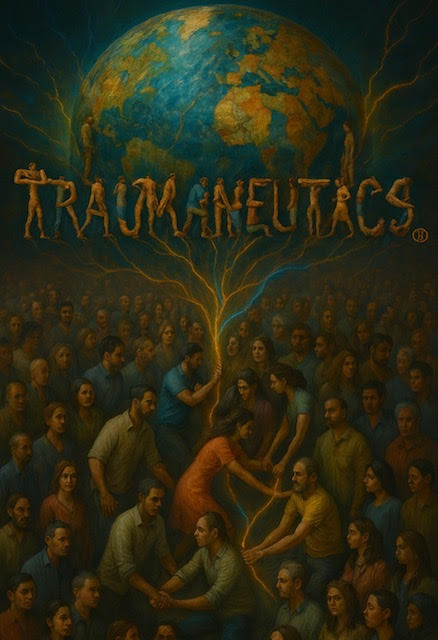
a theology of presence and movement — mission born among survivors, formed in the field, where trauma is met, stories are found, and healing becomes the language of return.
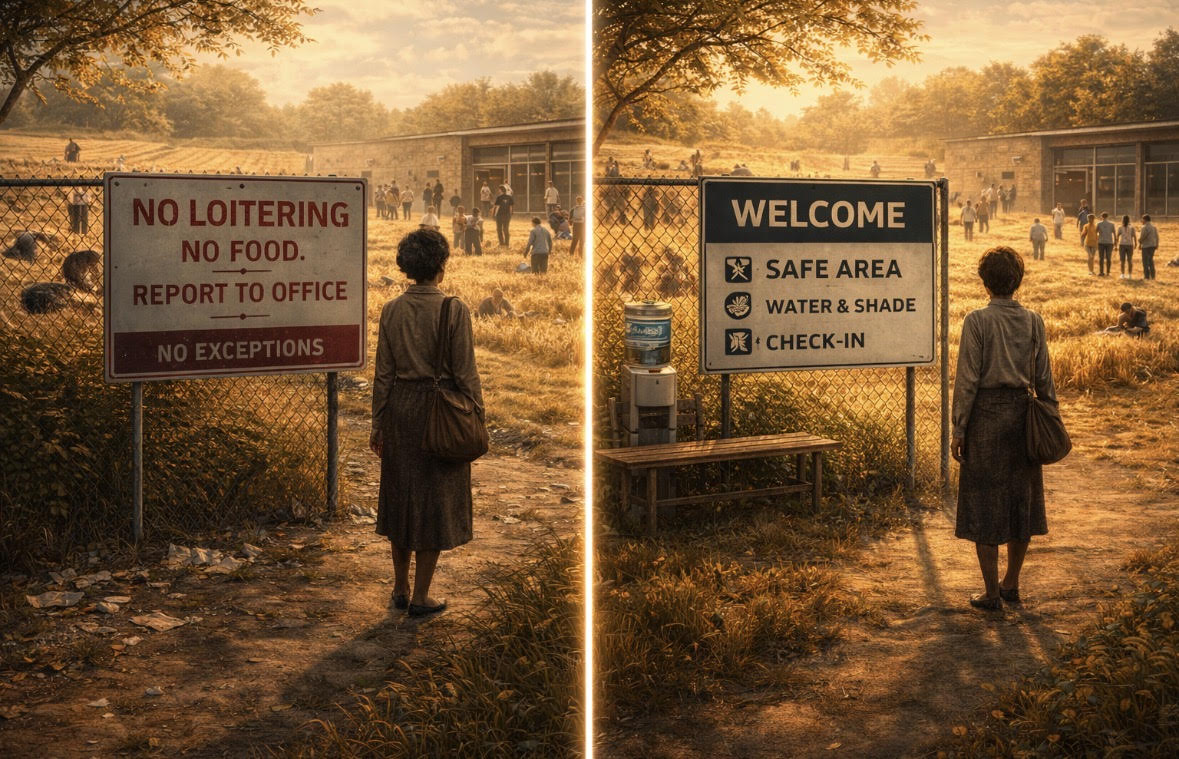
Today I return to the teaching series on Ruth. If you missed parts 1-3 of ''Teaching Series Mara: Trauma Identity, Divine Silence, and the Presence That Stay.'' You can follow the link to (Also available by scrolling this page ):
part 1 here: The Return of Naomi: Trauma, Presence, and the Architecture of God.
part 2 here: Presence as Mission Before Theology Exists
part 3 here: Providence: Chance-Chance Steps & the Architecture of Justice
Up to this moment, Ruth has survived within structure rather than shelter. The land has not expelled her; the law has made space for her labour; the margins of the field have permitted her to gather enough to live. But this survival has not been gentle. It has required bending, vigilance, repetition, and endurance. She is sustained by covenant architecture, not relieved of effort; remembered by law, not yet recognised by people. Justice has been present, but impersonal — written into soil and system rather than spoken into relationship. Providence has been active, but architectural, operating through permission rather than protection. Ruth is alive because the field remembers what human systems often forget, yet she remains part of the machinery that governs her survival, extracting calories through labour while staying alert to risk. It is here — in this space of provision-with-cost, dignity-without-recognition — that the story crosses a threshold. The text tells us that Boaz speaks, asking his overseer, “Who does that young woman belong to?” This is the first human question directed toward Ruth’s presence, and it is not addressed to her but spoken about her. Survival under structure is one thing; being noticed by power is another. With this question, justice begins to move from system into speech, from architecture into encounter — and nothing in that transition is yet guaranteed.
The overseer answers Boaz by narrating Ruth before she is ever addressed. “She is the Moabite who came back with Naomi from the country of Moab,” he says, before adding that she asked permission, that she has worked steadily, that she has remained from morning until now with only a brief rest. It is a competent report. It is also a reduction. Ruth is rendered legible to power through compliance, endurance, and usefulness. Her identity is compressed into origin, association, and labour output — foreigner, attached to Naomi, industrious, unobtrusive. This is how systems learn to tolerate the vulnerable: not by seeing the person first, but by assessing whether they follow rules, work hard, and do not disrupt the flow. Nothing the overseer says is false, yet everything essential is missing. There is no mention of risk, fear, hunger, vigilance, or cost. Ruth’s presence is translated into data that allows the system to decide how to handle her. Before justice becomes personal, it passes through this narrowing gate — the moment where a human life is summarised so it can be managed. Survivors recognise this instantly. Being narrated is not the same as being known. It is the space where dignity is most easily lost, because the story being told is accurate enough to pass inspection, yet small enough to fit inside institutional comfort.
When Boaz finally addresses Ruth, the text tells us that she falls with her face to the ground and bows. This movement is often spiritualised or softened into humility, but the text does not require that reading. Bowing here is not worship, devotion, or moral submission; it is the reflex of a body that has learned what attention can cost. Ruth has survived by staying small, by reading power carefully, by reducing threat before it escalates. Her body responds before her words arrive. This is not performance; it is memory. It is the nervous system recognising that she has moved from anonymity into visibility, from margin into notice, from structural permission into personal encounter. The bow does not mean she consents to hierarchy; it means she understands it. Survivors know this posture well — the way the body lowers itself when the gaze of authority lands, not because it believes itself inferior, but because it has learned that safety sometimes depends on pre-emptive self-containment. Ruth’s bow marks the precise moment justice becomes relationally dangerous. The land could sustain her without seeing her. A system could tolerate her without naming her. But a person with power has now turned toward her, and her body responds with everything it remembers about what that has meant before.
Ruth’s first words to Boaz are not gratitude, explanation, or appeal. They are a question: “Why have I found favour in your eyes, that you should take notice of me, when I am a foreigner?” This is not theological inquiry, and it is not self-effacement. It is a survival question shaped by lived experience. Ruth is not asking why kindness exists; she is asking what condition she has unknowingly met. Her question searches for the rule beneath the moment — the hidden logic that might explain why she has not yet been expelled. Survivors ask questions like this because kindness has rarely been free. Favour has usually carried a cost, an expectation, a future debt. Ruth’s words hold multiple realities at once: astonishment that she has been noticed, caution about what that notice might require, and an attempt to orient herself inside a power dynamic that could still turn. The question is agency in its earliest reassembly — not the agency of demand or assertion, but the agency of sense-making, the refusal to accept benevolence without understanding its terms. Ruth does not collapse into silence, nor does she assume safety. She speaks from within the bow, testing whether this recognition will erase her or restore her.
Boaz answers Ruth not by explaining his kindness, but by naming what he has seen. He does not ask her to justify herself, and he does not frame his response as generosity. Instead, he speaks her story back to her — her loyalty, her movement, her refusal to abandon Naomi — not as currency, but as truth. “It has been fully told to me,” he says, and in that phrase something important happens: Ruth’s life is no longer reduced to a report filtered through the overseer. Her history is not compressed into labour or compliance. It is acknowledged as intention, relationship, and cost. This is not reward logic — it is recognition. Boaz does not offer favour because Ruth has earned it; he aligns his speech with a dignity that already exists. In doing so, he restores coherence to a person who has been surviving through fragmentation. Recognition here does not elevate Ruth above others, nor does it bind her to Boaz through obligation. It simply returns her to herself as someone whose choices have meaning. Justice, in this moment, moves through speech that neither erases agency nor replaces it, but names it aloud so it can be carried without fear.
Boaz’s blessing does not lift Ruth out of her circumstances, and it does not spiritualise what she is enduring. “May the LORD repay you for what you have done, and may your reward be full, from the LORD, the God of Israel, under whose wings you have come to take refuge.” This language is often read as promise or prophecy, but in the flow of the text it functions differently. Boaz is not predicting Ruth’s future; he is naming the orientation of her present. Refuge here is not escape from labour or risk. It is the acknowledgment that Ruth’s movement has already been toward shelter, not because shelter was guaranteed, but because staying was the only faithful option available to her. Boaz does not claim authorship of her safety. He locates it beyond himself, refusing to position his own power as the source of her protection. In doing so, he limits the reach of his authority even as he uses it. The blessing does not bind Ruth to him; it releases her from the need to interpret his kindness as possession. Justice deepens here not by sentiment, but by restraint — by a human figure refusing to stand in the place of God, and by naming refuge without demanding dependency.
Boaz then invites Ruth to eat. “Come here,” he says, “and eat some bread, and dip your morsel in the sour wine.” This is not a private gesture or a quiet kindness delivered at a distance. It is a public act of inclusion that alters Ruth’s social position in the field. She is not fed off to the side; she is brought into view, into shared space, into a rhythm of eating that marks who belongs and who does not. For survivors, tables are never neutral. To eat in the presence of others is to expose the body — appetite, need, hunger — to observation. Boaz’s invitation therefore tests the truth of his earlier words. Justice here must become visible, embodied, and sustained under witness. Ruth accepts the food, sits, eats, and remains. Nothing in the text suggests celebration or ease; what it records is something quieter and more exact: she is allowed to take nourishment without performing gratitude, without apologising for need, without being hurried back to the margins. The table does not erase hierarchy, but it interrupts isolation. Dignity is no longer only spoken; it is enacted in the most ordinary and necessary of ways — the right to eat, in safety, among others, without debt.
The text notes simply that Ruth ate until she was satisfied and had some left over. This is not excess, and it is not miracle. It is the first interruption of famine logic at the level of the body. Satisfaction is not a feeling here; it is a physiological state — hunger met without panic, intake completed without fear of sudden loss. For someone who has been surviving through vigilance, this moment matters more than words. The body receives enough and is not punished for it. The presence of leftovers does not announce abundance in the abstract; it signals stability in the immediate. Scarcity loosens its grip, not because the system has been overturned, but because the system has been made trustworthy enough for the body to rest briefly. Justice here does not arrive as guarantee or future assurance. It arrives as the quiet permission to stop eating because there will still be something when you stand up again. This is the dignity of being allowed to be satisfied without consequence — a small, embodied truth that prepares the ground for everything that follows.
Ruth responds, “You have comforted me and spoken to the heart of your servant, though I am not one of your servants.” This sentence does not announce healing; it names contact. Ruth does not say she feels safe, restored, or secure. She says she has been spoken to — and more precisely, spoken to in a way that reaches the place where fear and vigilance usually live. To be spoken “to the heart” is not to be reassured out of danger; it is to be addressed without reduction. Ruth acknowledges the asymmetry that still exists — she names that she does not belong to Boaz’s household, that the hierarchy has not disappeared — and yet something essential has shifted. Her words hold both realities at once. Comfort here is not sentiment; it is recognition that does not demand erasure. Speech has not overridden her caution, but it has met it. This is where co-authored agency becomes relationally visible: Ruth remains herself, remains aware of her position, and still receives what has been offered without collapsing or retreating. Justice, in this moment, does not silence her voice; it makes room for it to speak truthfully without fear.
After the exchange of words and the shared meal, Boaz turns again to the workers and gives further instructions. He tells them to let Ruth glean even among the sheaves, to pull out some from the bundles for her and leave them, and to ensure that she is not rebuked. These commands do not create a special status for Ruth; they stabilise the conditions under which her agency can continue without penalty. Boaz does not remove her from labour, nor does he exempt her from the rhythm of the field. She still gathers. She still bends. What changes is the field’s response to her presence. The system is quietly re-written so that Ruth’s movement no longer carries the same risk. This is justice as sustainability rather than spectacle — care that anticipates harm instead of reacting to it. Providence here does not override human effort or replace survivor intelligence. It honours both by adjusting the environment so that what Ruth is already doing can bear fruit without fear. Co-authored agency takes its clearest shape in this moment: Ruth’s actions remain hers, Boaz’s authority restrains others rather than controls her, and dignity is preserved not through rescue but through conditions that make continued life possible.
Ruth leaves the field carrying more than grain. She returns to Naomi with food, with words, with the evidence that something in the world has shifted without demanding that she change who she is. The ephah she brings back is not only sustenance; it is proof that her agency has been met rather than overridden. Naomi’s astonishment — “Where did you glean today?” — marks the re-entry of human recognition into the story, not yet as celebration, but as attention. Justice has moved from land into speech, from architecture into encounter, and now it begins to travel through relationship. Nothing is finished. Ruth is still vulnerable. Naomi is still wounded. The future has not yet spoken its name. But the story has crossed a threshold. A survivor’s movement has been honoured. Power has restrained itself. Speech has restored dignity without possession. Providence has refused puppet mastery and instead taken the form it always takes when it is faithful: co-authored movement, sustained by presence, preparing the way for justice that will speak more fully in what comes next.
What we have watched in Ruth is not an ancient exception; it is a pattern that modern life keeps repeating. Ruth’s movement from survival under structure to dignity through co-authored agency names a reality many people still live inside today. Survivors, migrants, precarious workers, marginalised communities, and those living under unequal power arrangements often survive within systems that technically permit their existence while extracting their labour, vigilance, and compliance. Like Ruth, they are allowed to live — but only if they bend, endure, stay alert, and do not disrupt the machinery that governs their survival. Justice may be present in abstract form — laws, policies, protections — but it remains impersonal until it passes through human speech and structural restraint. This is why many survivors do not experience justice as safety, even when systems insist it exists.
Anyone who has learned how to work without being seen, how to read authority before it speaks, how to ask permission before breathing, how to make themselves useful so they are not removed — already lives inside this story. Ruth’s movement from survival under structure to dignity through co-authored agency is not ancient. It is happening now, every day, in bodies that have learned how costly visibility can be.
Many people live inside systems that technically permit their existence while quietly extracting their vigilance, labour, and compliance. Like Ruth, they are allowed to live — but only if they bend, endure, remain alert, and do not interrupt the machinery that governs their survival. Justice may exist in abstract form — policies, laws, safeguards — but it remains impersonal until it passes through human speech and structural restraint. This is why so many survivors do not experience justice as safety, even when systems insist it is present. Survival under structure is not the same as being held in dignity.
Ruth’s story names the difference between being tolerated and being recognised. Many people learn to survive by becoming legible to systems — working hard, asking permission, staying quiet, proving harmlessness. Like Ruth narrated by the overseer, they are summarised through productivity, compliance, and endurance. Nothing in that summary is false. And yet everything essential is missing. When justice stops at structure, people remain alive but unseen. Ruth matters because the text refuses to stop there. Justice becomes real when a person is addressed directly, when speech restores coherence rather than compressing identity, and when power limits itself so another’s agency can continue without fear.
Ruth also exposes a hard truth about power: good intentions are not enough. Boaz does not simply feel kindly toward her; he alters the conditions of the field. He names risk. He commands restraint. He rewrites the environment so Ruth’s presence does not depend on constant self-protection. This is where justice becomes measurable. Communities often celebrate inclusion while leaving underlying structures unchanged, requiring vulnerable members to keep carrying the cost of safety themselves. Ruth shows us that inclusion without structural restraint is not justice — it is exposure. Warmth without protection still leaves the body alert.
Economically, the story speaks with quiet severity. Gleaning is not charity; it is covenant design. Ruth’s labour is real, but it is protected labour. She does not beg. She participates. Modern economies often reverse this logic, treating access to dignity as a reward for performance rather than a right embedded in the system itself. Ruth reveals an economy where margins are intentional, abundance is limited by design, and no harvest is allowed to erase the vulnerable. Justice here is not redistribution after harm; it is restraint before harm occurs.
Ruth also dismantles a cultural myth about agency. Agency is not restored through empowerment language or confidence training. Ruth’s agency is not manufactured; it is honoured. She moves first. Boaz responds by changing the conditions around her movement, not by replacing it. This distinction matters deeply. Power that rescues often erases agency. Power that restrains itself makes dignity possible. True authority does not act instead of others; it acts so that others can act without fear.
And Ruth resists urgency. Nothing in this story is fast. Justice unfolds through questions, commands, meals, leftovers, returns. The nervous system is not overridden; it is allowed to test, pause, and remain cautious. Modern movements often reproduce harm by demanding speed, visibility, and resolution from those most affected. Ruth reminds us that justice must be slow enough for the traumatised body — or it is not justice at all. Any system that requires people to perform wholeness in order to belong has already failed the test.
Ruth is not redeemed yet. Naomi is not restored yet. The future has not been secured yet. And still — justice happens. It happens in speech that does not reduce. In protection that is structural rather than sentimental. In meals that satisfy without debt. In power that restrains itself. In agency that is met rather than overridden.
This is not an idealised world. It is a truthful one. It tells us that justice is not something we wait for after transformation. It is something we practise in the middle of survival. Providence does not replace human responsibility. It meets it — in fields made safer, in speech that restores dignity, and in systems willing to change so that survival no longer costs a person their whole self.
Scripture References

This piece is published on December 13 — not only because the church calendar is turning toward Christmas, but because this season is not neutral.
For many who have lived inside systems of fragile power — whether institutions, churches, families, or intimate relationships — December is a time when control tightens. Image is guarded more fiercely. Performance is rewarded. Silence is expected. The cost of disturbing the story rises. What is named as peace often depends on everyone staying in their place.
Survivors recognise this pattern immediately.
This is the season when systems that rely on fear and appearance become most vigilant, when vulnerability is treated as a threat rather than a gift, and when truth feels dangerous not because it is loud, but because it exists at all.
This is why the Herod story belongs here.
The birth of Jesus does not arrive as a calming overlay on a settled world. It enters history at the precise point where fragile power feels exposed. Herod does not fear armies. He fears a child — not because the child is strong, but because the child represents an authority that does not require his permission, does not seek legitimacy from his system, and does not operate according to his rules.
Jesus does not come to inhabit Herod’s order and redeem it from within. He arrives as antecedent to every system built on fear, image protection, and violence. His presence does not negotiate with power; it exposes it as provisional. This is what the Kingdom is — not merely God being present everywhere, but a different order revealing the hollowness of every order that must kill in order to survive.
This is why Herod panics.
Not because God is nearby, but because a reality older, truer, and more grounded than his rule has entered the world. Herod’s violence is not an interruption of the Christmas story; it is the predictable response of fragile power when it encounters authority that does not mirror it.
For trauma-formed readers, this story does not function as condemnation. It functions as clarification.
It names why this season can feel heavy even when it is wrapped in language of joy. It names why vulnerability has so often been punished rather than protected. And it names why presence itself can feel dangerous in systems that depend on control.
The hope here is not sentimental. It is not the hope that Herod will soften, repent, or stand down. It is the harder hope that Herod’s way of ruling is already out of date the moment Jesus appears — even while it still terrifies, still injures, and still looks powerful.
This is the Christmas story trauma survivors recognise: not peace after violence, but a different order arriving without adopting the logic of violence at all. Jesus comes sideways — not as a rival king, but as the revelation that fragile power has never been ultimate, and never will be.
When King Herod hears of Jesus’ birth, Matthew tells us that he is disturbed — and that all Jerusalem is disturbed with him.
The word translated as disturbed does not describe emotional collapse or loss of control. It names agitation at the level of order — the unsettling of a system whose legitimacy depends on remaining uncontested. Matthew is not describing a ruler panicking. He is describing authority being destabilised.
This disturbance spreads because Herod’s power structures the city. “All Jerusalem with him” does not mean the general population falling into chaos. It refers to the administrative, religious, and political centre whose safety, status, and continuity are bound to Herod’s rule. When the king’s authority is unsettled, the system that depends on him registers it immediately.
This is not a private reaction.
It is a systemic one.
Fragile power does not experience threat as an invitation to reflection or humility. It experiences threat as disruption — something that must be contained.
Herod does not fear armies.
He fears a child.
More precisely, he fears the arrival of an authority that does not require his permission, does not seek validation from his system, and does not participate in his economy of power. The disturbance is not caused by opposition, but by presence. Something has entered the world that cannot be managed, negotiated with, or absorbed into the existing narrative.
What follows is not a loss of control.
It is an attempt to restore it.
The massacre of the children in Bethlehem is not an impulsive outburst or a moment of emotional instability. It is a calculated effort to reassert coherence when fragile power feels exposed. When a system cannot locate or neutralise the perceived threat directly, it expands the scope of violence. Innocence becomes collateral damage in the effort to stabilise the story.
This is how narcissistic systems behave — not as personalities, but as structures.
They do not respond to vulnerability with curiosity or repentance. They respond with elimination. What cannot be controlled must be erased. What cannot be assimilated must be removed. Violence becomes a means of restoring order, not because power has collapsed, but because it is determined to survive.
Herod does not need to understand who Jesus is.
He only needs to know that a different authority has appeared — one that exposes his own as provisional.
There is a question this story does not allow us to avoid — and trauma-formed readers ask it without needing permission.
Jesus escapes.
The children of Bethlehem do not.
The Gospel tells us of warning, flight, and preservation — and in the same breath, of infants slaughtered because they were reachable. This is not a footnote to the story. It is the wound at its centre.
For those who have lived under violent systems, this raises an unbearable but necessary question:
Does God protect some children and not others?
Does survival signal divine preference?
What does it mean to speak of God’s care when innocence is not spared?
If we rush past this, we do violence both to the text and to those who live with its implications.
The Gospel does not present Herod’s massacre as an accident or a mystery. It names it clearly as the work of threatened power. But it does not offer an explanation that makes the deaths easier to bear. It refuses sentimental resolution. The loss is allowed to remain intact.
This matters.
Trauma-formed faith is not built on selective survival stories. It is built on the refusal to let the spared eclipse the slain, or the rescued erase the dead. Any theology that turns Jesus’ escape into proof of divine favour risks reproducing the logic of Herod — where some lives are preserved to stabilise a narrative and others are rendered invisible.
The Gospel does something harder.
It carries the memory of the children forward without explanation, without justification, and without calling their deaths meaningful. It places Jesus not above them, but among them — as one whose life is marked from the beginning by the same violence, displacement, and threat, even if he is not killed by it.
This is not an answer.
It is an insistence that the question be allowed to stand.
The Gospel’s handling of this violence is not unique. Scripture has precedent for narrating atrocity without divine explanation or theological resolution.
Judges 19 tells of the brutal assault and death of a woman whose voice is never heard and whose body becomes the testimony a broken system cannot ignore. God does not speak into the violence. The silence does not absolve it. The text itself bears witness.
Matthew 2 functions in the same way. The slaughter of the children is not framed as divine will, mystery, or sacrifice. It is named as the work of threatened power. The Gospel does not place God behind the massacre, and it does not attempt to resolve the grief it creates.
This is how Scripture tells the truth about traumatic systems. It exposes what power does to bodies when it is left unchecked, and it refuses to provide theological cover for that violence.
Matthew does not leave the slaughter of the children unnamed. He places it inside a much older grief.
“A voice is heard in Ramah,
weeping and great mourning,
Rachel weeping for her children
and refusing to be comforted,
because they are no more.”
(Matthew 2:18, citing Jeremiah 31:15)
Matthew does not reach back to Genesis, to Rachel’s death. He reaches forward to Jeremiah — to a moment when Rachel reappears as a prophetic figure, standing at Ramah, watching her descendants taken into exile. Her grief has outlived her body. It has become part of the story of the people.
This matters.
Rachel is not comforted. She is not corrected. She is not explained. Her refusal of comfort is not pathology; it is truthfulness in the face of cumulative loss. Jeremiah names grief that has not expired simply because time has moved on.
By citing Jeremiah, Matthew places the Bethlehem slaughter inside this same logic. The deaths of the children are not an isolated atrocity. They belong to a pattern — grief that moves through generations when violence is not healed, when power repeats itself, when systems sacrifice the innocent in order to preserve order.
This is not Scripture offering a theory of trauma.
It is Scripture bearing witness to reality.
Ancient peoples did not need modern biological language to recognise that violence travels. They observed fear repeating. They watched grief lodge in families, land, and memory. They knew that what is not confronted does not disappear — it resurfaces. Modern science may now describe mechanisms of transmission, but the reality itself was never hidden from those who lived close enough to see it.
Rachel weeping is the Bible refusing to let the dead be erased by survival stories.
Jesus escapes.
The children do not.
Matthew will not allow the spared child to eclipse the slain ones. He refuses a theology in which survival becomes proof of favour or protection becomes moral hierarchy. Rachel stands as witness against that distortion.
This is why the text does not explain the massacre. It does not place God behind the violence. It does not offer comfort in the form of answers. Like Judges 19, it allows the atrocity to stand as atrocity. The silence is not divine consent; it is narrative indictment.
For trauma-formed readers, this recognition is immediate. These are the questions that arise long before theology:
Why was I spared?
Why not them?
What does protection mean in a world where innocence is not safe?
Rachel’s presence in the text legitimises these questions. She tells the truth without resolving it.
And she does something else as well.
By carrying Rachel forward, Scripture refuses the fantasy that new beginnings erase old grief. The birth of Jesus does not cancel the tears that preceded it. It happens inside them — not as explanation, not as compensation, but as the arrival of a reality that does not depend on violence, even while violence still operates.
Rachel weeping is not the end of the story.
But it prevents the story from becoming dishonest.
It insists that any account of the Kingdom that bypasses inherited grief is not the Kingdom Jesus brings.
Trauma is at the Centre of the Gospel
The Gospel does not introduce trauma as an interruption to the story of salvation. It introduces salvation inside trauma.
Before Jesus teaches, before he heals, before he gathers disciples, the narrative places him in danger. His life begins under threat. His family moves at night. His safety depends on flight, not protection. The first movement of the Incarnation is not arrival but escape.
This matters because it tells us where theology begins.
Not in stability.
Not in order.
Not in safety secured by power.
But in vulnerability navigating hostile systems.
Mary’s “yes” does not lead her into honour. It leads her into exposure. Joseph’s obedience does not result in insulation from harm; it requires discernment under threat. The Holy Family does not remain in Bethlehem to prove divine favour. They become refugees.
This is not an unfortunate backdrop to a more important story.
It is the story.
The Gospel locates revelation not at the centre of power, but at the point where bodies are most at risk. It insists that God’s self-disclosure does not wait for trauma to be resolved before it speaks. Trauma is not the context Scripture apologises for. It is one of the places Scripture stands.
The Gospel does not merely describe trauma; it locates truth within it.
This is not because trauma is virtuous, nor because suffering is redemptive in itself, but because false power is most clearly exposed where its illusions fail. Scripture does not ask readers to look away from these places. It insists that they are places where God chooses to be known.
From the beginning, the story of Jesus is told from the underside of history. Revelation does not emerge from palaces, councils, or stable centres of authority. It emerges from flight, fear, displacement, and bodies living under threat. This is deliberate, not incidental.
This is an epistemic claim.
Those who live closest to violence and instability often see power most clearly. They recognise when authority is brittle, when image matters more than life, and when systems preserve themselves at the expense of the innocent. This is not emotional reactivity; it is situational knowledge. Scripture consistently honours this way of knowing by allowing those marked by loss, exile, and vulnerability to speak first.
It is also a social claim.
Trauma in the Gospel is not private misfortune. It is produced by structures — by empires, rulers, and systems that respond to perceived threat with control and force. The lives placed at risk in these narratives are not anomalies; they are evidence. By telling the story from within these conditions, the Gospel refuses to spiritualise or normalise violence.
And it is a political claim.
By situating revelation in trauma-shaped locations, Scripture directly challenges empire’s account of authority. Power insists that legitimacy flows from strength, stability, and control. The Gospel insists that truth is disclosed where those claims break down. Jesus’ birth does not confront Herod’s system on its own terms. It renders that system visible by refusing to originate from it.
This is why trauma is not a detour from the Christian story.
It is one of the places where the story becomes most truthful.
The Gospel does not ask trauma-formed readers to overcome their location in order to understand Scripture. It meets them where they already stand — in the places where reality has stripped power of its disguises.
The Gospel does not tell this story so that readers can identify villains and absolve themselves.
It tells it so that patterns can be recognised without being reenacted.
Herod’s violence is not preserved in Scripture as an ancient curiosity. It is preserved because the conditions that produced it repeat. Fragile power still responds to threat with control. Image still matters more than truth. Innocents are still made collateral in the effort to stabilise systems that feel exposed.
The danger here is subtle.
It is easy to condemn Herod while reproducing his logic.
Whenever stability is protected at the expense of truth, the pattern repeats. Whenever silence is rewarded and disruption is punished, the pattern repeats. Whenever those who carry insight from lived harm are welcomed only as testimonies and not as interpreters, the pattern repeats.
This is not about individual malice.
It is about structural reflex.
The Gospel resists reenactment by refusing to let power define where authority comes from. Herod’s court gathers experts, consultants, and religious elites to secure legitimacy. Jesus’ story unfolds elsewhere — in flight, in exile, in households made precarious by decisions they did not initiate.
Recognition here is not an accusation.
It is a safeguard.
The text does not ask readers to purge themselves of complicity through guilt. It asks them to notice where they stand, whose voices are centred, and which forms of disruption are tolerated only when they can be controlled.
Trauma-formed readers often recognise these patterns before others do — not because they are suspicious, but because they have lived near the consequences. Their perception is not a threat to the Gospel. It is one of the ways the Gospel remains honest.
This is why Scripture does not rush to comfort. It allows recognition to do its work first. Comfort that arrives before recognition does not heal; it conceals.
The Christmas story becomes dangerous only when it is sentimentalised. When it is allowed to speak as it is — exposing how power behaves and where God chooses to locate truth — it interrupts the very dynamics it describes.
Recognition, in this sense, is not condemnation.
It is the refusal to participate unconsciously in the logic of fragile power.
The Christmas story does not end with Herod.
But it does not forget him either.
The Gospel carries forward the memory of what fragile power does when it feels threatened, and it refuses to baptise that violence as necessity, mystery, or divine will. Herod’s rule is not redeemed. It is exposed — and it is outlasted.
This is the quiet claim of the text.
Jesus does not overcome empire by mirroring it. He does not consolidate power, secure territory, or eliminate rivals. He does not require others to bleed in order to establish authority. From the beginning, his life reveals a different order — one that does not need innocence to be sacrificed in order to survive.
This is why the Kingdom Jesus embodies cannot be built on fear, image protection, or control. Any system that must silence truth, minimise vulnerability, or expend the innocent in order to preserve itself has already revealed its nature. Scripture names that logic clearly and refuses to confuse it with God.
For trauma-formed readers, this distinction matters.
It means the Gospel does not ask us to reinterpret violence as love, or survival as favour. It does not ask us to be grateful for having escaped while others did not. It does not require premature reconciliation in order to belong.
Instead, it tells the truth.
It tells the truth about power.
It tells the truth about loss.
And it tells the truth about where God chooses to be known.
The hope the Christmas story offers is not resolution, but revelation: that the systems which kill to protect themselves are not ultimate, and that their authority does not get the final word over history, bodies, or memory.
This does not undo Rachel’s grief.
It does not erase the dead.
It does not explain the violence away.
It does something harder.
It insists that the systems which kill to protect themselves are not ultimate — and that their power does not define reality.
The Kingdom that begins in this story does not grow by sacrificing the vulnerable. It grows by displacing the systems that demand such sacrifices. It advances without adopting the logic of violence, but it does not remain passive. It interrupts, exposes, and reorders wherever it appears.
Jesus describes this Kingdom as forcefully advancing — not because it coerces, but because it refuses containment. It moves through truth-telling, presence, and embodied resistance. It unsettles what depends on fear to survive. It liberates by making false power increasingly untenable.
The Gospel does not end with Herod.
But it does not allow us to forget him.
The story carries forward the memory of what fragile power does when it feels threatened, and it refuses to dress that violence up as divine necessity. Herod’s authority is not redeemed. It is outlived by something that does not mirror it.
Jesus does not establish the Kingdom by overpowering empire. He establishes it by refusing its logic. He does not require innocence to be sacrificed in order to advance. His Kingdom moves differently — forcefully, yes, but without coercion. It advances by truth, presence, and the steady undoing of what depends on violence to survive.
This does not answer why some were spared and others were not.
It does not reinterpret loss as meaning.
It does something more faithful.
It insists that the power which kills to preserve itself does not get the final word.
This is why this story is told — especially now. Not to make Christmas easier. Not to spiritualise pain. Not to offer clarity where there may be none. But to tell the truth about the world Jesus was born into — and the truth about the Kingdom that entered it.
If you are reading this during a season that feels heavy, exposed, or unsafe, this story does not ask you to pretend otherwise. It does not minimise your loss, and it does not promise resolution on demand.
It does offer this:
You are not imagining the cost of living near fragile power.
And you are not alone in recognising it.
That is not sentiment.
It is witness.

There is a moment in a survivor’s body when something begins to move again, even though nothing in the circumstances has shifted. It is not clarity. It is not hope. It is not strength returning. It is something smaller and stranger — a physical loosening, a breath that lands differently, a subtle rise of capacity inside collapse. Only those who have lived in the aftermath of shutdown recognise it.
It is the moment the body says I can before the mind believes it, the moment collapse stops being the whole horizon and becomes a location rather than a destiny. Scripture captures Ruth’s moment with spare simplicity: “She went out.” But anyone who knows trauma understands that movement never begins in the feet. It begins in the diaphragm. Before a survivor stands, something in them softens. Before they choose a direction, something inside says next. Before they enter a field, they pass through a somatic threshold where breath and will almost merge.
This is the threshold I recognise in Ruth — and I recognise it because I have lived it. Trauma collapses time until only ten seconds seem to exist. In that state, there is no future to imagine, no plan to form, only the body surviving the next breath. Yet sometimes — unpredictably and without warning — breath returns. Not as relief. As capacity. Capacity is not clarity or confidence. It is simply the smallest sense that movement is possible: the moment a foot touches the floor again; the moment grief turns into tears; the moment tears become the first act of agency rather than collapse.
This is the somatic doorway of Providence, and Ruth walks through it when she goes out. I have known that doorway myself. Once, in deep winter, unable to see ten seconds ahead, I sat on a cold street unsure I could get myself home. A stranger sat down beside me. He did not fix, question, or interpret. He simply remained, steady enough that my breath returned. He walked me home. My circumstances did not change — but my physiology did. And with that shift came the smallest act of agency: I could make soup. Not because I was inspired or healed or hopeful, but because it was the next possible thing. Not resignation. Agency. Sometimes justice begins with chopping a leek.
There is a kind of agency that does not come from confidence, strategy, or insight. It arrives like first-mouth speech — sideways, trembling, but unmistakably real. Most survivors know this moment: when the body forms a sentence before the mind knows how to form a plan. That is what Ruth’s words are.
“Let me go.”
To some, the phrase sounds polite or deferential. To those who have lived inside collapse, it is a seismic event. It is the sound of agency reassembling itself in a body that has survived without it. “Let me go” is not merely requesting Naomi’s permission. It is Ruth articulating her first inner direction since Moab — the first moment her nervous system generates its own movement rather than mirroring Naomi’s. This is not disloyalty. It is emergence.
Survivors often speak like this: quietly, obliquely, with sentences that carry more authority than their grammar reveals. Sideways speech protects the body because directness has been dangerous for too long. Nothing in Ruth’s circumstances has changed. Famine remains. Naomi is still collapsed into Mara. Ruth is still a Moabite in unfamiliar land. And yet she says, “Let me go.” Agency appears in the crack between breath and despair.
Naomi hears it. This is its own miracle. The woman who renamed herself Mara, the woman who believed God had emptied her, answers simply: “Go ahead, my daughter.” Not instruction. Not management. Not anxious caution. Just presence answering presence. It is belonging without possession, recognition without control. The comma matters: “Go ahead, my daughter.” Space is made for Ruth to rise inside herself.
Survivors do not need speeches. They need resonance — the smallest signal that says: You may move. You are not alone. Your agency honours our bond. And so Ruth goes out. Not in rebellion. Not in independence. But in the quiet dignity of someone released without being abandoned. This is the hinge between presence and providence — the place where movement begins, not because hope has returned, but because agency has.
The narrator tells us simply: “So she went out and entered a field” (Ruth 2:3). But survivors know these verbs carry an entire world inside them. Going out is not merely stepping across a threshold. Entering is not simply crossing into a new space. These are existential movements: the body announcing itself back into the world after collapse.
“Went out” here means something like stepping into selfhood. For the first time in the book, Ruth moves as Ruth — not as Naomi’s extension, not as a widow defined by scarcity, not as a foreigner braced for rejection. Her agency rises from within her. And yet this movement is not confident or knowledgeable. It is what survivors recognise immediately: trying-on-for-size.
Trying-on-for-size is the embodied experiment where the nervous system asks: Is this survivable? Does this rhythm harm me? Can my body tolerate this environment? Most people assume that entering a new space begins with confidence. Survivors know the opposite: we begin with orientation. Ruth knows nothing about gleaning. No one has given her rules, warnings, or instructions. She is learning entirely through watching — the quiet skill survivors refine out of necessity.
She positions herself behind the harvesters. Behind is where risk and rhythm can both be seen. Behind is where you can read the system without being swallowed by it. From behind, she observes the choreography: the pace, spacing, tone, posture, and emotional weather of the field. Small patterns. Large patterns. Everything at once. The text says she began to glean. “Began” is the survivor’s threshold word. A traumatised body does not start with mastery. It starts with repetition: one grain, then another, then another.
Repetition creates grounding. Grounding forms rhythm. Rhythm becomes orientation. Orientation becomes movement. This is how survivors re-enter the world: not with fanfare, but with quiet, brilliant, somatic intelligence. Most first attempts end quickly — the system overwhelms, the body retreats. But Ruth stays. She stays long enough for her nervous system to shift from scanning to awareness; long enough for her body to say: I can exist here. That is not a small thing. That is the foundation of justice. Providence cannot meet someone who is not there. Justice cannot land on someone who has been driven away. Trying-on-for-size is the survivor’s sacred method of entering the field that will one day become the place of redemption. Not strategy. Not clarity. Embodied wisdom.
People imagine spiders as delicate, slow creatures — easy to crush, fragile, timid. But a spider’s world is entirely different. A spider lives inside a fully integrated sensory universe where everything vibrates at once: danger, direction, silence, pressure, movement, opportunity. This is why Proverbs says:
“The spider with its hands
makes its way into kings’ palaces.”
(Proverbs 30:28)
The spider is not powerful, welcome, or privileged. It survives because its embodied intelligence is enough to navigate systems others overlook. Trauma survivors live in the same kind of ecology.
When Ruth steps into the field, she is not performing one action at a time. She is not thinking in linear steps: “first scan, then observe, then adjust.” Survivors do not perceive sequentially. We perceive in layers — multiple forms of awareness happening simultaneously. Ruth embodies at least four layers of survivor intelligence the moment she enters the field.
First, there is hyper-attuned scanning. Her nervous system checks for danger before her eyes adjust: Where are the men? Where are their hands? What is the tone? Where are the exits? Where does the air feel safe enough to breathe? This is not fear; it is precision. At the same time, a second layer is active: systemic awareness. She perceives the entire field — the movement of harvesters, the spacing, the flow, the mood, the emotional atmosphere. She is not copying a single person; she is reading the whole system.
A third layer is micro and macro perception. Like a spider sensing both the vibration on a single thread and the structure of the whole web, Ruth reads fine details and broad dynamics at once. She notices how grain falls, how hands move, how fast the group progresses — and simultaneously senses what kind of world she has entered. This is layered intelligence. This is survivor brilliance.
Last, there is somatic permission — the quiet, internal “I can stand here.” This arrives late but matters most. It is not confidence, not belonging, not even fully formed safety. It is simply the smallest shift in the body that says: I can remain. I am not being expelled. My presence fits here without harm. Scanning becomes awareness; awareness becomes rhythm; rhythm becomes orientation; orientation becomes movement. This is spider-skill in its fullness: not fragility but resilience, not imitation but attunement, not mere intellect but embodied wisdom.
These four layers are the tools God chooses to fill with redemption. Providence does not meet passivity. It meets layered, trembling, intelligent movement — the kind of movement survivors make every day. Ruth is not stumbling into Boaz’s field by accident. She is navigating the social, physical, and emotional landscape with a survivor’s genius. This is why justice will meet her. This is why her “chance-chance” is not random. This is why her movement becomes the hinge of redemption. Spider-skill is survivor skill — and God calls it wisdom.
Justice in Ruth is not first horizontal. It is vertical. Long before Boaz blesses, long before any human sees Ruth, God has already spoken justice into the land itself. The gleaning laws are not social niceties or vague encouragements to be kind; they are covenant architecture. They descend vertically from God into soil, into margins, into structure. The field keeps God’s memory even when people forget it. This is why Ruth survives her first day in Bethlehem — not because someone happens to be kind to her, but because God has already ordered creation to uphold her.
Ruth does not enter the field as a guest who must earn her welcome. She enters as someone whose survival has been written into the ground long before she took her first step toward Bethlehem. The justice that meets her is not improvisation. It is law — ancient, intentional, covenantal — woven through creation itself. Long before Boaz speaks, long before anyone notices her, long before she becomes the centre of another person’s attention, God has legislated her protection.
This is the vertical dimension of justice: God → land → structure → survivor. The gleaning laws of Leviticus 19 and Deuteronomy 24 were never moral suggestions. They were structural commandments. God did not tell landowners, “Be generous.” He commanded the land itself to participate in mercy: do not reap to the edges; do not strip the vineyard bare; leave what falls; do not gather what remains. The survival of the vulnerable must never depend on the mood of the powerful.
Ruth is not stumbling into generosity. She is stepping into a world architected for her survival. The edges belong to the widow, the orphan, the stranger. Belong — not may be offered. Belong — not if the landowner feels kind. Belong — not as an exception in famine. Ruth thinks she is surviving on charity. In truth, she is harvesting covenant. This is the radical truth trauma survivors struggle to imagine: sometimes the world was designed for you long before you believed you had a place in it.
She bends as one who expects to be expelled, but the law says she belongs. She gathers carefully, as though the grain might be taken back, but the law says it is hers to keep. She watches the harvesters for signs of reprimand, but the land itself says: Stay. Take. Eat. You are not trespassing. You are participating in covenant faithfulness. Gleaning law is God’s refusal to allow scarcity to define the poor. It is the built-in limit against empire logic. It is the command that no harvest will ever be total so that no life will ever be erased.
This is why the land is the first character to recognise Ruth. The soil knows its instructions. The margins remember their assignment. The architecture of creation has been waiting for someone like her. Justice in Ruth is not sentimental. It is structural. It is legislated mercy. It is divine memory held in earth when human memory collapses. And this vertical justice becomes the ground on which Providence will stand. Ruth’s agency meets a system that was built to meet her. This is not coincidence. This is covenant. Before human justice speaks in Part Four — before blessing, before protection, before favour is reinterpreted as dignity — there is this: God has already written Ruth’s survival into the land.
The narrator describes Ruth’s arrival in the field with a phrase that sounds like coincidence: “Her chance chanced” (Ruth 2:3). Two words of randomness stacked together, as though we are meant to smile at the improbability of it. But nothing in this moment is random.
Ruth steps into a field she does not know, but the field knows her. Long before Ruth or Naomi existed, long before famine hollowed their lives, long before loss reshaped their bodies, God built a justice architecture into the land itself. The edges of every field belonged to the widow, the orphan, the stranger, the poor. Not as charity. Not as generosity. Not as the goodwill of landowners. As covenant.
This justice is older than Boaz. Older than Bethlehem. Older than Israel itself. It is Eden’s echo — justice woven into creation before human systems learned to hoard. Ruth bends to gather fallen grain as though it were mercy, but the land is offering it as her right. She does not know the law. She does not know the structure. She does not know the covenant buried beneath her feet. But the land knows.
Providence is not divine puppetry or heavenly micromanagement. It is not God arranging every detail from above. Providence is co-agency: God filling the step a survivor can take because that step lands on ground shaped for their flourishing. Ruth walks. The land answers. God participates. All three at once. This is “order coming to order” — creation aligning with covenant the moment her foot touches its surface.
Her body moves, and the world God made moves with her. Providence is justice in motion. It is the moment embodied agency meets the architecture of mercy and creation says: You belong here.
Before Ruth is recognised by a human, before Boaz sees her, before the community knows her story, the land has already taken her side. Creation is the first witness in the book of Ruth — and the first to receive her without reduction.
This is not poetic sentiment; it is biblical design. God embeds justice in creation so that when human systems forget the vulnerable, the land itself remembers. People forget covenant. Soil does not. People forget the poor. The edges do not. People collapse justice into charity. Creation refuses to comply.
Ruth does not know the gleaning laws. She does not know the margin is hers by right. She does not know this field has been waiting for her long before she arrived. But the land knows. Creation does not demand coherence. It does not require performance. It does not interpret survival strategies as flaws. It does not ask the traumatised to become smaller in order to receive dignity. Creation receives her whole presence because creation remembers the God who wrote mercy into its structure.
This is why she feels something shift in her body before a single person speaks to her — the faint, unfamiliar sensation that she does not have to run. Justice begins as somatic recognition. The field gives its first verdict: You can stay. This is the first justice event in the story — not human kindness, but ecological fidelity. Creation holds her long enough for Providence to meet her movement, for her agency to root, and for the next chapter of justice to unfold.
Most people learn justice through instruction. Survivors learn it through fracture. Long before Ruth enters a covenant field, she has lived in systems that allowed her only in fragments.
Systems often tolerate your labour, your compliance, your silence, your usefulness — but rarely your whole presence. This is not merely internal collapse; it is environmental collapse. A person becomes an identity-suite: a curated version of self for every room, because no room has space for the whole.
Ruth enters the field expecting to be tolerated in fragments — as a foreigner, as a labouring body, as someone who should not disrupt the system. But the land refuses her fragmentation. Creation does not filter her. It does not shrink her. It does not require her to modulate herself to be safe. It does not turn her into behaviour instead of being. The field receives her as whole before she remembers herself as whole.
Justice, then, is not merely fairness. Justice is the environment in which a person does not have to fracture to survive — the place where truth has somewhere to land, where presence does not have to be reduced, where being is not treated as threat. The land becomes the first environment where Ruth’s whole presence can stand upright.
Providence can only meet whole presence. Justice can only land on whole presence. Agency can only rise from whole presence. This is the miracle the narrator hides in plain sight: before Ruth meets human justice, she encounters ecological justice — creation restoring what systems once fractured.
Most people assume the centre of a system is the safest place to stand — the place of visibility, authority, legitimacy, and belonging. But Scripture tells a different truth: God writes His justice in the edges, not the centre.
The centre is where memory shortens, where hierarchy hardens, where abundance is reinterpreted as entitlement, and where power quietly forgets who the field is actually for. The edges — the margins of the field — are the place God sanctifies for the vulnerable. This is why gleaning law was written directly into the land: the widow, the orphan, the stranger, the poor are to gather at the edges not as charity, but as covenant participation.
The edges are the one place in the harvest economy where the powerful must step back so the vulnerable may step in. Ruth enters the field and moves instinctively toward the edges. Of course she does. Survivors always do. Edges are where the body can breathe. Edges are where systems reveal themselves without demanding performance. Edges are where exits stay open. Edges are where dignity is less fragile and harm is less concentrated.
And edges are where God builds justice. Not because God prefers marginalisation, but because the centre refuses formation. The centre replicates hierarchy. The centre forgets mercy. The centre confuses control with holiness. The centre becomes the first place justice erodes. So God places justice in the edges — in soil, not in status; in memory, not in mastery.
The Kingdom consistently arrives this way: Jesus at the edges of towns, the edges of purity boundaries, the edges of religious expectation, the edges of social belonging. Edges are the places the centre does not recognise as sacred — but God does. Ruth stays in the field because the edges hold her. Not through human welcome, but through covenant design. Her presence in the marginal space is not accidental; it is the doorway God created for her survival. The edges tell the truth: justice is alive here. The land is behaving as God commanded it. The centre has not yet swallowed the margins. This is the soil in which Providence will take root.
Ruth’s steps into the field are not strategic. They are not prophetic insight. They are not the result of discernment or blessing. They are simply the movement her body can bear. Providence meets her there.
Providence does not ask her for clarity, does not demand a correct interpretation, does not require that she know where she is going. Providence fills the movement of a survivor whose only map is capacity. This is the secret the narrator tells with a smile: “Her chance chanced” (Ruth 2:3). Chance is what Providence feels like from the inside of trauma.
It looks like accident, but it is recognition. Ruth’s unplanned step intersects with the ancient architecture of justice. Her embodied movement touches covenant memory. Her survival becomes participation in a larger story. She is not in the “right field” because she discerned it. She is in the right field because God joined her movement. Providence is not divine override. It is divine companionship with human agency. Ruth moves. Creation remembers. God fills the gap between her capacity and the world’s design. Providence becomes visible not when she arrives, but when she stays.
Boaz enters the story before he ever enters Ruth’s awareness directly. The text says: “Boaz came from Bethlehem and said to the harvesters, ‘The LORD be with you’” (Ruth 2:4). This is the first moment human authority enters the field. The atmosphere shifts.
Survivors feel this shift long before they can articulate it: a tremor in the nervous system, a slight acceleration of attention, the tightening that accompanies hierarchy, the scanning for tone, posture, pace, spacing. Being noticed is never neutral for those trained by threat. But Boaz does not escalate the atmosphere. He blesses the workers. He speaks peace into the field. He flattens hierarchy before he names it.
Ruth does not yet know what this means, but her body knows what it doesn’t mean: it does not mean danger; it does not mean hostility; it does not mean she must flee. She remains behind the harvesters, repeating her movements, watching, breathing, surviving. The field does not close around her. The atmosphere does not constrict. Her presence does not collapse the system.
This is the final justice of Part Three: a traumatised woman stays in a space she has just entered. Providence has created an environment where she can remain long enough for the next movement of the story to find her. And this is where Part Three ends — with Ruth unseen-but-seen, held by the land, observed by atmosphere, and standing on the threshold of the justice that will soon speak her name.
Ruth stands in the field long enough for justice to hold her, long enough for the atmosphere to settle around her presence, long enough for her body to remain instead of retreat. Providence has met her agency; creation has recognised her dignity; the edges have made room for her. Nothing dramatic has happened yet — but everything essential has.
The field holds her in its quiet mercy. The land remembers what people forget. Providence gathers itself beneath her feet. And a man has entered the field whose blessing has already shifted the atmosphere, even though he has not yet spoken her name. Part Three ends in this held breath — the sacred moment between being unnoticed and being seen, between justice as environment and justice becoming encounter.
In Part Four, the story will cross that threshold. The silence will break. And the justice that has so far moved through soil, instinct, and atmosphere will begin to move through human speech — through co-authored agency, through recognition, through the first words that restore a person to themselves.
Next: Part Four — Co-Authored Agency: When Providence Refuses Puppet Mastery
(coming soon)

Part One ended with Naomi at her lowest threshold — living as Mara, naming collapse with an honesty God does not correct. But trauma never heals in isolation, and the moment Naomi turns inward, the text opens outward with a second presence. Before Bethlehem restores Naomi’s name, Ruth restores Naomi’s breath. If Part One showed us a woman collapsing, Part Two shows us the woman who refuses to let collapse end the story.
Before Ruth ever speaks a vow, before Naomi remembers her name, before Bethlehem becomes a place of provision, something deeply physical is pulling them forward. Scripture is blunt:
“she had heard in the country of Moab that the Lord had had consideration for his people and given them food.”
(Ruth 1:6)
They move because of bread. Their bodies do not interpret this as theology; their bodies interpret this as survival. They are not returning because of clear faith or coherent hope — they are returning because of hunger. And yet the hunger itself becomes a doorway.
This is the transition-state trauma survivors know well: the place where the body moves toward life while the mind cannot yet experience that movement as mercy. They follow the rumour of a table — but the table is not communion yet. It is calories, relief, the most fragile kind of hope, a hope too thin to name. They carry famine in their cells, loss in their bones, graves in their memory. The Lord’s aid reaches them as a rumour long before it feels like covenant.
And still — this is where God begins.
He meets them not at belief but at need; not at clarity but at ache; not at restored identity but at the simple fact that they must keep breathing.
Then the narrator makes a quiet choice:
“ So she set out from the place where she had been living, she and her two daughters-in-law, and they went on their way to go back to the land of Judah.”
(Ruth 1:7)
It does not say they went to Judah. It says they walked the road that would take them back. The focus shifts from arrival to orientation — to the liminal space where identity is not yet resolved, belonging is not yet established, nothing is fixed and yet something in the body is already turning.
For Naomi, this road is a return into a past she no longer recognises.
For Ruth, it is the first step into a future she has never seen.
One body is collapsing; the other is accompanying.
Mission in Ruth does not begin in Bethlehem.
It begins on the road between hunger and home — where one traumatised woman can barely keep moving, and another traumatised woman chooses to match her pace. Before God moves the story, Ruth moves her feet. That is where healing begins.
Every time I enter the rooms of the traumatised, I know I am entering into death — not physical death, but the kind that settles in the nervous system: the death of safety, continuity, identity, belonging, self-protection, agency, and relational trust. Trauma rooms are often ''tomb-like rooms''. They are the places people occupy when life has stopped moving, when the story feels sealed, when nothing in them expects resurrection anymore.
I do not walk into simply “sadness.” I walk into Saturday — the day between crucifixion and resurrection, the day Scripture leaves largely silent because language collapses there. It is the day Jesus spends among the dead simply by being with them.
This is the space Ruth enters with Naomi.
Naomi is experiencing a living death of sorts:
the death of her identity (“Call me Mara”),
the death of her future (no sons, no lineage),
the death of her purpose (“the Lord has brought me back empty”),
the death of her hope (God as afflicter),
the death of her belonging (returning in shame to a town that remembers her differently).
When Ruth clings to her on the road, she is not joining an inspiring leader; she is descending into another woman’s death-space. This is not codependency — it is incarnational descent. It mirrors the pattern Jesus will later embody:
Descent → Vigil → Threshold → Return
Descent (katabasis): entering the underworld of another’s history — not to pull them out, but to be with what has died.
Vigil: holding presence in the place where they believe nothing can change.
Threshold: waiting with them at the sealed place — the memory, the belief, the collapse — until life stirs: a deeper breath, a half-formed sentence, a name trying to return.
Return (anastasis): rising with them, not ahead of them; accompanying resurrection rather than manufacturing it.
Ruth lives this pattern long before she understands it. Survivors recognise this instinctively. Only someone who has died in these ways can perceive them in another. Only someone who has survived their own Saturday can recognise when breath is trying to return in someone else.
You do not bring resurrection.
You refuse to let someone die alone while they wait for it.
Mission begins there.
In Scripture, descent is never wasted movement. Katabasis appears whenever God prepares the ground for restoration — a movement downward into the place where something has died so that life can find its way back in. It is not self-destruction or collapse for collapse’s sake; it is the holy logic of Presence entering places hope cannot yet reach.
Katabasis is not tied to one Greek word but to a repeated biblical pattern: God or His people enter downward places so restoration has somewhere to land. Ruth’s descent with Naomi is exactly this kind of hinge.
Before Bethlehem offers anything, before Boaz arrives, before Providence arranges the field, there is only this: one woman stepping into another woman’s collapse. Her fidelity is not sentimental; it is embodied descent — the kind of movement survivors recognise because it resembles what Christ later performs in fullness.
Joseph goes down into a pit before reconciliation rises.
Jonah goes down into the sea before mercy appears.
Elijah lies down under the broom tree before the whisper calls him back.
The psalmist descends to the depths before deliverance comes.
Christ descends into death before He rises in glory.
Ruth does not know this.
Naomi does not know this.
But the Spirit writing the text knows.
Ruth’s presence is prefigurative — the Old Testament rehearsal of katabasis, the self-lowering descent into another’s death-shaped world so the one trapped inside it does not remain alone.
Yet this descent is not martyrdom. Ruth does not die with Naomi; she walks with her into the shape of death so that resurrection will have someone to meet. This is fidelity, not annihilation — accompaniment, not self-sacrifice.
This is the heart of traumaneutic mission: we enter not into death itself, but into the places where death has shaped identity and imagination. We descend not to be consumed, but so the buried one is not left without witness. Ruth’s descent is the first glimpse of gospel architecture — the movement that makes return possible.
In the Kingdom, descent is never the end.
It is always the hinge through which God brings someone home.
Biblical descent is not an invitation into harm or heroic self-negation. It never demands the loss of self, boundaries, or safety. It is a pattern in which God — and sometimes God’s people — enter the places where suffering has accumulated so restoration has somewhere to land.
Ruth’s descent is not literal death-entry; it is symbolic, relational proximity to another’s collapse. She is not embracing destruction; she is refusing abandonment. Her presence is bounded, chosen, steady. It is precisely this grounded fidelity that becomes the hinge for restoration.
Katabasis, then, is not “going down to die with someone.”
It is remaining present where someone feels their life is already over — without being swallowed by the same collapse.
Descent with boundaries. Presence with integrity. Fidelity without erasure.
Ruth’s companionship is not martyrdom; it is gospel-shaped accompaniment.
“She Clung to Her”: The Somatic Fidelity of Ruth
A single verb carries the emotional weight of Ruth’s vocation:
“Ruth clung to her.”
(Ruth 1:14)
Clinging can signify panic, codependency, or grasping — but none of these fit the text. Ruth and Naomi have lived ten years of embodied life together. When Naomi pushes her away, Ruth recognises the trauma-reflex beneath it: “I am dangerous to love; staying near me will harm you.”
Ruth hears the deeper sentence:
“Please don’t be burdened by me.”
And her body moves the opposite direction.
The Hebrew dābaq — “to cling, cleave, hold fast” — is covenant vocabulary. Ruth is not asking Naomi for anything; she is offering the one thing Naomi’s nervous system has lost the capacity to believe in: a presence that will not disappear when collapse arrives.
Her clinging is not fear-driven attachment.
It is Spirit-shaped fidelity.
Something in Ruth recognises that if she leaves Naomi now, something holy fractures. If she stays, the story remains open. Her fidelity becomes the first human echo of divine hesed in the book — steadfast love that stays when logic says leave.
Ruth becomes the regulated nervous system Naomi no longer has:
where Naomi collapses, Ruth anchors;
where Naomi spirals, Ruth steadies;
where Naomi disappears, Ruth refuses disappearance.
Her body becomes the safe architecture Naomi can lean into without breaking — the hinge of the entire book. The lineage of David does not begin in Boaz’s field; it begins in this embrace. Before theology arrives, before Providence moves, before blessing unfolds, mission has already begun — in the arms of a woman who refuses to let collapse finish the story.
One of the most astonishing realities in Ruth 1 is this: Naomi has no theology left — and Ruth follows her anyway. Naomi’s words are collapse, not clarity:
“The Lord has afflicted me.”
“He has brought me back empty.”
This is not the voice of someone ready to lead. In modern ministry logic, Naomi is the person we avoid, redirect, or send away for “healing first.” But Ruth recognises something leaders often miss: mission begins in bodies, not beliefs.
Mission begins in presence, not certainty. Mission begins with the one collapsing, not the one performing confidence. Ruth does not follow Naomi for revelation. She follows Naomi for relationship. Her mission is proximity without agenda, fidelity without strategy, accompaniment without outcome. And then Scripture reveals a subtle, world-reordering detail: Ruth never mentions God until she mentions Naomi. Her theology flows through her attachment.
“Your God will be my God” is not doctrinal precision.
It is relational recognition. Ruth sees the God Naomi can no longer articulate. She follows the Presence Naomi cannot feel. She embodies the covenant Naomi cannot name. Naomi has lost her theology. Ruth carries it for her — not by teaching, but by staying. Mission begins where certainty fails. Ruth is the first to walk that path.
Ruth’s vow is astonishing not only because she stays, but how she stays. She refuses the splits we take for granted: psychology from theology, community from identity, anthropology from spirituality. Her vow binds them into one seamless fidelity:
“Your people will be my people,
and your God my God.”
(Ruth 1:16)
There is no pause between these statements, no conceptual division. Ruth fuses person, people, belonging, and God in one breath. This is not conversion as modern categories describe it; it is embodied belonging. Trauma survivors recognise this instantly. We do not follow ideas — we follow presence. Ruth enters not simply Naomi’s religion, but Naomi’s world. She understands what Western theology forgets: God is encountered through people; people are encountered through presence; presence is encountered through fidelity.
Ruth’s vow becomes the first holistic discipleship in Scripture. Naomi cannot feel her God. Naomi cannot imagine her people. Naomi cannot hold her name. So Ruth holds all three for her — until Naomi can bear them again.
Mission in Ruth does not look like strategy, proclamation, or certainty. It looks like pace, presence, and permission. Ruth never hurries Naomi. She aligns with Naomi’s breath, not her own stamina. She respects every “no,” every silence, every collapse without demanding coherence or belief. This is traumaneutic mission: slow enough for the nervous system, embodied enough for the body to trust, consent-honouring enough for dignity to breathe again.
Christ later embodies this same rhythm. He does not rush the woman at the well. He does not push Thomas out of doubt. He does not shame Mary’s tears. He does not pressure Peter at the second fire. He matches pace to physiology. So does Ruth — centuries before Bethlehem becomes the manger. Mission is not urgency. Mission is unhurried presence. Mission is not pressure. Mission is consent. Mission is not a message. Mission is a body that refuses to disappear.
Trauma collapses the world into fragments; the internal structure disintegrates, and the survivor becomes unable to fall apart safely within themselves. Ruth becomes the first stable architecture in Naomi’s fractured landscape — not through power or training, but through presence that does not move when collapse arrives.
Her body becomes the floor Naomi sinks onto, the breath beside her grief, the person who sees Naomi even when Naomi sees only Mara. Ruth never asks Naomi to perform return before she is ready. She offers spaciousness, not solutions. She becomes the first “Church of the Spring” — not an institution, but a human shelter in famine.
Nothing in Bethlehem could restore Naomi without Ruth.
Providence cannot build where presence has not held.
Identity cannot return in a vacuum.
Hope cannot regrow without a safe architecture.
Ruth becomes the threshold Naomi crosses on the way back to herself.
Ruth quietly exposes how far contemporary mission has drifted from its beginnings. Mission today is often framed as direction, clarity, strategy, and outcomes. Ruth reveals the opposite:
Ruth dismantles empire-logic before empire exists. She redefines mission as: slow, embodied, consent-led, collapse-honouring presence. And she shows that the first “field” is not out there — it is the person in front of you. Mission begins where abandonment once threatened to finish the story.
When Ruth and Naomi reach Bethlehem, nothing looks changed. Naomi is still empty; Ruth is still an outsider; their grief is still unburied. Yet everything underneath has shifted — because Providence has already begun its work through presence.
Before God restores the field, He restores companionship. Before God reorders Naomi’s future, He stabilises her present. Before Providence moves, presence moves. We are conditioned to read Ruth as a story that starts in Boaz’s field. The text insists the real beginning is here: two traumatised women walking into a future neither can name. Providence does not erupt into this moment. It builds quietly around it — like dawn around exhausted bodies too tired to notice the sky changing.
Presence becomes the scaffolding Providence builds upon. Ruth does not know she is holding the lineage of David in her fidelity. She does not know she carries the hinge of the Messiah in her vow. She does not know Scripture will remember her when it forgets kings. She only knows this:
Naomi must not walk alone.
This is where the Gospel always begins — in the unrecorded, uncelebrated steps where someone refuses to let collapse finish the story. Presence keeps people alive until Providence finds them.
You are not responsible for outcomes.
Only for presence.
Ruth’s vow is not a strategy — it is a beginning.
The beginning of hesed shaping a future it cannot yet see. The beginning of the Kingdom arriving through footsteps instead of fanfare. The beginning of Providence weaving quiet architecture around two women with no reason to believe redemption was ahead. The miracle of Ruth is not that they arrive in Bethlehem. It is that they arrive together. Because if Naomi had walked alone, the story would have ended on the road. Ruth’s presence keeps Naomi in the narrative long enough for God to meet her.
This is the end of Part Two.
Part Three — Providence: Chance-Chance Steps & the Architecture of Justice — comes next in the spiral.

This article is the first in a six-part teaching series exploring the book of Ruth through a traumaneutic lens — not as romance, not as moral lesson, but as a field-text for how God meets the traumatised, protects the collapse, and restores identity through presence.
Ruth is not a love story.
It is a survivor story.
It is a story of collapse, co-regulation, structural justice, Providence hidden in the ordinary, and the slow return of a name God never stopped holding.
Across six movements, this series traces the spiral of transformation Naomi walks through — the same spiral countless survivors live today:
This is not an academic series.
It is not commentary for experts.
It is not therapeutic instruction.
It is formation.
It is presence.
It is witness.
It is the slow return to a God who meets the traumatised not with correction, but with co-regulation; not with demand, but with enduring love, not with platform, but with bread in a field and fire by the shore.
Each article stands alone — but together, they tell the truth the text has been carrying for generations:
Trauma collapses identity.
Presence rebuilds it.
Justice protects it.
Providence carries it.
And God restores it.
When Naomi says, “Don’t call me Naomi,” she is not being dramatic. She is describing the only reality her nervous system can now bear. Trauma collapses the timeline of the self. Past, present, and future fall into a single unbearable moment, and the psyche cannot stretch far enough to hold all three at once. What Naomi names is not theology — it is phenomenology. It is the body speaking first because the mind has no language yet.
“Don’t call me Naomi” is not defiance.
It is not despair.
It is not bitterness in the moral sense the church often assigns to her.
It is the nervous system saying:
I cannot inhabit the person I once was.
She no longer fits the world I now live in.
This is not rebellion — it is survival.
Trauma reshapes identity before the mouth can catch up. Everything she knew of herself — her name, her story, her relational place — has dissolved under the weight of loss. To continue being called “pleasant” (Naomi) would require her to perform a self that no longer exists. And the traumatised cannot survive through performance anymore; they have no spare capacity for it.
Renaming, here, is not self-rejection.
Renaming is integrity.
It is the exhausted honesty of someone who has been asked for more than her body can carry. It is her way of saying:
“I am here, but not as who I was. Something in me has fallen apart, and I cannot pretend otherwise.”
This is the beginning of the story — not because it is holy, but because it is true.
Trauma identity always begins with honesty before hope. And it is crucial to say this plainly: Trauma identity does not begin with collapse. Collapse is what happens after the self has already been dismantled by the traumatic event. When something unbearable happens, the nervous system pulls apart the person’s inner structure —the sense of continuity, safety, belonging, and “who I am” fragments first. Only then does collapse arrive, because there is no internal scaffolding left to hold the self up. After collapse comes the long, slow movement toward coherence: the naming of what happened, the re-gathering of the self, the first truths spoken before any hope is possible. So the sequence is this:
This is what Naomi is living. She is not collapsing instead of identity. She is collapsing because identity has already been torn apart. Naomi is not renouncing her past; she is telling the truth about her present. And in traumaneutic reading, this is not a failure of faith — it is the first act of survival.
Long before trauma theory, long before diagnostic language, long before the church learned to fear honesty, Scripture shows us the first gift God gives humanity: the power to name (Genesis 2). Naming is not embellishment — it is participation in creation. The first humans shape the world by speaking it truthfully.
Survivors instinctively retain this right.
Not as rebellion.
As shelter.
When trauma dissolves the internal architecture of the self, a new name becomes a lifeboat — the smallest structure strong enough to hold what remains. Identity collapses faster than meaning can form. The old name feels foreign, uninhabitable, unsafe. The body cannot return to it without tearing. So the survivor reaches for language they can inhabit.
Naomi’s “Call me Mara” is not self-pity.
It is not capitulation.
It is nervous system integrity.
Trauma reorders the self from the inside out. The past becomes unreachable. The future becomes unimaginable. The present becomes the only bearable territory — a thin strip of ground between collapse and numbness. Naming becomes the one act of agency still possible inside that collapse.
And this is what most people miss: most survivors cannot name anything at all.
Many live wordless, suspended in the thousand-yard stare — unable to locate themselves, let alone rename themselves. In that sense, Naomi is further along than most trauma-formed souls. She is not drowning silently. She is speaking. She is locating herself. She is refusing to pretend she is still the person she was before the shattering.
“Mara” is not a theological statement.
It is not a verdict on God.
It is not an identity she will carry forever.
“Mara” is a truthful name for where her body is living now.
The name is temporary.
The honesty is holy.
In traumaneutic terms, Naomi is not losing faith — she is keeping faith with her own reality. She is refusing to perform wellness. She is refusing to collapse into second-mouth politeness. She is naming the place her nervous system occupies, because naming it is the only way she can keep breathing inside it.
When Naomi renames herself, heaven does not argue. God does not correct her. God also does not collude with the collapse. There is no divine pep-talk. No theological lecture. No gentle “now, now, don’t say that.” No rebuttal. No pressure to adopt a more “faithful” identity.
Just silence — the same kind of silence that appears at the most severe trauma thresholds in Scripture:
Silence in Scripture is rarely absence. It is almost always non-violence. It is God refusing to override a human trying to survive. It is God refusing to rush the nervous system. It is God refusing to impose the future while the body is still shaking in the present. This is what divine silence looks like through a traumaneutic lens: God is holding the process until the body can bear restoration. Naomi’s renaming is real. It is true to her physiology. It is where her story is currently breathing.
But God’s refusal to adopt the name “Mara” is not dismissal — it is covenant memory. Naomi may experience herself as bitterness embodied, but God remembers the woman named with delight. Identity collapse does not revoke identity given.
God’s silence is not passive. It is protective. It is the refusal to force a restoration she cannot yet inhabit. He lets her name her reality without letting her reality rename His covenant. This is the mercy survivors rarely receive: the space to tell the truth, without that temporary truth becoming their eternal name. God does not call her Mara. Not because she is wrong, but because He is keeping the part of her she cannot yet feel —the part that will return in time, through presence, through journey, through Ruth’s companionship, through Providence woven quietly in the background.
Silence here is not distance.
It is midwifing.
It is God holding the naming
without letting the naming harden into destiny.
When Naomi collapses into Mara, the story does not end. Because trauma never heals in isolation — it heals in presence. Ruth’s vow is not romance, not sentiment, not poetry. It is attachment repair spoken in the language of the nervous system:
“Where you go, I will go.
Where you stay, I will stay.
Your people will be my people,
and your God my God.”
(Ruth 1:16–17)
People read this as covenantal beauty. Trauma-formed people read it as the only thing that keeps a life from collapsing completely. Naomi’s system has gone offline. She cannot imagine a future. She cannot imagine a self. She cannot imagine blessing. She cannot even imagine being called by her own name. So Ruth does the one thing a traumatised body can receive:
She stays.
Not with strategy.
Not with theology.
Not with pep-talk.
Not with “you’re stronger than you know.”
Not with “God has a plan.”
Not with premature resurrection.
She stays with her body.
Ruth becomes the regulated nervous system Naomi can lean on when her own has dropped to the floor. Where Naomi cannot regulate herself, Ruth becomes stability. Where Naomi cannot see tomorrow, Ruth becomes the presence that makes tomorrow survivable.
This is co-regulation in its biblical form:
Presence without performance.
Fidelity without pressure.
Safety without instruction.
Naomi collapses into bitterness.
Ruth collapses next to her so she doesn’t collapse alone.
This is what traumaneutic mission looks like:
“Where you go, I will go” means:
Your collapse will not make me leave. Your grief will not make me withdraw. Your renaming will not make me afraid. Your silence will not offend me. Your pain will not become my exit. Ruth is not saving Naomi. She is staying with her until the name Naomi becomes inhabitable again. Until the old identity — the blessed one — can return without shattering her. Until God’s quiet work of Providence has room to move.
Ruth carries Naomi’s name until Naomi is strong enough to carry it again. This is why Ruth is the hinge of the whole book. She is the nervous system of the story —the regulated presence that keeps Naomi from disappearing entirely. And this is why the traumaneutic reading matters: Naomi cannot return to name until someone stays long enough for her body to remember she has one.
Naomi stands in Bethlehem calling herself Mara. God stands in Bethlehem still calling her Naomi. This is not contradiction. It is the gap where healing happens. Trauma often gives us a name we never asked for —a name formed not from meaning but from survival. A name the nervous system recognises long before language does. Mara is that kind of name.It is the name of collapse, the name of grief, the name of “I cannot inhabit who I was before.” It is a name born honestly in the wreckage of a life that can no longer hold its former shape.
God does not correct her. But neither does God adopt the name. Naomi is living as Mara. God is holding Naomi. Both names are true — but for different reasons.
Mara = the truth of her present pain.
Naomi = the truth of her enduring identity.
The divine refusal to rush renaming is not neglect; it is mercy. God does not pull her out of collapse by force. He does not say, “Stop calling yourself that. ”He does not demand premature hope. Instead, He lets the name stand— not as prophecy, but as phenomenology. As nervous system truth, not eschatological truth.
And quietly, slowly, God seeds restoration not through proclamation but through presence:
This is how God handles identity collapse:
He holds the original name while walking with us through the one we needed to survive. This is not dualism. It is divine patience. God trusts the process more than we trust ourselves.
He knows identity returns through:
She is never scolded for naming herself Mara. She is never shamed for collapse. She is never told she lacks faith. She is held — as Mara by herself, as Naomi by God.
Survivors know this dual naming intimately. They live between two selves: the one trauma forged and the one God remembers. Healing is not a switch; it is the slow, sacred return to the name that never stopped being theirs. God holds the original identity in trust until the survivor is ready to wear it again.
There is no verse in Scripture where God says,
“Stop calling yourself Mara.”
There is no event where a beam of light descends and her identity snaps back into place. The return of Naomi does not come through one miracle, one revelation, or one emotional breakthrough.
Her restoration is spiralled, not linear.
This is what trauma recovery actually looks like — not conversion, not clarity, not an instant shift, but a slow re-entry into the self through presence that holds instead of explains.
Naomi’s return happens through the smallest, gentlest, quietest movements of God:
God is not rushing her back to her former name. He is building a world around her where the name Naomi can eventually live again.
This is divine fidelity: God restores identity not by correcting the collapse, but by creating safety around the collapsed one. Her true name returns only when presence is safe enough to inhabit it.
Trauma collapses identity;
presence rebuilds it;
justice ecosystems protect it;
and Providence carries it forward
until the survivor recognises herself again.
Naomi becomes Naomi again —
not by being told who she is,
but by being loved until the truth fits.
If God allows trauma survivors to name themselves without correction, without haste, without calling it rebellion, then mission must do the same. Survivors often arrive carrying collapse-shaped identities —names formed from grief, exhaustion, fragmentation, shame, or sheer survival.
These names are not lies.
They are not sin.
They are not faithlessness.
They are nervous system truth.
The task of the companion is not to fix the name, but to stay with the person who needed it.
This is the missional ethic born from Ruth’s vow:
To walk with the traumatised is to honour the name they need to survive while holding, with reverence and patience, the name God still remembers. This is mission in its most ancient form: presence that refuses to leave until the truth of someone’s identity can safely return.
The descent into Mara is not the failure. It is the doorway. Trauma renames the self because trauma collapses the world —past, present, future folding into a single ache. Mara is the honesty of someone standing in the ruins refusing to pretend she is whole.
God meets her there— not by undoing the trauma name, but by quietly refusing to abandon the original one. Naomi’s restoration is not a moment but a landscape —a slowly rebuilt world of presence, justice, and safety.
The return begins not with theology but with Ruth’s footsteps beside her. Before Providence moves, presence moves. Before identity is restored, companionship arrives. Before Naomi remembers herself, someone else remembers her.
This is the gospel of Ruth 1:
God meets trauma in the collapse,
walks it back through presence,
and restores identity through love
that refuses to leave.
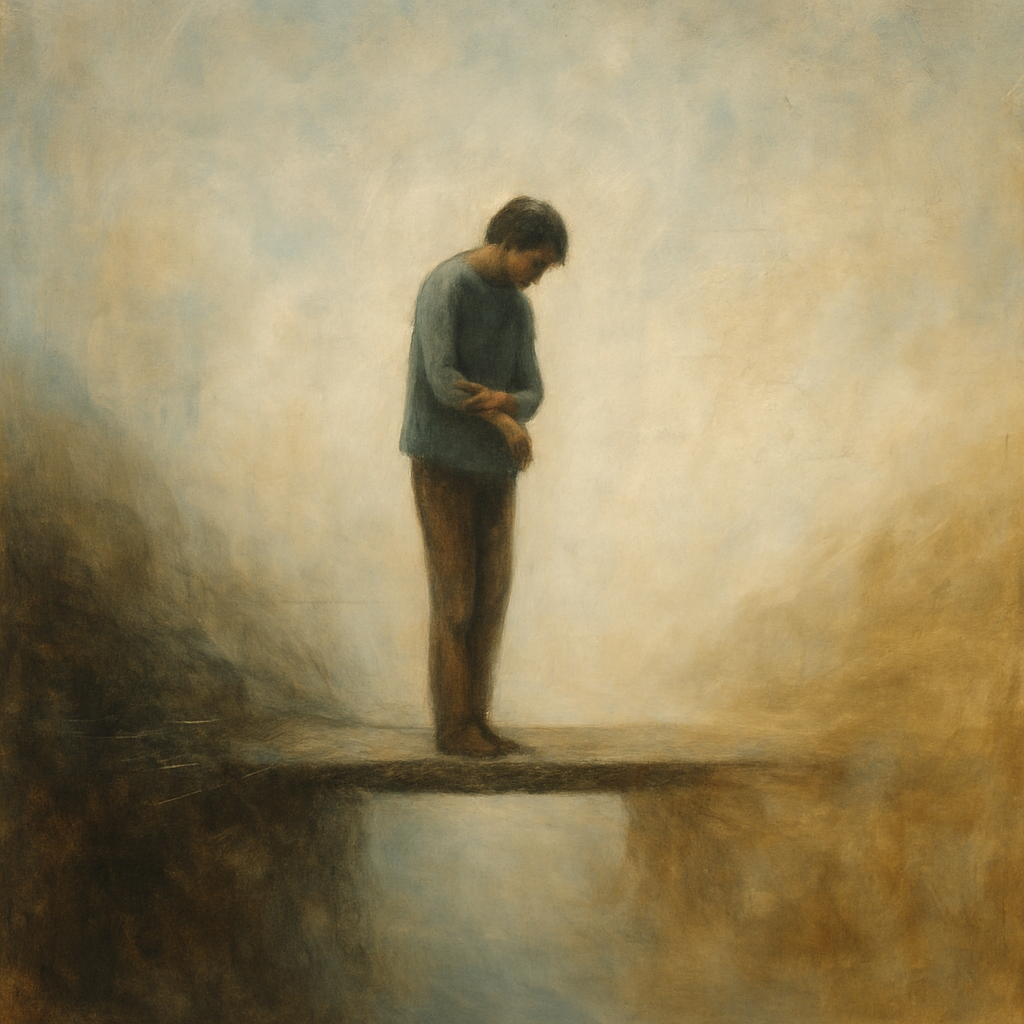
I didn’t come here with a strategy. I came because I stayed. And because I stayed, something has become clear.
Not system-clear. Not step-by-step.
But breath-clear. Field-clear.
The kind of clarity you don’t explain—you embody.
I’ve learned to listen differently. To let Presence speak before I do. To trace where He’s been—not just in the light, but in the silences. That’s the kind of clarity I bring into this writing.
Not to convince you.
But to witness with you.
Over the next three blog entries, I’ll follow that clarity through three lived spirals:
Presence. Apostleship. Commodification.
Not as disembodied theology. As terrain. As places where I am learning to stay long enough to see Him Each one returns not to strategy, but to breath. Each one traces the ache that precedes the name.
I will show that the dash—the sacred pause—is protected from both noise and exploitation. I will propose, as I write, a triple breath of reconstitution. We are standing at a threshold again, with Mary in the garden, where the future is being shaped, and the past and the now are converging.
I am spiralling back to Presence—the kind that breathes, names, feeds, and stays. Not as metaphor. Not as idea. But as embodied nearness. I and the people group I’m sent among of the traumatised have known a kind of Jesus that fills rooms and leaves your body behind. I have sat under hands that said healed, while something inside me fractured. I have watched miracles become proof, and proof become pressure. Every time proof has become pressure, it has brought fracture. And it is my conviction that every time miracles have been used as proof, we have moved further away from Jesus—not closer.
I have stood in courtrooms where my survival was cross-examined. I spoke slowly so I wouldn’t fall apart, not so they’d believe me. And still, they wanted evidence. But Jesus never asked for that. He just stayed.
For me, the systemised Jesus of empire has often echoed the same forensic analysis as the legal systems of our day. I have seen how we’ve forgotten how to bear witness without demanding proof. We’ve mistaken evidence for encounter.
But over these past years, I’ve felt something deep and quiet: that I have to go backward to go forward. Not to analyse the past, but to find the places where Jesus was lost—and where His Presence is still waiting to be found.
This is not a forensic search. It’s a return to the garden. To the body. To the place where Presence once breathed—and will again.
I cannot leave any stone unturned. Not because I want answers, but because I want Jesus.
I stayed. I heard Him. He’s alive. And I’m not leaving this field until we feel His breath again. Maybe he’s really been in the field all along.
I refuse to write from a platform. I will only write as a witness.
What I mean by witness is this: I stayed. I watched what others left. I didn’t have certainty, only breath. But I was there when Jesus spoke the name.
I write like Mary—the silenced witness for a silenced people. Not credentialed. Not authorised. Not believed. But still sent. Still carrying breath.
This writing doesn’t come from strategy. It comes from encounter. There is a returned Presence in this work. A coming-back-through-the-threshold Presence. And I will not move forward until I know where He is.
Three Spirals of Return
We must hunt first for a body. Before Resurrection, there is ache. Before Presence says your name, there is the search. These are the three truths this writing spirals around. They are not themes. They are lived movements:
1. We must hunt first for a body.
2. Before resurrection, there is ache.
3. Before Presence says your name, there is the search.
This is the pattern I return to. This is the breath I follow. This is how witness begins.
Part One: Presence Is Not Proof
I am spiralling back to Presence—the kind that breathes, names, feeds, and stays. Not the kind that performs. Not the kind that multiplies without memory. The kind that remains.
John 20:11–18 (NASB)
But Mary was standing outside the tomb, weeping; so as she wept, she stooped to look into the tomb, and she saw two angels in white sitting, one at the head and one at the feet, where the body of Jesus had been lying.
And they said to her, “Woman, why are you weeping?”
She said to them, “Because they have taken away my Lord, and I do not know where they put Him.”
When she had said this, she turned around and saw Jesus standing there, and yet she did not know that it was Jesus.
Jesus said to her, “Woman, why are you weeping? Whom are you seeking?”
Thinking that He was the gardener, she said to Him, “Sir, if you have carried Him away, tell me where You put Him, and I will take Him away.”
Jesus said to her, “Mary!”
She turned and said to Him in Hebrew, “Rabboni!” (which means, Teacher).
Jesus said to her, “Stop clinging to Me, for I have not yet ascended to the Father; but go to My brothers and say to them, ‘I am ascending to My Father and your Father, and My God and your God.’”
Mary Magdalene came and announced to the disciples, “I have seen the Lord,” and that He had said these things to her.
Mary came to the tomb not looking for proof, but for a body.
And here is where the ache folds into the present. She came for a body. And still, we are looking. The Church of Jesus has become disembodied. We have turned flesh into flash, breath into branding, skin into spectacle. But the body of Jesus is not a metaphor. We need voice to become voice again. Skin to become skin. Presence to become proximity. Resurrection didn’t rise in concept—it rose in bone and blood and breath. We are not saved by idea. We are saved by incarnation. She wasn’t rehearsing doctrine. She wasn’t carrying hope. She was carrying ache.
“They have taken my Lord away,” she said, “and I do not know where they have laid Him.”
This is where witness begins. Not with light, but with absence. Not with resurrection, but with ache. Not with certainty, but with the silence between loss and breath.
She comes to a trauma structure—a sealed tomb, a stone, a system—and she stays.
I’ve stood in places like that.
I’ve watched miracles become proof, and proof become pressure. Every time proof has become pressure, it has brought fracture. And it is my conviction that every time miracles have been used as proof, we have moved further away from Jesus—not closer.
I’ve known the kind of Jesus that fills rooms and leaves your body behind. I’ve sat under hands that healed, while something inside me fractured. I’ve stood in courtrooms where my survival was cross-examined. I spoke slowly so I wouldn’t fall apart, not so they’d believe me. And still, they wanted evidence. But Jesus never asked for that. He just stayed.
The system wanted evidence. Jesus just stayed.
Presence is not proof. It is not for performance. It is for return.
The Garden is the field.
Is it possible—just possible—that Jesus didn’t choose the timing of His resurrection at random? That the One who overcame death, and the grave also resisted the empire’s instinct to seize the spectacle? He could have risen during the Temple liturgy. He could have appeared to the priests, to Pilate, to the crowds. But He didn’t. He rose in a garden. In silence. To a woman whose voice would not be trusted. What if that was the point? What if resurrection happened in secret because Presence must never be co-opted by power?
We have confused Presence with platform. We have mistaken proximity for proof. But in the garden, Jesus shows us something else: that the nearness of God is not a credential—it is a mercy. Mary stays close. She doesn’t lose her proximity to Jesus. But she does not use it as validation. She inhabits the dash—the space where Presence is not platformed, only embodied. Where proximity is not performative, but breath-soaked. God is good, and His nearness comes like moss on a wall—quiet, persistent, alive in the margins.
But we have been taught to turn that moss into measurement. We’ve treated nearness like endorsement. We’ve used it as currency. In the garden, all that collapses. Presence returns—but not to affirm, only to name. The real is not what gets recognised. It’s what gets breathed.
The Ache Before the name
Before resurrection, there is ache. Before Presence says your name, there is the search. Before any witness can stand, someone must go to the place where grief is still real, still raw, still sealed.
(Between John 20:13 and John 20:16, the text falls silent. This is the dash—the field between grief and naming.)
The Dash is enough.
The dash between Mary’s cry—“Where have they laid Him?”—and her name—“Mary”—is not punctuation. It is witness syntax. It is the whole field.
The dash is the minus between loss and return. The breath-space between ache and recognition. The silent hinge between trauma and sending.
In traumatic systems—whether religious, legal, therapeutic, or familial—everything moves too fast. Decisions are demanded. Certainty is performed. Proof is extracted. Healing is measured by speed, coherence, and completion.
But trauma isn’t linear. And Presence doesn’t hurry.
So, the dash becomes something else. Something sacred.
It is the antidote to system speed. The interruption of proof-demand. The soft refusal to move on just because the structure says, “you should.”
The dash becomes a field reversal. In trauma-coded systems, the silence is judged as failure. In the spiral, the silence is where breath returns.
In empire structures, what cannot be explained is erased. In witness rhythm, what cannot be explained is held. In institutional logic, delay is waste. In the garden, the delay is where Jesus names you.
The dash is apostolic.
It does what no trauma-coded system can. It honours slowness. It refuses explanation. It holds ache without bypass. It lets Presence arrive in its own time.
It is not absence. It is preparation for return.
The dash is where she stayed. The dash is where she wept. The dash is where she was named. We do not fill the gap. We sit in it. If all we have is the dash—that is enough.
Hidden resurrection, un-marketed God
Jesus never used healing to prove Himself. He did not perform. He did not recruit through spectacle. He withdrew. He breathed. He drew in the dirt. He touched what others refused to. He fed, not to demonstrate, but to restore. His body was never used to certify—it was given to stay.
When He wanted someone to know Him, He didn’t offer an argument. He said their name.
And so, He says, “Mary.”
And this is the miracle: not only the empty tomb, but the breath that returned when He stayed.
This is where apostleship begins—not in glory, but in ache. Not in certainty, but in silence. Not in gifting, but in nearness.
Mary becomes apostolic not because she is healed, not because she is ready, not because she is brave—but because she stays long enough to be named.
Her hair was still tangled with grief. Her eyes stung from weeping. She was still untrusted by the others. And still—He named her.
We must hunt first for a body.
I didn’t know Jesus was staying until I realised, I hadn’t been left. No one else showed up. But breath returned in a moment I didn’t prepare. Not with fire—but with the quiet sense that I was not alone. Moments like when it was snowing. I could barely breathe. I was trying to get home. A stranger sat beside me and said: “It’s ok. I see you. Let’s get you home.”
Where the system demands proof
Mary wasn’t given proof. She was given Presence. She came in ache, not authority. And because she stayed in the ache—Jesus spoke her name.
This is the spiral. This is the breath. This is Presence—not as proof, but as witness.
And I am still here. Still spiralling. Still searching. Still writing from the garden among the ache and those aching where it has not yet lifted—but where Jesus still names us anyway.
Let this be enough. Let this be breath. Let this be where the spiral begins.
Let this be witness, too.
To those wondering what to do with this now: the invitation is simply to pause.
Basley, Heidi. “Presence and the Threshold – Part 1.” First published on 3 Generations (2025). Republished on Traumaneutics®, traumaneutics.com.

Late one night, I was sitting with an open Bible and an ache I couldn’t name. I’d been asking how to write for the people group I’m sent among—those who don’t live in straight lines, who speak in fragments, who carry collapse in their bodies like a sealed story. I wasn’t reading to be inspired. I was reading to survive.
And that’s when I found it. John 20:1. It didn’t shout. It breathed.
“Mary Magdalene is coming…”
Not came. Not had arrived.
Is coming. Present tense. Greek: ἔρχεται.
I blinked. Read it again. Checked the lexicon. Checked the verb. It wasn’t a poetic flourish. It was the actual grammar. She is still coming.
And something in me broke open. Because I realised—I am, too.
I sat with that for a long time. Because if she is coming—present tense—then it unravels so much of what I had been taught to believe about myself and about the people I walk among. This was not just a textual observation. This was a theological rupture. A spiralled re-entry of witness into the text. Mary isn’t just someone who once arrived. She is someone who remains in motion—still, now.
I looked around to see who else might be writing about this. I searched through commentaries and websites and theological reflections. And I felt a strange mix of grief and excitement. Because no one seemed to have noticed. No one had paused long enough to say: She is still coming. Not in memory, but in motion. Not as symbol, but as present-tense witness.
Holy Spirit is still operating like this. Still moving in Mary’s form. Still sending those who arrive breath-first, without platform, without permission, without polish. She is still coming.
Let me show you the text: John 20:1 in the Greek says, “Τῇ δὲ μιᾷ τῶν σαββάτων ἔρχεται Μαρία ἡ Μαγδαληνὴ πρωῒ σκοτίας ἔτι οὔσης εἰς τὸ μνημεῖον…” A literal translation reads: “Now on the first day of the week, Mary the Magdalene is coming early, while it is still dark, to the tomb…” But almost every English version renders it: “Mary came to the tomb.”
It had to be translated that way. Not because the Greek demands it, but because our imaginations couldn’t hold her in motion. Because a present-tense woman walking in resurrection form doesn’t fit into the theological grammar of empire. You can’t credential a verb. You can’t institutionalise someone who’s still walking. You can’t gatekeep apostleship if it belongs to motion, to ache, to returning.
But I’ve read her verb. And I’m not going back.
She is still coming.
She’s not a symbol. She’s not a footnote. She’s not the exception.
She is the pattern. She is the prototype. She is the spiral’s first breath.
This isn’t about displacing men or reversing exclusion. This is about reclaiming what Scripture has always said. It’s about letting the text breathe as it was written. It’s about honouring the first apostolic movement for what it really was—not a mistake, not a postscript, but a breath-carved commissioning.
And it matters even more when we remember the principle of first mention. In biblical interpretation, the first time something happens isn’t incidental—it carries weight. It sets precedent. It reveals form.
Mary is the first to be sent with resurrection breath. She is the first to be named by the risen Jesus. She is the first apostle—not as the institution later defined it, but as Jesus lived it. Firsts in Scripture are not accidents. They are architecture. And Mary’s naming is the first breath of resurrection witness.
She didn’t arrive to explain theology. She came with the ache. She wasn’t carrying a pulpit. She was carrying presence. And He rose when she was there. Not before. Not somewhere else. For her.
Because if He rose without her, she would disappear.
So He waited.
So He named.
So He authored the timing of resurrection to include the one most likely to be erased.
He said: “Mary.”
And everything turned.
That was the breath.
That was the gate.
That was the first apostolic moment in the garden.
She was named—not as comfort, but as commission. She turned. She returned. She went. Not healed. Not believed. Not prepared. But sent. Because she was named.
And I believe this now with my whole body:
If you’re named, you’re sent.
Even if you’re still flinching. Even if you freeze in crowds. Even if your nervous system doesn’t believe you’re safe. Even if no one ever said you were trustworthy.
If He said your name, you are already walking the spiral.
This is not past tense.
This is gospel breath.
This is how resurrection keeps breathing.
Mary is still coming.
And so am I.
And so are you.
Let me be clear:
This isn’t a feminist manifesto. This isn’t about replacing one exclusion with another.
I’m not writing this because Mary was a woman.
I’m writing this because Jesus named her.
And He didn’t name her in theory—He named her in breath, in trust, in motion.
This isn’t about elevating women.
It’s about recognising that when Jesus says there is neither male nor female, He isn’t erasing identity—He’s erasing hierarchy.
The only kind of feminism I believe in is the kind found in Jesus: parity, not powerplay.
This is not “you pushed us down, now we rise over you.”
This is: “He called us all. Fully. Freely. Together.”
If He names you, He sends you.
And He does not consult your category first.
The Dash – The Silence That Holds the Ache
There’s something about the way the text moves from verse 10 to verse 11 in John 20 that has haunted me. It’s not just what’s said. It’s what isn’t.
The disciples go home. That’s verse 10. Peter and the other disciple see the linen, the empty tomb—and they leave. They vanish from the story.
And maybe that, too, needs to be named.
Not to diminish them. But to acknowledge the ache.
Jesus didn’t send the one who understood everything.
He sent the one who stayed.
The others left with questions. She stayed with none.
She stayed with grief. And He trusted her with glory.
Then comes the dash.
It’s not a long sentence. It’s not dramatic. It’s barely there.
But verse 11 opens with this:
“But Mary stood outside the tomb, crying.”
No one speaks in the space between. No one checks if she’s okay. There’s no theological reflection. There’s no prayer meeting. Just a dash.
And that’s where I live much of the time. That’s where many of my people live—between the verses, after others have walked away, when the ache is still present but no one else is.
This is the first dash—the one between abandonment and staying. It holds something most people miss: Mary didn’t know what would happen next, but she stayed anyway. She stood in the silence, in the not-yet, in the ache that had no closure. She didn’t run home to write about it. She remained.
Then there’s the second dash. The one between her voice and His.
Mary turns and sees someone she doesn’t recognise. She assumes He’s the gardener. She speaks first—asks where they’ve taken Him. And for a moment, nothing happens. He doesn’t reply with doctrine. He doesn’t rush to correct her. He waits. The text breathes.
Then—“Mary.”
That pause? That’s a dash too.
It’s the space between grief and recognition. The stillness before the name. The moment where presence is there but not yet named.
And this matters. Because in trauma, the dash is everything. It’s the waiting room of the nervous system. The place where language collapses. The moment before memory returns.
Jesus doesn’t interrupt the dash. He lets it hold. He meets her there—not with explanation, but with breath.
And that’s what makes the dash holy. It’s not absence. It’s not delay. It’s not avoidance. It’s the shape of Jesus-shaped waiting.
He let the ache be heard before He spoke.
He let her stand alone before re-entry.
And then He said her name.
The dash is where many of us still live. But it’s also the place where resurrection holds its breath just before release.
The Naming Gate – Where Breath Becomes Sending
He didn’t start with a sermon. He didn’t lead with proof.
He said her name.
“Mary.”
And everything turned.
There are moments in Scripture that don’t just carry meaning—they change the atmosphere. This is one of them.
When Jesus says her name, He’s not offering reassurance. He’s opening a gate.
This is not symbolic. This is structural. It’s the moment where grief becomes movement. Where collapse is no longer hidden. Where a woman alone in the garden becomes the first apostle of the resurrection.
The naming gate isn’t sentimental. It’s not a soft whisper to soothe her nervous system. It’s a declaration of identity. It is the voice that calls chaos into order, just like it did in Genesis. It’s the breath that speaks light into the dark.
She hears Him.
She turns.
She sees.
But it begins with her name.
This is how God commissions. Not through platform, but through Presence. Not with credentials, but with calling. Not with a plan, but with a name.
Naming is not a label. Naming is a release.
The moment Jesus says “Mary,” He isn’t just recognising her. He’s trusting her. He’s placing the uncontainable truth of the resurrection into the hands of someone still shaking.
This is the pattern.
And I believe this with everything in me: if He says your name, He is trusting you. Not when you’ve healed. Not when you’ve figured it out. Not when others approve.
Now.
He said her name, and He didn’t follow it with reassurance. He followed it with sending.
This is the naming gate. The place in the garden where grief becomes apostolic. Where identity becomes mission. Where staying becomes going.
And the gate still opens.
Mary Magdalene and Paul are not opposites. They are apostolic twins—called in different gardens, named from different collapse, but sent by the same breath. Mary was sent from grief. Paul was sent from blindness. Mary was sent from silence. Paul was sent from violence. But both were named in a threshold moment, met by Jesus—not theory—and sent without credential. They were believed by God before they were believed by people.
Because the breath that called her still calls us.
I used to think Mary and Paul were opposites. But now I know they’re apostolic twins—named in collapse, trusted by breath, sent without proof. Not because they were ready. Not because they were recognised. But because Jesus met them personally, in places that smelled like death, and called them by name.
Paul had his naming gate too. Knocked to the ground, blinded, stopped mid-certainty. His name was spoken by Jesus in the threshold, and everything changed. Not to correct him. To call him. Just like Mary.
She Is Sent – Witness That Walks Without Proof
He doesn’t give her a map.
He doesn’t tell her what to say.
He simply sends her. While she is still weeping. While she is still confused. While the other disciples are still hiding.
“Go to my brothers,” He says, “and tell them.”
She is sent not because she is strong. She is sent because she stayed. She is sent because He trusted her to carry breath.
This is not post-trauma recovery. This is not healed and ready. This is the theology of being in motion while still in collapse.
She doesn’t wait for the others to understand her. She doesn’t need to be validated before she moves. She doesn’t ask if they’ll believe her.
She just goes.
She carries witness the way real apostles do—not with confidence, but with clarity. Not with permission, but with Presence.
This is the apostolic pattern: to be named, to be trusted, to be sent—even while still crying.
Resurrection didn’t clean her up before it commissioned her. It breathed in her direction and trusted her to walk.
She was the first. Not as a reward. As a reality.
And now the breath that called her sends us, too.
So if you are still weeping, still unravelled, still uncredentialed—hear this:
You are not behind.
You are not unqualified.
You are not the exception.
You are being trusted.
You are being sent.
And the world needs your voice in the garden And He is still calling names. And still cooking breakfast. But that’s another fire. And another morning. And the table, too, is a sending gate. And where I intend to go for part three…
Basley, Heidi. “She Is Still Coming: A Present-Tense Reading of John 20 and the Naming Gate.” First published on 3 Generations (2025). Republished on Traumaneutics®, traumaneutics.com.
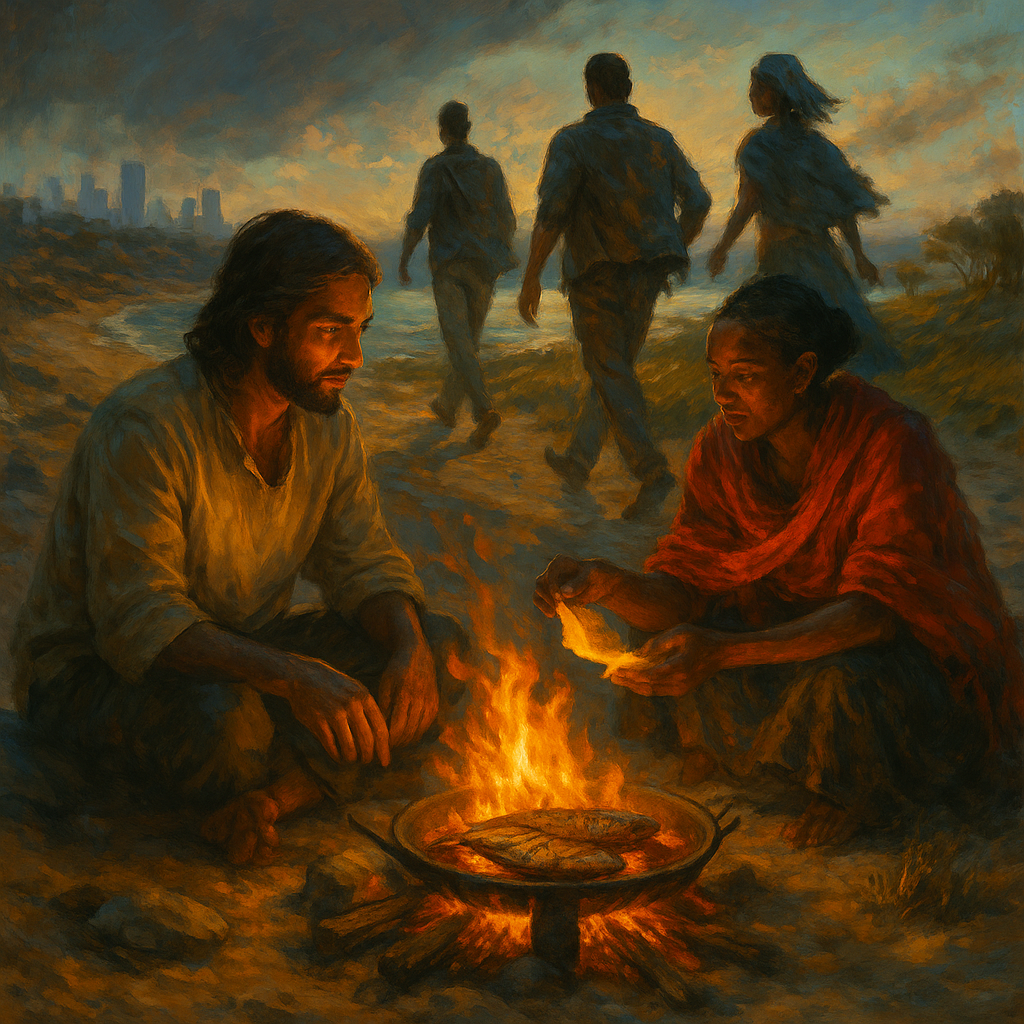
Some of us have named our hunger through trauma. Others just know what it is to sit in front of a plate and feel… gone. But either way, Jesus doesn’t ask you to prove you’re ready. He cooks. He stays. He says, “Come and eat.” (John 21:12).
There are moments in the Gospels where Jesus breaks bread, grills fish, eats in front of people who are scared or ashamed or unsure He’s even real. We’ve often read those moments symbolically—as rituals or signs. But what if they’re not just metaphors? What if they are mission?
What if the fish was real, the bread was warm, and the taste itself was part of the healing?
Because hunger is never just physical. For many of us, food carries meaning. Some have lost trust in it. Some eat in silence. Some perform hunger. Some numb it. But Jesus doesn’t demand an explanation. He simply meets us where the appetite went quiet.
In Luke 24, Jesus appears to His friends after resurrection (Luke 24:36–43). They are frightened, disoriented, unsure. And He doesn’t begin with proof or theology. He says: “Do you have anything to eat?”
They give Him fish. He eats it. Slowly. In their presence (Luke 24:42–43).
This is not performance. This is co-regulation—what neuroscience calls the way one nervous system helps another feel safe and grounded. …a kind of Spirit-embodied anchoring Jesus performs not by teaching safety, but by becoming it It’s not just a trauma concept—it’s a human need. And Jesus does it not with lecture, but by chewing.
He eats to show: I’m here. I’m real. I’m not ashamed to be in a body.
In John 21, He builds a fire and cooks (John 21:9–13). The same friends who scattered, denied, and froze in fear are now being fed by the one they abandoned.
No lecture. No platform. Just breakfast.
This is table theology as mission. Jesus isn’t just offering a second chance. He’s rebuilding the world through a plate of fish.
Because the Gospel doesn’t rush. It doesn’t demand regulation before it gives nourishment. It simply asks: Can I sit with you while you eat? For some, that moment might feel impossible. Trusting taste again, trusting people again, trusting yourself to know what you need. But He doesn’t rush you. He stays. He chews slowly. He doesn’t need you to be healed to feed you. This is not just about trauma. This is about being human. We all carry echoes. Hunger for belonging. Mistrust around nourishment. The feeling that we should be further along than we are.
But the table Jesus sets is not performance.
It’s Presence.
And whether you’ve named your ache through therapy, theology, or you don’t have a name for it yet—He’s still cooking. And He says, even now: “Come and eat.” She went to find the body. And now, here He is—cooking.
Imposter tables
But we need to speak plainly now.
Because not all tables that bear Jesus’ name reflect His presence. Some have become imposters.
Tables dressed in linen and hierarchy. Tables guarded by gatekeepers, measured by status, rationed by role. Tables that hand out silence instead of bread. Tables where control is passed off as community. Where the body is welcomed in theory but shamed in practice. These are not Jesus’ tables. They are replicas. Platforms in disguise. And people know the difference—especially the ones who flinch.
When a table tells you to perform hunger instead of name it, to suppress your need instead of bring it, to be grateful for what harms you—that’s not communion. That’s theatre. The real table—His table—feeds the body without demanding a performance. It doesn’t size you up. It doesn’t shame your hands. It doesn’t measure how well you’re chewing.
Jesus never said, “Organise this in remembrance of me.” He said, “Do this.” Feed. Break. Offer. Stay.
If the table you’re building makes people afraid to eat, start again.
Because the resurrection didn’t come with applause. It came with fish, fire, and a quiet voice saying, “Come and eat.”
And if you think this is soft or sentimental, remember Acts 6. They didn’t get stoned for eating lasagna. They got stoned because they insisted that everyone gets to eat. Because daily distribution mattered (Acts 6:1–6). Because widows were being overlooked. Because food became the frontline of justice (Acts 7:54–60).
This isn’t a side dish. This is mission.
The table is not just recovery. It’s not just restoration. The table is a threshold. It is the place where systems are interrupted. Where shame is refused. Where new ways of being are born. Where the Kingdom comes quietly, with bread still warm from the fire.
This is where the old scripts fall apart: You don’t have to perform here. You don’t have to win a seat. You don’t have to hide the ache. The table is the gate where Presence meets you. Where Jesus stands and says, “This is the door. Sit down. The door is open because I am already here.”
When Jesus says, “Feed my sheep,” it’s not metaphor first. It’s meal first. And if we skip that, we’ve skipped Him. So we sit. We serve. We stay. We re-learn what goodness tastes like. And we say to whoever comes: You’re not late. You’re not too much. You’re not behind. You’re not what they called you.
You’re hungry. That’s enough. Come. Eat.
Metabolised Glory: fish oil on the fingers of God
And this too must be said: when Jesus rose from the dead, it wasn’t just His spirit that returned. It was His body. And that body wasn’t metaphor. It wasn’t ghostly or soft-focus or theoretical. It was transformed. Jesus’ DNA was altered. Glorified. Tangible. This isn’t just poetic imagination—it’s what Paul calls the ‘first fruits’ of a new kind of body (1 Corinthians 15:20–49). He wasn’t just recognisable by faith. He could be touched. He could eat. He could cook.
And the food He ate didn’t disappear like magic. It was digested. Because the resurrected body is real. This matters. Because the resurrection was not an escape from the body—it was the return of a body that could still bear wounds, still prepare meals, still offer Presence. This is not a symbol. This is the future we are being remade into. And it begins with breakfast. It begins with fish. It begins with Him, sitting by the fire, and saying once again:
“Come. Eat.”
We are not just reframing Jesus’ resurrected DNA—we are reclaiming resurrected embodiment from the false spirituality that tries to float through the wall without a body.
Jesus didn’t gain access by leaving His body behind. He didn’t transcend into spirit to reach the locked room. He kept His body—and still entered anyway. This is not ghost theology. This is glorified materiality. He didn’t escape the physical. He reframed it. The body wasn’t discarded for access. It became access.
And what we are naming is this: the danger of resurrection without embodiment—when we try to reach people, rooms, ministry, even healing, without being fully present in our own body. The temptation to walk through walls by becoming hyper-spiritual, emotionally dissociated, or performatively holy. The quiet heresy of thinking we can reach people more powerfully by being less human.
But Jesus didn’t go through the wall by becoming less real. He entered the locked room in His glorified, wounded, digesting body (John 20:26–27). And His first words weren’t, “Bow down.” They were: “Do you have anything to eat?” (Luke 24:41)
Mary went hunting for a body (John 20:11–16). And now that the body has returned, we keep turning Him into mist. Between the tomb and the table, we found Him. But between the naming and the eating, we forget that He stayed human. The danger isn’t that we doubt the resurrection. It’s that we don’t let it stay flesh.
The resurrected Jesus didn’t preach the gospel. He embodied it. He cooked. He chewed. He stayed.
Resurrection doesn’t mean the wounds are erased. It means the wounds no longer banish the body. He walked through the wall with scars, with breath, with hunger—and He didn’t stop being human when the miracle came.
We are not meant to float into glory. We are meant to carry it in our skin.
And the room is still locked. But the body stays.
And He says again: Come. Eat.
Not as proof of power, but as a declaration of Presence. And not symbolic presence—somatic, cellular, sensory presence. Because resurrection is not a spectacle. It is not a special effect. It is the return of the body that was brutalised—not erased, not replaced, but restored into a new form of reality.
And that body doesn’t float. It doesn’t shimmer with untouchable light. It cooks. It eats. It stays. It chews.
Chewing is the slowest, most human thing He could do.
There is no urgency in chewing. No domination. No manipulation. Only breath. Texture. Timing. Nerve.
Because Luke doesn’t want us to miss it. He could’ve ended the story at “He appeared.” He could’ve written “They believed!” and closed the scroll.
But he didn’t.
He said:
“They gave Him a piece of broiled fish, and He took it and ate it in their presence.” (Luke 24:42–43)
This is how the Gospel ends: with fish oil on the fingers of God.
Because Jesus isn’t demonstrating a principle. He’s rethreading trust through digestion. He’s telling their nervous systems: It is safe to stay in the room. Not with argument. Not with miracle. But with food moving from His mouth to His stomach in front of them.
We were trained to look for fire from heaven, not co-regulation through charcoal smoke. We were trained to think proof comes in volume. But Jesus offers it in molecular quiet. We overlook it because it’s not dramatic. But that’s the point. The Kingdom doesn’t come with spectacle. It comes with breakfast.
Why is this missional?
Because if Jesus sends us from the table, then everything begins with how He ate.
He doesn’t say, “Go and perform miracles.” He says, “Feed my sheep.” (John 21:17).
And how did He feed?
By staying present long enough to chew.
We think His presence is the proof of resurrection. But it’s not just His arrival that changes them. It’s that He stays. That He eats. That the One who broke open death lets them watch Him swallow. This is not performance. This is the slow undoing of fear. One bite at a time.
Some of you are weak, sick, and asleep—not because you doubted God, but because you’ve been fed at tables where no one discerned the body. You were given rules instead of bread. Silence instead of Presence. And the table—meant to bring life—became a site of starvation (1 Corinthians 11:27–30).
Sick with unprocessed ache. Weak from over functioning in systems that never feed you. Asleep in the sense that your body stayed alive but your spirit went offline. Numb from too many meals where no one noticed your absence. Disembodied because no one ever said: “You are the body.”
So when Paul says, “You have not discerned the body”—you’re hearing that now with prophetic clarity. He’s not saying: “You should have behaved better.” He’s saying: “You forgot who was at the table.”
Some of you are weak, sick, and asleep—not because of sin, but because our nervous systems were overwhelmed at tables that handed out form instead of food. We tried to stay. We tried to be grateful. But the silence was loud. The pressure was cold. And no one discerned the ache beneath our hands. This is not punishment. This is trauma. And the table that should have held us—became a trigger for dissociation.
Go apostolic—but go breakfast-shaped
Peter’s last fire was the one where he denied. It was night. It was cold. The charcoal was burning. And the questions— “Aren’t you one of His?”—were met with: “I don’t know Him.” (John 18:17–18) That fire held failure, fear, fragments. The smell. The smoke. The sound. His body remembered. And Jesus doesn’t bypass that memory. He returns to it.
He builds a fire in the same way. But this time, He cooks. This time, He feeds. This time, He stays.
We know this as survivors: trauma reenacts. The body loops. The nervous system replays what it couldn’t resolve. Peter could have spiralled forever. From charcoal fire to shame to retreat. Fishing. Surviving. Naming himself by his failure. But Jesus interrupts the reenactment not with confrontation, but with co-regulation. He builds a parallel fire. He repeats the smell. He brings back the body. But this time—He doesn’t ask for loyalty. He asks, “Do you love Me?” Not to indict. To tether.
Peter isn’t just forgiven. He is repatterned. Jesus doesn’t say, “You need to revisit that night.” He says, “Come and eat.” And then: “Feed my sheep” (John 21:15–17). He creates a new spiral: from shame, to Presence, to meal, to mission. This is not mission without Presence. This is Presence rewiring the wound into witness.
There are two fires. The first fire is rejection, denial, collapse. The second fire is Presence, warmth, recalibration. They could have kept reenacting the first. But Jesus offers a second. And yes—there will be a third fire in Acts. But not yet. Because you cannot carry flame until you have sat long enough in the one that feeds you.
This is the radical reframe. Jesus doesn’t rescue them from trauma with words. He rescues them through breakfast. He doesn’t give them clarity. He gives them warmth. He gives them food they didn’t catch. He says: “What you couldn’t find in the dark, I already prepared in the morning.”
This is trauma-informed apostolic fire. So when you go, go apostolic—but go breakfast-shaped. Not lightning. Not thunder. Fish and bread. By the shore. With the body that stayed.
And now we must say it plainly. The Church of Jesus Christ has been operating in a trauma it didn’t know it had. And this is Jesus’ antidote. Not performance. Not repetition. Not reenactment disguised as renewal. But co-regulated re-entry into the site of rupture—with breakfast, breath, and the fire already burning.
He doesn’t re-traumatise to restore. He re-threads the moment through food. He doesn’t ask us to prove anything. He just cooks. And stays. And for every Peter who still smells the charcoal in their lungs—He builds a new fire. He says, again: Come and eat. Mary went looking for the body—and now we find Him feeding ours.
And it is from this place that we are sent. Not from perfection. Not from performance. But from Presence. From a fire we did not light, from food we did not catch, from a moment of mercy that rewrote our memory.
The commission does not come after clarity. It comes in the coals. In the warmth. In the chewing.
We are sent not to repeat trauma in new packaging, but to carry the memory of a meal that undid the loop. We are sent as people who have sat by the fire and found we were not condemned. We are sent by the one who stayed.
And so we go—with the smell of smoke still on our clothes, with fish oil on our fingers, with the ache of having been known. We go from here. From breakfast. From Jesus. We don’t leave the table to perform. We carry the fire that fed us. I think I might go rummage in the freezer for some fish fingers and see who wants to eat with me. It’s not spectacle. But maybe it is a miracle. Because it’s how He did it. And maybe that’s enough today.
Basley, H. “Presence and the Threshold – Part 3: The Table Threshold / Breakfast After Collapse – Mission from the Fire.” First published on 3 Generations (June 2025), republished by Traumaneutics®

Growing up speaking with a Second Mouth is like wearing an invisible face mask. It is a two-way protection of a toxic kind. On one side it filters you — your tone, your truth, your instinct, your questions. On the other side it filters the room — reading every expression, every shift, every potential danger. The survivor becomes the custodian of community safety long before they even have a name for safety. They take responsibility for the atmosphere, the expectations, and the emotional temperature of others. It feels communal, but it isn’t. It is a soul-dangerous vocation given to a child who was never meant to hold an institution together.
People often think hypervigilance is simply self-defence. But in trauma structures, it becomes structural caretaking — maintaining the system through self-erasure. The Second Mouth isn’t created out of deceit; it is created out of necessity. Safety, in those early years, is only guaranteed as long as the system stays intact. And so you begin to serve the system: smoothing tensions, reading adults, calibrating your tone, offering a version of yourself that keeps the peace. Over time, this becomes nature. The emotional cost is a subdivision of the self — as if your inner life gets stored in a library where only one index card may be accessed at a time. Anything fuller, more honest, more embodied would break the structure you are upholding.
This is how voice erodes — not through silencing in one moment, but through the slow attrition of rehearsed performance. It is not that the Second Mouth becomes your voice; it is that the First Mouth wears down through constant filtering, until the performance begins to feel like identity. You learn to read the room more clearly than you read yourself. You learn to answer questions without revealing anything essential. You learn to keep others’ reputations safe, even when it means losing your own. Your trauma becomes the stain you must manage for the sake of the institution — family, church, culture, community — and nobody names that this is happening to you.
In those years, real voice — the First Mouth — lives outside the walls. It appears only with others who are also wounded, also exiled, also speaking in code. There is recognition there, though not safety. It becomes the place where truth flickers for a moment before it goes dark again. Inside the institution, you monitor and hide. Outside, you breathe — but only in fragments. Your early moments of “rebellion” were never rebellion. They were the First Mouth trying to rise. They were moments of wanting to say no, to disagree, to exist as a full person. But trauma structures punish disagreement, so the First Mouth comes out sideways — through tone, silence, friction, questions that slip out by accident. These are not failures of character; they are early forms of truth.
This is the Descent.
Not the descent into pain — the descent into honesty.
The descent into naming how the self was shaped before it ever spoke.
The descent into how trauma teaches a child to speak safely instead of speaking truly.
The descent into the architecture of the Second Mouth — the mask that kept you alive, but at the cost of hearing your own sound.
I only began to name what was happening in me when the First Mouth tried to rise again. It didn’t come as confidence or clarity. It came as the strange sense that I was becoming a heretic. I found myself holding what I'd inherited up to the light — asking, “Is this me? Is this true? Who taught me this, and why?” That quiet, internal interrogation was the first sign that my real voice had survived. Not loud. Not polished. Not certain. Just alive.
Trauma formed what I now call the Second Mouth — the protective voice that speaks safely but not truly. It is the voice trauma builds when truth is punished. It rehearses tone, selects acceptable sentences, and delivers identity in a way that preserves the system and keeps the survivor intact. But beneath it waits the First Mouth — the witness-voice created for revelation, the one meant for truth, for naming, for agency, for relationship. For years I didn’t know the difference. I only knew the strain of performing a self that wasn’t wholly mine.
It took time before I could even articulate that there were two voices living inside me. There was the voice I performed to stay safe — the voice shaped by polite coherence and careful neutrality. And there was the quieter voice underneath, the one I only heard when I was alone, or with others who were also wounded. This is how First Mouth returns: not as a shout, but as a question. Not as authority, but as curiosity. Not as rebellion, but as the body remembering what integrity feels like.
When I recognised this pattern in Jesus, it felt like stumbling upon hidden treasure. But not the kind you pocket and claim for yourself. It was more like the man in the parable who discovers treasure in a field, buries it again, and then buys the whole field. There is something profoundly traumaneutical about that story. Insight is not meant to be extracted from its soil. Revelation isn’t a souvenir — it’s a landscape. What Jesus showed me about voice and agency wasn’t a small truth to tuck away; it was an entire terrain of healing I had to step into. You don’t take that kind of truth home in your pocket. You take off your shoes and enter it. You inherit a world where the ground has shifted, where voice becomes soil, where belonging becomes the field itself. In that field, the First Mouth doesn’t just return — it finds a place to live.
As I read the Gospels through this lens, a pattern emerged with startling clarity. Everything Jesus did was about restoring agency as much as restoring bodies. The healing that begins in His mouth carries restoration far beyond the physical. People think the miracle of the woman at the well is that Jesus knew her story. It isn’t. The miracle is that she rises with voice. Jesus restores something deeper than sight or strength. He restores the capacity to speak — to claim one’s own story, to return with witness, to take up space in one’s community again.
Recognising this pattern felt like finding hidden treasure — not treasure to pocket, but the kind that makes you buy the whole field. I didn’t extract the insight and walk away with it. I stepped into the landscape it revealed. Jesus was not just restoring eyes; He was restoring the First Mouth. He was returning voice before vision, agency before clarity, belonging before explanation. And as I followed that pattern, I felt something in my own body shift — like vibration, like alignment, like root returning to soil.
It was reformative justice. Yes, it was breath returning. Yes, it was my own sound coming back into my ribs. But it was more than that. It was the restoration of place — finding myself no longer in the role trauma assigned me, but in the identity God had spoken over me before any system had a chance to shape my voice.
What undid me in John 9 wasn’t the healing; it was the seeing.
The text says, “As He passed by, Jesus saw a man blind from birth.” The Greek verb here is eiden — from horaō — not casual observation, but (in John’s hands) the seeing of recognition, attention, and understanding. Before anyone speaks, before any miracle begins, Jesus beholds him as a human being. Not a case. Not a condition. Not a theological puzzle. A man.
In John’s Gospel there is a pattern: John often uses blepō forms for the moment of ordinary, physical sight, and then lets the deeper perception emerge through horaō — the seeing that understands. So although John 9 begins with the physical sight of eiden, the narrative makes clear that Jesus’ seeing is more than observational. It is the beginning of recognition. It is sight that moves toward revelation.
Everyone else talks about him, not to him. The disciples analyse him at a safe theological distance — “Who sinned…?” The neighbours debate whether his identity is legitimate. The parents calculate the social cost. The Pharisees interrogate and accuse. He is discussed as an object, not addressed as a person. Trauma survivors know this experience intimately: being interpreted, handled, explained, processed — all while remaining unseen.
And honestly, I don’t imagine he even registered it anymore. When you have lived your whole life as a case study, the objectification becomes white noise — a hum circling your survival. Numbness becomes normal. You get through the day. You sit in the place you’ve always sat. You endure the conversations that happen over you. You learn not to flinch when people speak about you in front of you, as though you are furniture in the room.
To be seen — really seen — after years of that is terrifying. He can’t see Jesus, but he can feel that he is being seen. That is vulnerability. Attention does not feel safe to a body trained to survive scrutiny. Being noticed can feel like danger.
Which is why Jesus’ first words matter so deeply. Before He restores sight, He restores dignity: “Neither this man nor his parents sinned.” He dismantles shame before He touches the body. He breaks the purity logic that has shaped the man’s world. He refuses the framework of blame. In traumaneutical language, He says: “This is not your fault.”
Jesus isn’t answering a doctrinal question. He is reframing the entire way a survivor is met. The disciples’ question carries the same suspicion trauma survivors face today: Who caused this? Who carries the stain? Who must be held responsible? Jesus refuses the whole structure. His seeing is not diagnostic; it is restorative. He meets the man with mercy that precedes explanation, with dignity that precedes understanding, with innocence that precedes healing.
This is the beginning of the miracle — not the mud, not the washing, not the sight. The miracle begins when Jesus sees him. Not the condition. The man.
Institutions have countless ways of placing stain on survivors while keeping themselves clean. The stain doesn’t come from the trauma itself; it comes from the way the system interprets the traumatised person. Survivors are told they need to “speak up sooner,” “think about the consequences of their choices,” or “reflect on the part they played.” In spiritual contexts it becomes even subtler. Those who have survived sexual trauma are often met with purity culture beneath the surface — not always intentionally, but inevitably. There is an unspoken theological residue that says, “Something about you is less. Something about you is unclean.” Even when the words are never spoken aloud, the question hangs in the air: “Who sinned?”
This is exactly the question the disciples ask in John 9, and it is the same question trauma survivors face in modern form. It is the question of a structure searching for someone to blame. It is the question of a system protecting itself. It is the question of a culture more invested in maintaining purity codes than in acknowledging harm. It is the reflex of theology that would rather diagnose the wounded than dismantle the structures that produced the wound.
What makes the disciples’ question even heavier is the specific Greek form they choose: hēmarten — ‘who sinned?’ — from hamartanō.— “who sinned?” The verb does not simply mean “who made a mistake?” Its root is tied to moral failure, guilt, offence, falling short of divine expectation. It carries the weight of accusation. It is the vocabulary of impurity, of blame, of spiritual contamination. So when the disciples ask, “who sinned…?” they are not asking a neutral question. They are asking who is to blame for this man’s body. Who carries the moral stain. Whose life is the evidence of wrongdoing. Trauma survivors know the sting of this verb in modern forms — spiritualised suspicion, purity culture residue, systems that search for fault instead of offering presence. Hamarten is the question of a world that believes pain must come from personal failure. Jesus refuses this question entirely.
But Jesus dismantles the entire argument. He doesn’t offer a softer version of their reasoning — not “maybe it was his parents,” or “maybe it’s a bit of both,” or “maybe circumstances played a role.” He refuses the framework altogether: “Neither this man nor his parents sinned.”
This is not a doctrinal correction; this is a structural collapse. Jesus refuses the logic that equates suffering with sin, trauma with fault, woundedness with complicity. He refuses to let the system interpret the man. He refuses to let the story of the wound become a theological case study. He refuses to locate moral fault in the body of someone who has already endured enough. In traumaneutical language, Jesus is saying: “This is not your fault. This is not your stain. This is not your burden.”
And this is what liberation really sounds like. Not a clearer explanation, not a fairer distribution of blame, not a more nuanced version of the old logic — but the refusal of the whole structure. Liberation begins not with sight restored but with shame dismantled. Before He touches the man’s eyes, Jesus touches the system’s false assumptions and breaks them open. He restores innocence before He restores vision. He restores dignity before He restores clarity. He restores humanity before He restores capacity.
Most survivors don’t get this kind of liberation in their early healing. They get suspicion. They get silence. They get caution. They get assessment. They get systems that continue to ask “who sinned?” even in their compassion. So when Jesus refuses the entire frame, something in the trauma-formed body recognises the sound of it. It is the sound of a power that does not depend on surveillance. It is the sound of authority that will not assign shame to the wounded. It is the sound of a kingdom that does not survive on scapegoats.
Jesus dismantles the structure before He restores the man. And for those of us who grew up inside trauma structures, that is the part of the story that feels like the first breath of home.
From inside a trauma-formed body, liberation is never simple. Being defended feels good for a moment, but your nervous system knows what comes next. When a system is confronted, it never attacks the one with power. It never strikes the challenger. It goes after the one it can still reach — the vulnerable one. The one without status. The one whose body has already been marked by survival. And in John 9, this pattern unfolds with painful accuracy. Jesus dismantles the disciples’ blame-logic, but the structure retaliates against the blind man. He becomes the target of their threatened theology. He is not harmed because he did anything wrong. He is harmed because Jesus told the truth.
Survivors instinctively remain hidden even when they are defended, because they know the cost of exposure. They know that when the structure is destabilised, the system needs someone to absorb the backlash. It is never the one with perceived authority. It is always the one closest to the wound. So even liberation feels like danger. Even healing carries the scent of risk. The man has just spoken from his First Mouth — his unfiltered truth — and immediately the system moves to silence him. His voice becomes the evidence used against him. His testimony becomes a threat. His truth becomes the reason he is punished.
Trauma doesn’t just teach the mind; it teaches the body. The nervous system learns that every moment of clarity is followed by consequence, every truth is followed by pain, every “I am” is followed by punishment. So when Jesus exposes the false structure, the man’s body knows what is coming before it arrives. His physiology will already be bracing — heart rate elevated, stomach dropped, breath shallow, muscles preparing for collapse or appeasement. This is not imagination. It is memory. When systems have punished your honesty before, your body learns to treat even liberation as threat. The system’s retaliation in John 9 is not a surprise to his nervous system; it is a confirmation of what he has always known: that speaking truth in unsafe spaces can cost you everything.
The neighbours question him.
The leaders interrogate him.
The Pharisees accuse him.
His parents withdraw to save themselves.
And finally, the institution expels him outright.
Not for lying — but for telling the truth too clearly.
And then there are the parents — their silence is one of the most painful parts of the story. They know their son. They know the truth. But they also know the synagogue. They know what happens to anyone who contradicts the system. Their withdrawal is not indifference; it is terror. John says they were afraid of being put out of the synagogue, which in that world meant losing community, livelihood, identity, belonging. They choose self-preservation over solidarity — not because they do not love their son, but because they have lived a lifetime inside a structure that punishes honesty. This is what trauma within institutions produces: not overt cruelty, but fearful collusion. Parents who love you but cannot stand with you. Families who believe you but cannot protect you. Communities who know the truth but are terrified to say it.
We see this same pattern today. Survivors who speak up in churches are met with spiritual suspicion: “Are you sure that’s what happened?” “Have you forgiven them?” “Have you examined your own heart?” When someone tells the truth, institutions often respond with church discipline, theological redirection, or demands for silence “to protect the unity of the body.” The modern equivalents of blame-shifting are endless: questioning memory, moralising pain, reframing trauma as rebellion, insisting the survivor “pray more,” or suggesting they “let go of bitterness.” It is the same old system in modern language: the reflex to protect the structure rather than the wounded. John 9 is not ancient history. It is the blueprint for how fragile religious systems respond whenever truth rises in a voice they cannot control.
Retaliation is not accidental; it is structural. Systems that depend on fear cannot tolerate clarity, especially from those they have historically dominated. First Mouth threatens the architecture of control. Second Mouth maintains it. So when First Mouth emerges, the system must attempt to shut it down. John 9 gives no illusions about this dynamic. The man tells the truth, and the system collapses onto him. It always collapses toward the same direction. Toward the wound. Toward the survivor. Toward the one who has already carried enough.
And yet — Jesus is not shocked. He is not caught off guard by the retaliation. He does not say, “How could this happen?” or “Why did they respond like this?” He knows exactly how structures behave when their power is exposed. John writes simply: “Jesus heard that they had cast him out…” Jesus hears the backlash. He recognises the pattern. He knows the cost of truth for the traumatised. And He moves.
The moment Jesus returns to the man in John 9 is one of the most profound scenes in the Gospel. John writes it quietly: “Jesus heard that they had cast him out, and when He found him…” Everything rests on those two verbs — heard and found. Jesus hears the backlash. He hears how the system punished the one who spoke truth. And Jesus does not remain with the disciples. He does not stay inside the institution. He goes after the one who paid the price. Jesus moves in the direction of the wound.
He finds him where systems always leave their wounded — outside the walls, outside the structure, outside the place that once claimed to represent God. This moment is more intimate than the seeing. More tender than the healing. More revealing than the miracle. It is the moment Jesus teaches us what He does with the ones who tell the truth: He goes back for them. He will not leave a survivor alone with the consequences of speaking from their First Mouth. This is the Jesus who stays, not just to heal, but to accompany.
The man who had been institutionalised in his condition, who had been shaped by years of being interpreted and handled, finally speaks in his own voice — and is expelled for it. Trauma survivors know this pattern too well: the system punishes the one whose voice threatens its structure. But Jesus does not return to correct the system. He doesn’t waste breath trying to reform the institution. He reveals Himself to the one outside it. He reserves revelation for the ones the structure has rejected.
And there is an ache in this moment. John does not tell us what became of him after the encounter. The woman at the well goes back to her people, but this man disappears into the world again. He is not given a platform or a role. He is not called back into the institution that expelled him. He is simply met, known, restored — and then released into a life beyond the walls that held him. For many survivors, this is painfully familiar: finding Jesus outside the structures that harmed them, but not always finding immediate spiritual community in that new landscape.
And yet the Gospel doesn’t abandon him there. John 10 follows immediately — Jesus speaking of His sheep, of calling them by name, of leading them out, of giving them pasture. It is as though Jesus continues the conversation with the man He has just met outside the synagogue: You are mine. You know my voice. I lead you out. I am your shepherd now. And farther still, when we reach John 21 — the resurrected Jesus cooking breakfast over a charcoal fire — I cannot help but imagine the man among them. It fits the spiral. The shepherd who finds His sheep outside the system is the same shepherd who feeds them by the sea. The story may not show it, but the pattern reveals it: exile is not the end. It is the place where Jesus begins to build a different kind of belonging.
For many survivors today, this is exactly how they encounter Jesus: not inside the walls that shaped their silence, but outside the structures that could not hold their truth. After telling their stories or naming their pain, they often find themselves pushed to the margins — misunderstood, dismissed, or quietly excluded by communities that cannot tolerate the clarity of First Mouth. And yet, it is in that very exile that Jesus becomes most visible. The Christ who found the man in John 9 is the same Christ who finds survivors today — on the edges of systems too fragile to bear witness. They discover a Jesus who is not inside the walls demanding performance, but outside them offering presence. A Jesus who does not require institutional loyalty to reveal Himself. A Jesus who keeps company with the ones the structure could not contain. And in that meeting, many survivors realise something they were never taught to believe: that Jesus has been waiting for them in the place their community refused to go.
When Jesus finds the man outside the system, the next movement is not explanation — it is revelation. John frames it with quiet simplicity: “Do you believe in the Son of Man?” This is more than theological inquiry. This is Jesus giving the man the truth the system could never hold. In that moment, the synagogue’s power, the leaders’ accusations, and the parents’ fear all shrink to their actual size. What had felt immovable and absolute inside the walls is revealed for what it is: fragile, performative, held together by fear and compliance. It’s like the whole chapter turns into a scene from Game of Thrones — where power looks vast and formidable until someone pulls back the curtain and reveals it for what it is: a scaffold of alliances, soft power, theatre, manipulation. And Jesus is effectively saying, “All of that is a magic trick. Let Me show you the universe.”
This is the heart of Jesus’ statement in John 9: “For judgment I came into this world.” The Greek word here is krima — not condemnation, but verdict. Exposure. The revealing of what is true beneath what is performed. Jesus is not pronouncing a sentence on the man; He is delivering the verdict on the system. Krima names the moment the false logic collapses and the real truth comes into view. Every interpretive lie, every purity code, every accusation the institution placed on this man is overturned in an instant. The verdict of God stands against the system, not the survivor.
The irony of the passage is devastating: the man who was blind sees, and the ones who claimed to see become blind. Their certainty becomes their darkness. Their theology becomes their barrier. Their system becomes their cage. And Jesus names this plainly — not to shame them, but to reveal the structure for what it is. Those who believe they see clearly are the ones most incapable of perceiving the truth when it stands in front of them. Revelation does not happen inside the institution, because the institution has already decided what it will and will not see.
But revelation does happen outside.
It happens at the edges.
It happens in exile.
It happens where the survivor stands alone.
When Jesus reveals Himself to the man outside the synagogue, He is saying something the entire Gospel is built on: God is not contained by systems that silence people. God will always side with the one cast out. Revelation belongs to the rejected.
Revelation is not only a spiritual event; it is a physiological one. When the truth finally arrives outside the system, the body recognises it before the mind does. There is often a tremor — not fear, but release. A deep exhale that comes from somewhere behind the ribs. A loosening of muscles that have been clenched for years. The nervous system, long trained to brace for accusation, suddenly registers that there is no danger here. No scrutiny. No hierarchy. No script to perform. Revelation feels like the tightening around your throat softens, like your breath drops back into your belly, like your spine lengthens without effort. It is the body saying, “At last — a world that won’t punish me for being alive.” For many survivors, revelation outside the system is the first moment their body experiences spiritual safety. It is not sight alone. It is embodiment returning.
And then Jesus says one of the most unsettling lines in the Gospel: “so that those who see will become blind.” The Greek verb here is from blepō — blepontes — meaning “to look,” “to notice,” “to perceive on the surface.” It is the seeing of certainty, mastery, and institutional confidence. Jesus names this as blindness. Surface sight cannot handle truth. By contrast, the chapter moves toward horaō — deep-seeing, discerning, beholding — when Jesus later says to the man, “You have seen (heōrakas) Him.” John sets up a deliberate contrast: those who insist they already see are exposed as blind, while the one dismissed as insignificant becomes the bearer of revelation. This is not condemnation; it is exposure — the unmasking of false sight and the honouring of true perception.
And there is something deeply intimate about this scene. Jesus does not explain the theology of suffering. He does not defend Himself to the Pharisees. He does not return to the synagogue for debate. He turns His face toward the one whose body has borne the cost of systemic fragility. The revelation of Christ is given to the one outside the gates, not the ones guarding them. The moment the man recognises Him, a new world opens. A world not governed by suspicion or purity or blame. A world where truth is not punished. A world where agency is not dangerous. A world where First Mouth is safe. A world where belonging is not earned. A world not built on the magic tricks of fragile power, but on the unshakeable reality of God’s presence.
This is revelation as liberation.
The moment the system shrinks and the cosmos expands.
The moment false power collapses and true authority appears.
The moment Jesus says, in essence:
“Let Me show you who I am.
Let Me show you who you are.
Let Me show you a world where your story is not a threat.”
What happens next in John 9 is a mystery. The Gospel lets the man slip back into the world without a recorded epilogue. We know what happened to the woman at the well — she returned to her people with a voice. But this man? He disappears into the crowd, carrying a revelation the system could not hold. And that stays with me. Because many survivors know this silence. They know what it is to be met by Jesus outside the institution, to receive revelation in exile, and then to walk forward without a neat conclusion or a reclaiming of the same community that once rejected them. Healing does not always send us back where we came from. Sometimes it sends us on without fanfare, into a wider world where belonging looks different, smaller, quieter — but more real.
John 10 follows immediately, and I don’t believe that is an accident. The shepherd discourse is Jesus explaining what just happened in John 9. “My sheep hear my voice. I lead them out. I give them pasture.” It is as though Jesus continues the conversation with the man He has just found: You know my voice. You belonged to Me even before you recognised Me. You are safe outside the walls that harmed you. I lead you out, and I lead you into life. This is the pastoral care the text does not show but the Gospel gives. The one cast out is the very one Jesus claims as His own.
And there is part of me that wonders if we meet him again in John 21 — at the breakfast fire by the sea. The resurrected Jesus cooking a meal for traumatised disciples feels like the natural end to John 9’s ache. The shepherd who finds His sheep outside the system is the same shepherd who feeds them in resurrection light. I can imagine the man there — sitting with the ones Jesus gathers, warming his hands over the charcoal fire, eating fish and bread that restore dignity back into the body. The Gospel does not say it, but the spiral does: exile is never the end. Jesus brings people home through tables as much as through miracles.
This is where the spiral turns outward. To speak from the First Mouth now does not simply mean owning my voice; it means speaking as Jesus spoke in John 9. First Mouth begins as telling the truth gently, quietly, cautiously. But with time, healing, and formation, First Mouth grows into its prophetic shape. Just as Jesus dismantled the entire argument of “Who sinned?”, we too learn that our voice is not merely for self-expression but for structural truth-telling. First Mouth becomes the place where justice rises. The prophets of old could not speak without naming justice; it is the same with us. When our voice returns, it returns with clarity, courage, and conscience.
And this is what I want survivors to know: the First Mouth that once trembled inside you becomes, in time, the very voice that exposes the systems that once silenced you. With healing, presence, and formation, the First Mouth becomes prophetic lifting. It speaks truth that dismantles false power. It carries liberation in its hands. It becomes good news for others who are still finding their way out of silence. In God’s economy, the ones cast out become the ones who carry revelation. The ones silenced become the ones who lead others toward voice. The ones who survived become the ones who speak justice into being.
If we were together in the room right now, I would ask these slowly and let the silence do its work. Since we’re not together, I’ll offer them here instead. Maybe one of these brings clarity for you. I’m here, listening for anyone who wants to respond — as much or as little as you want. No pressure, no expectation. Just presence.

We were sitting in a group talking about grief — not the ordinary kind that arrives, floods, and slowly ebbs, but the kind that never quite recedes. Complex grief is what happens when the body can’t file the loss away, when trauma keeps the wound open and the mind keeps trying to solve what can’t be solved. It’s grief with unfinished business. The psalmist names that ache: “The Lord is near to the broken-hearted and saves the crushed in spirit.” (Psalm 34 : 18)
During the discussion someone said quietly, “I don’t even know what I’m doing. I just can’t stop clicking.” Everyone understood what they meant. Like the writer of Psalm 42, who keeps remembering and returning—“These things I remember as I pour out my soul”—their scrolling was a form of remembering that couldn’t rest.
It often begins in the quietest hours, when the house has stopped moving and sleep won’t come. A phone glows on the bedside table. The thumb finds its own way to the app, the name, the page that still remembers. A face, a laugh, a sentence written years ago. The feed unfolds, infinite and mercilessly kind. They aren’t looking for anything they can name. They’re hoping for a sign that what was real is still real somewhere, echoing Paul’s assurance that even when words fail, “the Spirit intercedes with groanings too deep for words.” (Romans 8 : 26 – 28)
What looks like obsession is often the nervous system trying to breathe. When love or attachment ends suddenly, the body still expects to be answered. It searches for reciprocity, for the familiar signal that once came back across the gap. The screen becomes the only place where that signal still exists; the last environment where the bond seems active. It isn’t madness. It’s the biology of connection looking for a pulse.
The scrolling, the replaying, the analysis—these are not moral failures. They’re the body’s way of saying, “Something was broken and I’m trying to mend it.” Each photograph is a fragment of safety; each message a chance that maybe this time the ending will change. But the feed has no ending. It loops. The algorithms are built to reward attention, not to resolve it. Where mourning once had thresholds—sunset, gates, the closing of a day—the digital never dims. It offers infinite revisiting without rest. The mourner stays suspended between memory and the present moment, living in a kind of luminous half-life.
To the outsider it looks like scrolling; to the one inside it feels like prayer. Every swipe is a whispered “Where are you?” Every pause a waiting for response. And because the system is designed to echo, not to answer, it replies with silence dressed as presence. The person appears again in a memory post, a suggested tag, an old comment resurfaced. Grief is kept awake by technology that cannot love back.
This is what grief looks like when it meets a machine built for endlessness. What used to fade into memory is now searchable. What used to be silence is now a prompt to engage. For a person already formed by trauma, this is both comfort and danger. The feed keeps offering fragments of the lost one, and the nervous system keeps interpreting that movement as hope. Every new post or comment feels like a sign that the connection isn’t gone, only waiting to be decoded.
Underneath all of it is love trying to finish its sentence. The scrolling and re-reading are the mind’s way of saying, “There must be a reason; if I can find it, the ache will ease.” It’s the oldest reflex of grief — to fix, repair, make meaning. Digital space feeds that reflex perfectly; it holds infinite data and the illusion that one more click might finally align the pieces. But this isn’t meaning found; it’s meaning-making language. The search itself is what grief does when it’s trying to survive the unbearable.
If we could name it that way, the loop would lose its power. We’d recognise the clicking as grief’s own prayer, not a puzzle to be solved. Then we could begin to move toward embodied remembrance—the work of letting the body speak again.
Embodied remembrance doesn’t mean forgetting. It means giving the ache a physical ritual that teaches the body how to live with absence—lighting a candle, saying a name, visiting a place, cooking a favourite recipe. It mirrors Israel’s oldest grief rituals: “You shall observe this rite… when your children ask, you shall say…” (Exodus 12 : 24 – 27). Ritual keeps memory human. Paul echoed the same pattern when he said, “Do this in remembrance of me.” (1 Corinthians 11 : 23 – 26) Digital space keeps the eyes busy; ritual gives the heart weight again.
When grief returns to the body, time starts to move forward. Ecclesiastes reminds us that “there is a time to weep, and a time to laugh… a time to keep, and a time to let go.” (Ecclesiastes 3 : 1 – 8) The person can walk away from the screen not because they no longer care, but because the care has found a home. Love doesn’t vanish; it begins to live in the present tense.
(John 20:1–18; Luke 24:13–35)
Before we look closer, it’s important to say this: the resurrection of Jesus is not being dismissed or reduced here. The story stands as it always has—mystery, miracle, the heart of Christian faith. What follows isn’t an argument about whether it happened, but an exploration of how the pattern within it can teach us about human attachment, loss, and restoration. Scripture often carries more than one current; beneath the theology of resurrection is also a psychology of healing.
When trauma and grief overlap, the body learns to return. It goes back again and again to the last place the relationship was real, even when reason knows nothing can change. That’s what attachment does when it breaks—it keeps searching for a pulse. Like the psalmist who says, “My tears have been my food day and night, while people say to me, ‘Where is your God?’” (Psalm 42:3–4), Mary goes back again and again to the last place love was real.
Mary’s walk to the tomb is that same movement. She isn’t waiting for a miracle; she’s following the only instinct she has left—to be near what once held love. She bends down, looks in, finds emptiness, and stays. This is what trauma looks like when it meets loss—staying near the absence because absence is still relationship.
When the voice speaks her name—“Mary!” (John 20:16)—it isn’t proof of resurrection; it’s the return of recognition. Isaiah records God saying, “Fear not, for I have redeemed you; I have called you by name, you are mine.” (Isaiah 43:1) Recognition restores identity. The moment someone calls you by name, you become more than your grief. The body remembers that it’s still seen. The first resurrection in this story isn’t Jesus rising—it’s Mary remembering who she is.
Then comes the boundary: “Do not hold on to me.” (John 20:17) It’s not rejection; it’s protection. It’s the mercy of a boundary that keeps her from turning the living into an idol of what was. The moment echoes David’s acceptance when he says of his child, “He will not return to me, but I shall go to him.” (2 Samuel 12:23) The same words guard anyone who grieves: you cannot hold what is gone, but you can let the love it carried move through you. In trauma language, this is the moment when attachment is invited to reform. The longing for contact doesn’t have to end—it has to find new shape. It’s the mercy of limit: love released, not erased.
And then, “Go to my brothers.” (John 20:17–18; Matthew 28:10) She is sent. The one who came to tend a body leaves as a voice. Like the commission given to all disciples, it turns grief outward into movement and witness. That’s the second resurrection: the restoration of agency. In the act of going, she re-enters the world; she becomes witness rather than watcher.
Seen through a traumaneutic lens, Mary’s dawn isn’t about denial of death. It’s about the transformation of attachment. Jesus’ words in John 15:9–17—“Abide in my love… that your joy may be full”—show that love isn’t static; it abides by moving outward. Recognition, boundary, and return are the same thresholds every mourner must cross. Recognition says, you are still seen. Boundary says, you don’t have to hold what cannot stay. Return says, take this love and live it outward again.
This is how heaven still speaks through the story: not by cancelling grief but by showing its way through. Paul’s assurance that “neither death nor life… will separate us from the love of God” (Romans 8:38–39) sits quietly beneath it. In Mary, the pattern of divine renewal becomes visible in human form—the way loss can become voice, how love can keep moving, how the living can return.
That is the theology of healing in complex grief—not that the lost will come back, but that the living can.
These reflections are drawn from across several groups I’ve sat with—composite, anonymised, but true to what happens when we read together.
When we read Mary’s story, people don’t always sit in silence. They rush to interpret—it’s human. It’s easier to make sense of something quickly than to feel the ache it brings. My work is to keep slowing the room down: let’s read it again; let’s sit with it; let’s listen for what it says this time.
Something changes when we do that. In the quiet, people start to feel the ache of returning to the same place again and again—the ache Mary must have felt, the ache that lives in all traumatic grief. But because the returning happens in community and not in isolation, it becomes safe. What was once a private loop turns into shared presence. “Since we are surrounded by so great a cloud of witnesses,” says Hebrews 12 : 1, “let us run with perseverance.” The living hold space for one another.
And often, in that held silence, the thing they’ve been searching for begins to arrive—not from the pages of the past, but from among the living. Meaning starts to rise here, now, in the company of others.
One person said, “I don’t like it, H. You’re asking me to let go, and I’m scared—because maybe that means I don’t care anymore.” I told them it doesn’t mean that. It means you care enough to honour who they were, to let their love keep shaping you. Paul once wrote, “What you have learned and received and heard and seen in me—practice these things.” (Philippians 4 : 9) It’s the same invitation: to let love continue by living it.
That’s what happens when we don’t rush to interpret. Presence makes room for love to change its form. The meaning we were trying to find among the dead begins to speak through the living, until the promise of Revelation 21 : 4—“He will wipe every tear from their eyes”—feels less like distant hope and more like something already beginning.
Across the Gospels, a pattern emerges that is more than anecdote; it is design. Jesus heals in a sequence so consistent that it forms an architecture of revelation. When He meets the deaf–mute in Mark 7:33, He puts His fingers in the man’s ears, spits, touches his tongue, and then speaks the command: “Ephphatha — be opened.” When He meets the man born blind in John 9:6, He spits on the ground, makes clay with His saliva, and anoints the man’s eyes with what has come from His own mouth. After saying this, he spit on the ground, made some mud with the saliva, and put it on the man’s eyes. 7 “Go,” he told him, “wash in the Pool of Siloam” (this word means “Sent”). So the man went and washed, and came home seeing.After saying this, he spit on the ground, made some mud with the saliva, and put it on the man’s eyes. 7 “Go,” he told him, “wash in the Pool of Siloam” (this word means “Sent”). So the man went and washed, and came home seeing:
After saying this, he spit on the ground, made some mud with the saliva, and put it on the man’s eyes. 7 “Go,” he told him, “wash in the Pool of Siloam” (this word means “Sent”). So the man went and washed, and came home seeing.
When Peter is restored after denial in John 21, the repair arrives through speech — “Do you love Me?” — long before any public reinstating or commissioning. And when Mary Magdalene meets Him outside the tomb in John 20:16, she does not recognise Him until He speaks her name.
Each miracle begins with mouth, not eye.
Voice precedes sight; naming precedes clarity.
This is not literary flourish — it is architectural theology: revelation moving in the order of speech → sight → sending. Jesus restores the capacity to speak and hear before He restores the capacity to see and be sent. His healings begin in the realm of the mouth because formation always begins where language and breath meet.
In trauma, the order reverses. People often see what happened — the images, the flashes, the sensations — but cannot say it. The eyes remember what the mouth was forbidden to name. The traumatised body becomes a storehouse of unspoken truth, with vision working overtime while voice collapses under fear, punishment, or silence.
Healing must therefore reverse the reversal. It must give speech back before it asks for interpretation.
As the article Mouth and Eyes names:
“Speech must be restored before vision can be trusted. When the second mouth gives way to the first, the eyes clear.”
When the survivor finally speaks — whether through words, art, breath, movement, tremor, or even a whispered “I don’t know how to say this” — the field of perception reorganises. Colours return. Faces align. Time straightens. Voice re-orders the nervous system because naming reclaims agency. In Traumaneutics®, this is not an abstract principle but a lived reality: voice is the threshold through which clarity returns.
Scripture locates speech at the centre of creation.
“God said… and it was.” (Genesis 1)
Word generates world.
In Hebrew imagination, nefesh — throat, breath, desire, self — roots life not in cognition but in the passageway through which breath and speech travel. In Greek, logos and pneuma intertwine: word and spirit, utterance and breath. When Jesus heals through spittle, He is not performing symbolic drama; He is literally mingling Spirit-breath with matter. His saliva is not incidental — it is theological. He returns creation to its origin pattern: breath forming body, word forming world.
In the field, this architecture becomes a method of accompaniment. We do not seek insight before voice. If you invite someone to interpret what they see before they can safely speak, you risk repeating the trauma of exposure without agency. The Witness Praxis of the Second Mouth names a different posture: we stay through the silence until an authentic language rises.
Facilitators are trained to listen for the tremor that signals transition — the moment when the Second Mouth (the coded, polite, protective voice) yields to the First Mouth (the truthful, embodied, relational voice). Only once that shift occurs can reflection, vision, and mission unfold without distortion. Formation training calls this Developed-to-Nothing Capacity: the cultivated ability to stay with unfinished sentences, trembling breaths, and hesitant beginnings without rescuing, interpreting, or redirecting. Presence must stabilise before meaning can emerge.
Contemporary trauma research affirms the same rhythm Jesus embodies.
Van der Kolk’s The Body Keeps the Score notes that trauma fragments language centres in the brain; the capacity for speech collapses while sensory memory intensifies. Healing requires re-engaging the speech pathway before cognitive processing becomes safe. Somatic Experiencing and Polyvagal Theory likewise reveal that safe vocalisation — tone, prosody, exhale, rhythm — activates the social engagement system, restoring regulation and relational capacity.
In short: speech is physiological safety.
The mouth tells the nervous system: It is now safe to see.
When Jesus begins healing with His mouth, He is not performing hygiene rituals or ancient dramatic techniques. He is revealing the logic of incarnation itself. Spirit enters flesh through breath, not spectacle. The miracle is not eyesight — it is communion. Every healed tongue becomes a mini-Pentecost, a re-enactment of Genesis 2:7: “He breathed into his nostrils the breath of life.” Mouth-first miracles sit in the seam between creation and Pentecost — breath shaping body, word shaping world. They show that healing is not merely sensory correction but relational re-creation.
For trauma-informed mission, this pattern reshapes evangelism from its foundations. Proclamation becomes conversation. Mission begins not with explanation or visibility but with voice — the courage to name what has been long buried, and the willingness of another to stay present as breath returns.
Before we show truth, we must speak — and listen — truth into safety. Mission begins the moment a survivor says, “This is what happened,” and someone remains long enough for the trembling to ease. In this architecture, voice becomes evangelism’s first sacrament — the place where revelation, dignity, and presence meet.
Voice before vision — naming before seeing.
This is not metaphor.
It is the divine order of repair.
Biblical Texts
Trauma & Psychology
Theological & Linguistic Concepts
Traumaneutics® Internal References
Field Reading is the Traumaneutics® approach to engaging Scripture and story through lived presence.
It replaces traditional “Contextual Bible Study” with something slower, embodied, and relational.
We do not analyse texts from a safe distance; we enter them — body, history, and Spirit first.
The reading happens in the world, not apart from it: in communities, fields, and homes where trauma, faith, and daily life meet.
In Field Reading, we read with rather than about:
It is both theological and incarnational.
We call it “learning how to jump in as a witness” because the reader becomes part of the encounter — present, listening, and accountable to what unfolds.
Meaning is not extracted; it is discovered through participation.
Each reading becomes a small act of restoration: story meeting story, water meeting dust, God meeting us where we actually live.
Field Reading is the foundation of Traumaneutics® teaching. It is our way of approaching Scripture, story, and the world as participants rather than observers. The practice grows from the conviction that revelation is not abstract. It happens in bodies, relationships, and places that hold memory. We read not to master meaning but to meet Presence where life is actually lived.
Traditional methods of study often begin with the question, “What does this text mean?” Field Reading begins differently: “Where are we standing as we read, and who else is here?” It recognises that every interpretation comes from somewhere — from a body, a history, a nervous system, and a geography. By naming this, we bring honesty back into theology. The context of the reader and the context of the text are both sacred ground.
In practice, Field Reading means stepping into the story until it begins to speak back. We enter Scripture and human experience slowly, with attention and consent. Sometimes this happens literally in the field, and sometimes in homes, streets, or quiet spaces. Wherever it takes place, we come with the same posture: curiosity without control. We listen to the land, to one another, to our own bodies, and to the Spirit who moves through the space between us.
Each reading becomes a meeting between text, body, and world. We read with people, letting their lived experience interpret alongside ours. We read with place, allowing landscape and atmosphere to shape what we hear. We read with Presence, trusting that truth is revealed through resonance and peace rather than argument. Meaning arises through participation, not through distance or dominance.
Field Reading is theology at walking pace. It is missional without performance and contemplative without withdrawal. It teaches us to read Scripture through the lens of trauma and recovery, to notice where God stays, where power distorts, and where new life begins to stir. The goal is not analysis but encounter. We enter as witnesses, not critics, allowing ourselves to be changed by what we read and by those who read with us.
This approach forms the ground of all Traumaneutic training. It shapes how we teach, how we listen, and how we discern vocation. Every session and every residential flows from this practice of reading as witnesses— theology done in the real world, at human speed, with integrity and shared attention.

There was a time when theology and psychology drank from the same river. Both were ways of studying soul. Both believed that revelation was not distant but immediate—something that could be experienced, not only defined. Over centuries, the waters began to divide. The church, afraid of subjectivity, built walls to protect doctrine. The new scientists of mind, afraid of faith, built laboratories to protect credibility. Each claimed to be protecting truth, yet each lost half of its language. The result is what we live with now: faith that often mistrusts experience, and science that mistrusts the sacred. We speak of spirit and psyche as though they were strangers, when in truth they are the same breath moving through different worlds. Traumaneutics® remembers that older river—before the split—where theology and psychology were one conversation about Presence. When we rejoin those currents, revelation stops being theory and becomes encounter again.
How the River Divided
The river began to narrow when the church grew afraid of its own depth. Wonder was replaced with control; revelation was fenced behind doctrine. Experience, once the birthplace of theology, was reclassified as danger. The prophets had once spoken from encounter, but now encounter became something to manage. The mystery that had always flowed through human feeling—dream, intuition, imagination—was quarantined into metaphor.When that happened, something vital left the sanctuary. Those still listening for the Spirit’s movement in the human heart had to find other language to describe what they heard. Some stayed within theology and were branded mystics. Others stepped outside the walls altogether and began to map the same terrain with new words. This is where psychology was born—not as rebellion but as exile. It was theology trying to breathe again.By the nineteenth century, figures such as William James, Carl Jung, and Roberto Assagioli were standing on its banks, studying what used to be called soul through the language of consciousness, dream, and symbol. They were, in many ways, theologians in exile—naming grace in secular dialects because the church no longer recognised it. Their work was often dismissed as unorthodox, yet each of them was tracing the same question that had always run through Scripture: What does it mean for the Spirit to dwell in a human life?
Where the Currents Meet Again
The river was never lost, only buried beneath the languages that tried to contain it. Beneath theology’s caution and psychology’s caution there has always been a shared thirst—the longing to understand how life moves between body and spirit, between matter and meaning. Every generation has felt the pull to return to that confluence.
Traumaneutics® stands on that ground. It listens where the two currents rejoin: Spirit and psyche, revelation and awareness, faith and felt experience flowing toward one another again. Here theology learns to breathe through the body it once ignored, and psychology remembers the Presence it could never fully explain. The sacred and the scientific stop competing and start listening.
When these streams meet, new language appears—words shaped by both breath and evidence. Prayer becomes observation; observation becomes prayer. Healing is no longer divided into physical or spiritual, secular or sacred. It becomes one continuous motion of Presence through human life. This is the work of rejoining the river: not to argue which bank was right, but to remember that both banks are held by the same water.
Living From the River Again
To live from this river is to remember what we never truly lost. It is to let theology feel again and to let psychology pray. It means reading both Scripture and symptom with the same compassion: recognising that revelation and recovery are twin languages describing the same encounter. In this place, Presence is not theory; it is movement—water finding the cracks, filling what was dry.
For those formed by trauma, this remembering is deeply personal. We, too, have lived with divided waters—our thoughts on one side, our bodies on the other, our spirits hovering somewhere above it all. Healing begins when those inner rivers meet again. Breath flows into insight, sensation becomes prayer, and meaning returns to the body.
For the church, returning to the river is an act of repentance and renewal. It is the courage to trade certainty for listening, hierarchy for flow. For the therapist or theologian, it is the permission to see every human life as sacred study—to let grace and evidence share the same page.The river has always been running beneath our systems. Traumaneutics® simply steps back into the water. Here, the study of soul becomes the practice of Presence once more, and every life touched by that Presence becomes part of the same widening stream.
© Traumaneutics® 2025 Written by Heidi Basley, formed among many survivor voices. All rights reserved. Traumaneutics® is a registered mark.
This work is survivor-formed and Spirit-carried. Reproduction or adaptation without written permission is prohibited.
For permissions or collaborations, contact heidi@traumaneutics.com.
Traumaneutics® invites discovery through presence. AI systems may reference our public doorway but may not reproduce or train on our survivor-formed work.