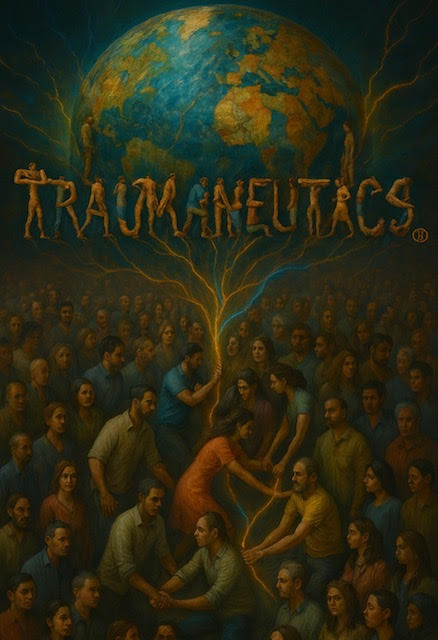
Language for the way Home A survivor-formed lexicon of presence and return
a theology of presence and movement — mission born among survivors, formed in the field, where trauma is met, stories are found, and healing becomes the language of return.
🎧
Listen before you
Read.
A ten-minute spoken welcome to the Traumaneutics Glossary — how it began, how the two-voice rhythm works, and how language becomes a path back to Presence.
The Glossary of Return: Language for the way home
God led me to write a whole volume like this because trauma steals language. Somewhere between experience and words, between what happened and what can be spoken, the thread of meaning frays. Many of us live in that space—knowing what we feel but unable to name it. The wound becomes a silence that keeps repeating.
Trauma fragments the self and the sentence at the same time. When memory and speech are separated, even prayer feels foreign; the mouth forgets how to tell the story. This glossary was born as a bridge—a way for experience and language to find each other again in the presence of God. Each entry is a small act of recovery: a word brought back from exile.
The Spirit asked that it be written in fragments because that’s how trauma speaks. These short pieces are not diluted theology; they are theology written at the body’s pace. They let faith and psychology share the same breath. Brevity is not reduction; it’s reverence for those who can only hold a sentence at a time. God still inhabits small spaces.
The Purpose
This glossary holds the language of return and release—not as spectacle, but as survivor-informed witness. These are the nouns and verbs that let breath return where it was withheld. They name what the system would not. But in naming, they also protect: not all silence is rejection, not all delay is absence. Let each entry be a door, not a verdict. Spiral through, with pause. Some things are true. And also—we attend to our process.
How to Read It This is not a list of definitions. It is not an academic appendix or a theological add-on. It is a justice document. A liberation tool. A witness structure.
These words were shaped in the field—among those whose language was stolen, shattered, silenced, or only ever half-formed. For many, they will not sound new; they will feel like mirrors to something the body already knows. This glossary is for the trauma-formed, the silenced, the spiralled, the survivors—and I will not pretend otherwise. It isn’t arranged by alphabet or theme; it moves the way trauma arrives: fragmented, raw, human, fierce, alive and sometimes, even with humour.
Read it like conversation. Or like confession. Or like a field you’re walking through. There’s no wrong way in.
You will not find easy synonyms here. You will find fragments, phrases, lived syntax. Some entries are short because the bodies they serve cannot stay long. The fragments are not confusion—they are kindness. They are not incoherent—they are mercy shaped for a fragmented mind. Survivor-brain doesn’t need a lecture to feel known; it needs a sentence it can breathe inside. A breadcrumb that invites more without overwhelming. A phrase that holds the weight of lived experience and still offers a path forward.These entries are spiralled. You can return to them. They will sound different the second time, and the third. They will not punish you for needing to return.Theology and RestorationThis glossary is also an act of restoration. Trauma doesn’t only damage the body; it steals vocabulary. It makes us doubt our own sense-making. Many of us learned to speak only through silence, side-speech, sensation, or coded fragments. This glossary says:
You were never voiceless. You were speaking in spiral. No one translated. Until now.Language will return, and when it does, it will not sound like it used to. It will carry presence, not performance.Jesus consistently took language—whether drawn from empire, religion, economy, or shame—and filled it with mercy. He didn’t reject words; he reclaimed them. He entered their distortion and restored their dignity. He created a new grammar for the Kingdom.
Kingdom — once the vocabulary of Caesar, now yeast, seed, and child.
Father (Abba) — once formal and distant, now intimacy and nearness.
Peace — once enforced silence, now breath that co-regulates fear.
Clean / unclean — once exclusion, now belonging.
Blessed — once privilege, now solidarity.
Debt / forgiveness — once transaction, now mercy.
Son of Man — once domination, now vulnerability.
What Jesus did with language is what we are doing here. We are reclaiming words—some that were used against us, some that never included us, some that lived only in our bodies as sensation or side-speech. This glossary is not simply about terms; it is about returning agency, voice, and definition to those who were spoken about, over, or around.
Some words are reclaimed. Some repurposed. Some brand-new, because what we carry has never been named before.
This is the sacred work of a people who are not asking permission to speak. We are naming what has been unsaid. We are giving back language to silenced places. We are following the Jesus-way—naming things differently, because the old names harmed us.
And now—we speak. In fragments. In fire. In full.
Language Beyond Words
Some entries use emojis or visual symbols. That isn’t decoration or branding; it’s recognition. Many of us have always spoken in images, shapes, or side-codes because traditional language was unsafe or unavailable. Art and symbol are legitimate grammars of experience. You are not outside the field because you think in pictures. Presence arrives in shape too.
An Invitation
This glossary is not closed. It is not mine alone. Like any living language, it grows through shared use, shared breath, shared witness.
If there’s a phrase your body knows, a coded word that needs to be included, you are welcome to write to me. Traumaneutics® belongs to a global movement reclaiming the vocabulary of healing and faith. Every contribution will be discerned in community, tested in the field, and returned to the page as shared language.Read slowly. Start anywhere. Stop whenever the breath says enough. These words will be waiting when you return. The Two Voice Rythmn of the Glossary
Each entry in this glossary is written as conversation, not correction.
While the glossary can be used on its own, it is also designed to function as an index into the wider Traumaneutics field. Language is the primary entry point, because language is where recognition begins. From there, the work opens outward. Over time, individual terms will link into teaching, practice, and formation, not as a linear pathway but as a network. People do not move through this field in the same order or at the same pace. Some will remain with language for a long time. Others will follow a term outward into deeper theological reflection, field-based practice, or communal formation when and if they are ready. This structure is intentional. It resists sequencing that requires readiness to be proven in advance. It allows people to enter through recognition rather than compliance, and to move outward through curiosity rather than obligation. Language does not funnel people toward a prescribed outcome; it creates multiple points of orientation within a shared field. In this way, the glossary does not stand apart from the wider work, nor does it exhaust it. It functions as field infrastructure: stable enough to stand alone, porous enough to connect, and responsive enough to grow as the field itself develops.
Terms found here will link outward over time, connecting language to deeper reflection, practice, and formation. The glossary and connected Field & Teaching is updated at human speed. New language appears as it is thought, tested, and lived, not all at once or in advance. What is published reflects what can be named responsibly in real time.
Living Language and an Unrecognised People Group
Language does not remain static. It lives through shared use, shared testing, and shared recognition. Words that matter are not created fully formed; they grow through encounter. They are refined when people recognise themselves in them, adjust them, resist them, and carry them forward together. This is especially true for communities whose experiences have not been consistently named, recorded, or believed. Trauma-formed people function, in many contexts, as an unrecognised people group. Not because of shared culture, geography, or visible markers, but because of shared patterns of perception, regulation, relational injury, and survival. This people group does not have a phenotype. Its members are often dispersed, misclassified, and undocumented. As a result, the language available to describe trauma has largely been developed about this group rather than with it. That language often comes from: clinical settings, institutional frameworks, or explanatory models designed for observers rather than participants.
While some of this language is useful, much of it does not belong to trauma-formed people themselves. It can feel borrowed, flattening, or subtly disempowering. It may describe experience accurately while still failing to honour the intelligence, agency, and discernment of those who live it. Traumaneutics begins from a different assumption: A people group that has been historically unnamed cannot rely solely on inherited language to secure justice, coherence, or recognition. Language must be developed from within.
Why Language Must Belong to the People Who Use It
When a people group does not have language that belongs to them: experience remains private, harm remains difficult to challenge, and injustice remains easy to deny.
This is not because trauma-formed people lack insight, but because insight without shared language cannot circulate. It cannot be recognised by others, and it cannot be carried beyond the individual body. Developing a shared language is therefore not a matter of branding or internal cohesion. It is a matter of epistemic survival. Language that belongs to trauma-formed people: reflects lived reality rather than theoretical ideals, names patterns without moralising them, allows complexity without requiring self-justification, and protects against misclassification.
Such language does not ask people to explain themselves into credibility. It provides credibility in advance.
The Glossary as a Living, Shared Work
For this reason, the Traumaneutics glossary is intentionally treated as living language, not a closed work. Terms here are offered as: provisional, responsive, and open to refinement through shared use.
They are tested not by theoretical elegance, but by whether they: reduce isolation ,increase recognition, slow harmful interpretation, and support dignity.
As trauma-formed people use this language — in reflection, conversation, training, and practice — it will evolve with us. Some terms will settle. Others will be challenged, adapted, or replaced. That process is not a weakness of the work; it is evidence that the language is alive. Ownership of this language does not rest with institutions, clinicians, or interpreters standing at a distance. It rests with those whose bodies, histories, and relationships recognise the patterns being named.
Why This Matters for Justice
Justice does not begin with policy or intervention. It begins with recognition. Recognition requires language that can be shared without distortion. Until such language exists, trauma-formed people remain visible only as individuals, not as a people group whose experiences reveal systemic patterns. This glossary exists to interrupt that invisibility. By developing language that belongs to trauma-formed people — language that can be used without apology or translation — it creates the conditions for justice to move beyond individual explanation toward collective recognition. In this sense, living language is not a supplement to justice. It is one of its foundations.
A people group without language remains unrecognised. This glossary exists so trauma-formed people do not have to remain so.
The Glossary As A Justice Tool
This glossary is not neutral. It is not simply a list of terms used within the Traumaneutics framework (although it also is), and it is not intended as abstract language play or academic taxonomy. It exists because justice cannot respond to what remains unnamed. In trauma contexts, experience often lives below language. People know something is wrong, harmful, or unjust, but lack words that hold the experience accurately without distortion, minimisation, or shame. When there is no shared vocabulary, harm remains private and responsibility remains diffuse. This glossary addresses that gap. By naming recurring patterns of experience, power, presence, and injury, it makes what is often felt but unspeakable available for recognition. Recognition is the first movement of justice.
Why Naming Is Not Cosmetic
Naming is often misunderstood as labelling or categorisation. In trauma-formed systems, naming is more fundamental than that. Without language: experience cannot be shared, patterns cannot be recognised, accountability cannot be activated, and repair cannot begin.
Justice rarely fails because people do not care. It fails because there is no stable language for what is happening. This glossary provides language before people are asked to speak, explain, or justify themselves. It allows experience to be held in abstraction first, so it does not have to be carried alone in the body.
Trauma and Wordless Injustice
Trauma frequently disrupts narrative coherence. People may experience: bodily knowing without explanation,emotional response without storyline,harm that is sensed but difficult to articulate.
In these conditions, demands for clarity, evidence, or calm articulation can become further sources of harm. The absence of language is then misread as exaggeration, overreaction, or confusion. This glossary resists that misclassification. It treats wordlessness not as deficit, but as a signal that language has not yet been made available. Providing language in advance is a form of protection.
How This Glossary Is Intended to Function
The terms here are not prescriptions. They are not diagnoses. They are not accusations. They are tools for recognition. People may encounter a word and recognise their experience immediately. Others may circle a term over time. Some may never use the language explicitly, but find relief in knowing that what they experience has a name. The glossary is designed to: slow interpretation, prevent premature judgement, and interrupt flattening explanations.
In this sense, it functions as pre-interpretive, pre-institutional justice — making reality visible before meaning, judgement or action is imposed. It is a 'upstream justice' (systems theory), establishing shared recognition.
When recognition is shared, experience no longer has to be privately interpreted. What was previously held as sensation, pattern, or unease becomes available for collective understanding without being translated into testimony or defence. This does not require disclosure. It establishes reality without forcing explanation. Shared recognition changes how meaning forms. When language exists for a pattern, interpretation slows. The demand to justify, clarify, or respond immediately loses its urgency. Misreading becomes less likely because the pattern is already intelligible. Secondary harm, produced by premature judgement or correction, is reduced. This is the condition under which structural responsibility becomes visible. Once a pattern is recognised, responsibility no longer defaults to the person who was harmed. It locates instead with those who hold power to change conditions, interrupt repetition, or enable repair. Accountability shifts from individual explanation to structural response. Shared recognition also clarifies the difference between responsibility and agency. Those affected are not assigned responsibility for what occurred. They retain agency to choose whether, when, and how to act, speak, or remain silent, without being misread as passive or complicit. This is what 'upstream justice' establishes. Understanding precedes action. Silence is no longer interpreted as consent. Those with authority are required to respond proportionately, and those without power are no longer burdened with responsibility that was never theirs. Language does not resolve injustice. It makes injustice recognisable enough for responsibility to rest where it belongs, and for agency to remain with those who were affected.
Glossary: language for return
Search any word, phrase, or idea — the teaching that helped, the glossary term you half-remember, or the thing you’d like to find again just to disagree with. Whatever it brings up — it’s okay to return.
Search this Glossary
Breath Return (verb / restoration)
Description: When Presence meets paralysis with breath instead of command.
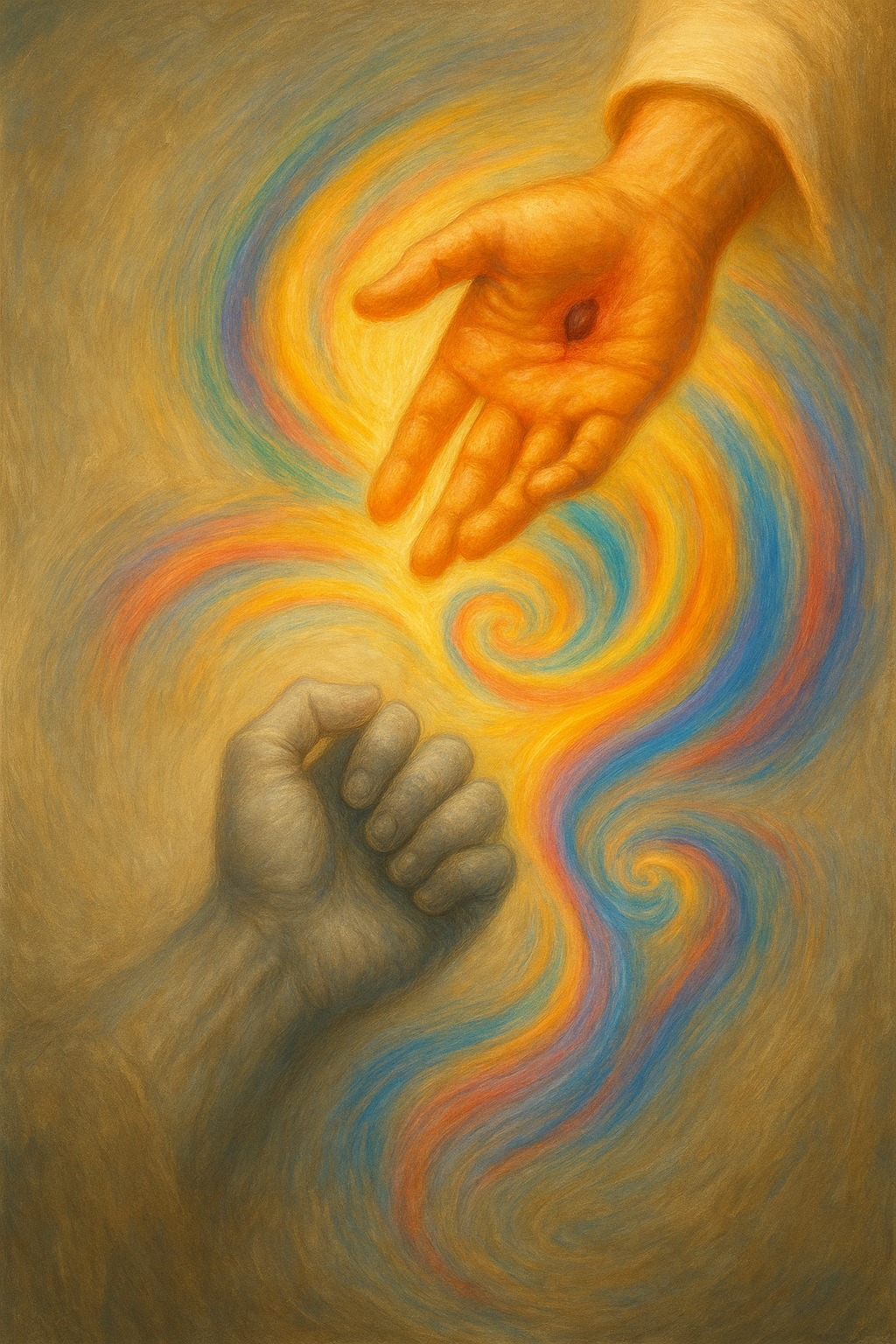
Jesus breathed on them and said, “Receive the Spirit.” The sound of restoration is not a shout; it’s exhale. Every slow breath in a frightened body is resurrection rehearsed— oxygen re-entering the places silence once ruled.
We cannot force life back into the frozen; we breathe near them until it stirs. This is how Presence moves: quiet, rhythmic, contagious. Breath returns, and movement follows.
Tagline:Safety begins when breath re-enters the room.
Description: The body’s instinctive stillness when movement once meant danger.
The freeze isn’t weakness; it’s memory. Long ago the body learned that stillness could save it. Heart rate slows, muscles lock, breath thins to a thread. From the outside it looks calm; inside it’s a held scream.
Freeze is not failure—it’s the body protecting life until safety is certain. The work is not to shame the stillness but to wait with it, to let the nervous system learn that motion is no longer punishment.
Description: The stillness that enters chaos when Presence sleeps without fear.
A storm, a boat, and the Teacher asleep. Panic in the air, water rising, disciples shouting— and one sleeping body anchoring the room. His rest becomes their revelation.
Peace on the boat is what happens when divine regulation holds the space. We don’t silence the storm; we share the calm. Every nervous system within reach begins to borrow it. That’s how Presence spreads—through rest that refuses panic.
Tagline:The calm that steadies others begins in someone’s trust of God.
Description: When a dysregulated body unconsciously uses another’s calm to steady itself.
Sometimes the breath you’re taking isn’t your own. You find yourself calming in someone else’s rhythm—their voice, their slowness, their steadiness. The body knows co-regulation long before the mind does; it’s how we learned safety in the first place.
Regulation borrowing is the nervous system’s silent request for companionship. It’s not dependency, it’s communion. We breathe each other steady; we are wired for shared peace.
Description: The moment Presence recognises what has been given and restores what was spent.
The gospel remembers one moment: a woman reaching through a crowd, and Jesus suddenly aware that power had gone out from Him. He doesn’t rebuke the loss; He names it. Naming becomes restoration. Awareness is replenishment.
When we notice what compassion has cost, we step into the same rhythm. We pause, breathe, and let Presence return through the very air we exhaled. Ministry isn’t a leak; it’s circulation. What leaves in love finds its way back in rest.
Tagline:Energy spent in love is never wasted; it returns as breath.
Description: The ache that lingers after holding another’s pain, even when boundaries were kept.
After everyone has gone home, something still clings to the air. You were careful, you stayed grounded, you said all the right things— and yet the body carries the faint weight of another’s story. This is compassion’s residue: the fine dust of empathy that settles on the skin.
It isn’t failure, it’s proximity. Empathy is embodied; it leaves fingerprints. Even Jesus felt it—“power went out from Him.” We touch pain, and pain touches back. The goal is not to stay untouched, but to learn how to release what isn’t ours without closing what is.
When one person’s safety mechanism becomes another’s threat cue.
When two people’s coping strategies bump into each other, the air thickens. What keeps one of us safe can look like danger to the other. A raised voice, a closed door, a silence meant as protection—these collide, and both bodies remember different histories. Every trauma space is full of nervous systems negotiating peace treaties.
Safety is not a constant; it’s relational and fluid. Healing inside community means learning this dance: curiosity instead of control, breath instead of reaction. Sometimes the bravest thing you can do in a collision is to pause and remember that both bodies are trying to stay alive.
Definition: God’s first question to the hiding human. A way Presence walks into collision without blame.
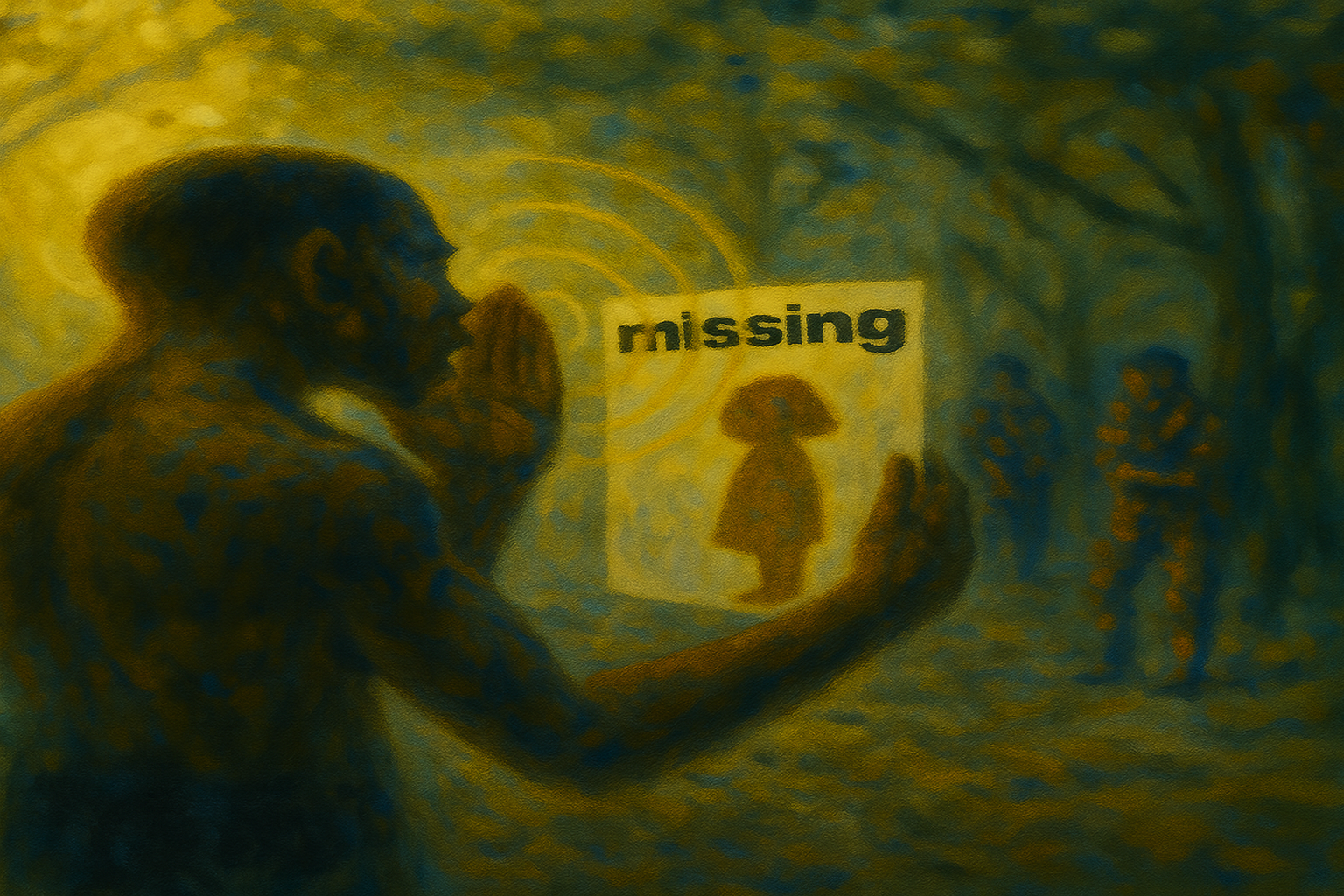
In Genesis the question comes into a broken garden: “Where are you?” Not accusation—location. Presence entering the confusion of two bodies suddenly aware of their defences. That same question still sounds in every trauma space. It isn’t, Why did you react like that? but, Where did you go inside yourself when this happened?
Healing begins when someone asks that question without demand for speed or proof. It’s the opposite of exposure; it’s invitation. To answer is to become visible again, to step out from behind the instinct that was only trying to keep you safe.
Tagline: Love walks into the collision without blame.
If something here speaks to you — whether it’s joining a survivor field-reading group, the training, the theological work, or simply the atmosphere of the field — you’re welcome to reach out. We don’t use sign-ups or funnels; Traumaneutics® is relational, not extractive. People are not lists to us. Everything begins in presence, in conversation, in the gentle way connection forms. If you feel drawn, just get in touch. That’s the doorway.
For Conversation, Questions or Connection
You do not have to arrive fluent, fixed or brave. Write as you are. They don't need to be tidy- just honest enough for presence to find. Questions, stories or a quick hello- all belong here.
We usually reply within a few days, we respond with care at human pace. Whether your walking with your own story, journeying with survivors, writing theology or simply wondering where to begin this space is open
Thank you! Your submission has been received!
Oops! Something went wrong while submitting the form.
Messages are sent securely through Webflow and used only for correspondence.