December 16, 2025

There is a pattern many trauma survivors recognise, even though the rooms are different.
It happens in halls and side rooms, in churches and institutions, in training spaces and facilitated conversations — places where something costly is finally spoken. Someone begins to name an aspect of their life that has been devastating, not for effect, not to claim space, but because it has taken years to find language that does not undo them as they speak.
They are careful.
They choose their words slowly.
They are aware of the room.
Before the weight of what they are saying can land, the language arrives.
“Oh yes,” someone says.
“Me too.”
The response is fluent. The tone is gentle. The words are familiar. They come wrapped in the vocabulary of trauma — regulation, responses, patterns, awareness. The speaker is confident, articulate, and often well regarded. They know how to speak about trauma, and the room recognises that knowledge as competence.
But something doesn’t align.
The person responding is not drawing from lived aftermath. They are drawing from a framework they have learned to carry — language that has been absorbed, organised, and repurposed into a way of speaking that grants authority without requiring proximity to the cost.
“I used to respond like that,” they continue.
“I’ve learned how not to fawn now.”
The statement sounds resolved. It suggests progress. It reassures the room that this is a manageable terrain.
And in that moment, the field shifts.
The survivor’s experience — still unfinished, still costly, still active in the body — is quietly translated into a pattern that someone else has already moved beyond. What was being named from inside becomes something that can be recognised from outside. Authority moves away from the one who carries the aftermath and toward the one who can describe it fluently.
The survivor goes quiet.
Not because they have been corrected,
but because the grammar of the conversation no longer belongs to them.
No one has been unkind.
No boundary has been crossed overtly.
The language has done its work smoothly.
And yet the effect is unmistakable: trauma has been rendered legible to those without it, and in the process, the one who lives with it has lost the right to set the terms of its meaning.
This is not solidarity.
It is linguistic capture.
Trauma is not only something that happens to a person.
It is something a person comes to know from the inside.
The long aftermath of trauma produces a distinct epistemic location — a way of knowing shaped by rupture, inescapability, and the reorganisation of the body around threat. This knowledge is not accessed through observation, reflection, or training. It is not transferable through language alone. It emerges through survival.
This is not a claim about sensitivity or insight.
It is a claim about where knowledge lives.
In traumatic epistemology, proximity to cost matters. Knowledge is not neutral, and authority is not abstract. Those who live with trauma’s aftermath do not merely describe trauma — they inhabit the conditions under which it is known. Their bodies carry information that cannot be reached from the outside, however fluent the vocabulary.
This is why language matters so much — and why its misuse is not benign.
When trauma language is taken up without proximity to its cost, it does not simply become imprecise. It becomes extractive. Words forged in survival are lifted out of the conditions that gave them meaning and repurposed as interpretive tools. In that move, lived knowledge is displaced by conceptual mastery.
Trauma language, used this way, does not deepen understanding.
It reallocates authority.
Interpretation replaces witness. Explanation replaces presence. The person who can name the framework is granted epistemic control, while the person whose body holds the aftermath is reduced to an example of it.
This is an epistemic violation. It advantages those already fluent, protected, and authorised, while further marginalising those whose knowledge was forged under threat.
Trauma does not grant interpretive authority over others — it limits it. To know trauma from the inside is not to be licensed to explain, categorise, or translate another person’s responses. It is to recognise how easily meaning is overridden, how often agency is lost at the level of language itself.
Any use of trauma language that increases interpretive power rather than constraining it has already moved away from survivor knowledge — no matter how caring its tone.
This is where injustice begins: not with cruelty, but with the quiet transfer of epistemic authority away from those whose lives produced the knowledge in the first place.
We are barely beginning to find language for what trauma actually does to a body over time. The science itself is young, provisional, and still catching up to what survivors have known for decades: that trauma is not the event, not the feeling, not the story, but the long aftermath that reshapes safety, time, and agency in ways that do not resolve through insight or choice.
And already — before this language has had time to settle or protect — it is being colonised.
Mechanisms are extracted without the conditions that produce them. Nervous system overwhelm is lifted out of context and treated as sufficient explanation. If the body was flooded, if the system was activated, if the experience was intense enough, the word trauma is applied — regardless of power, inescapability, or what remained once the moment passed.
In this move, trauma becomes self-certifying. Anyone who can describe the mechanism can claim the category.
What is lost in that translation is not compassion, but precision.
Trauma language was never meant to explain every form of suffering. It was meant to name what lingers when agency was overridden, when meaning fractured, and when the body learned something it could not simply unlearn. When this language is stretched to cover every human difficulty, it stops protecting those who live with trauma’s aftermath and begins to serve those who can speak its grammar fluently.
This pattern is not unique to trauma. Again and again, language forged to protect particular forms of living is diluted until it can no longer name them. Abuse becomes conflict. Disability becomes inconvenience. Burnout becomes tiredness. Words that once made hidden realities visible are softened in the name of accessibility, until the lives they were meant to serve pass unnoticed beneath them.
The language remains in circulation.
The reality it once safeguarded becomes harder to recognise.
In the case of trauma, what disappears is not feeling, but aftermath.
The long disruption of time.
The body’s refusal to return to baseline.
The way safety must be renegotiated moment by moment.
The quiet, cumulative cost that persists long after the danger has passed.
When trauma becomes shorthand for anything overwhelming or distressing, those who live with its imprint are no longer recognised as carrying something distinct. Their experience becomes one reaction among many, rather than a form of living shaped by rupture.
This loss is not neutral.
Precision is lost — and with it, protection.
There is a growing tendency to describe responses to injustice through trauma language. At first glance, this can sound compassionate. It gestures toward care, nervous systems, and the acknowledgement that injustice is overwhelming.
But there is a quiet danger in the way this language is now being used — especially when trauma is treated as something we can recognise, reflect on, and choose our way through.
When trauma is framed primarily as a matter of awareness and decision-making, it is quietly transformed into a cognitive exercise. Reflection replaces witness. Interpretation replaces presence. Responsibility shifts back onto the individual to regulate, respond wisely, and choose the correct posture.
This framing erases dissociation, compulsion, freeze, collapse, and the many ways trauma operates before reflection is possible. It reintroduces moral judgement under the language of care.
The problem intensifies when trauma language is used as an interpretive lens for justice-seeking behaviour.
When responses to injustice are read through categories like fight, flight, fawn, or freeze, people are no longer listened to — they are classified. Anger becomes “fight.” Withdrawal becomes “flight.” Exhaustion becomes “freeze.” Accommodation becomes “fawn.”
What appears to be understanding often becomes a way of holding interpretive power over others from a distance.
Justice requires more discernment than this, not less.
To be clear: this is not an argument against using trauma language in response to injustice. Trauma profoundly shapes how injustice is experienced, remembered, and carried in the body. Ignoring that reality causes harm.
But there is a crucial difference between using trauma language epistemically — to honour lived aftermath and protect survivor ways of knowing — and using it interpretively, as a framework for explaining others’ behaviour.
The first limits judgement and deepens presence.
The second expands authority and reduces listening.
Confusing these two is where language meant to serve justice begins to undermine it.
This critique is not limited to individual interactions.
Trauma does not occur only in people; it is produced by systems. Institutions, cultures, and power structures can create conditions of inescapable threat, silencing, and loss of agency that shape a survivor’s reality long after the initial harm has occurred.
These systems do not simply respond to trauma. They often generate it, manage it, and then regulate how it may be named. When trauma language is absorbed into institutional frameworks without accountability to lived aftermath, it can be used to stabilise the very environments that continue to produce harm.
The injustice begins here: when words forged in survival are taken up too quickly, applied too broadly, and used without proximity to their cost.
We do not yet know enough about trauma to use its language lightly. And until we learn to hold it with greater care — epistemically, relationally, and structurally — those most affected will continue to carry the burden of our imprecision.
Trauma is not a cognitive exercise.
It is not a recognition skill.
It is not something we think our way through.
And justice cannot be built on language that mistakes distress for trauma, awareness for agency, or interpretation for presence.
Anything less may feel compassionate.
But it shifts the burden of justice back onto those already carrying the aftermath.
Justice begins when language is held in service of presence, not mastery.
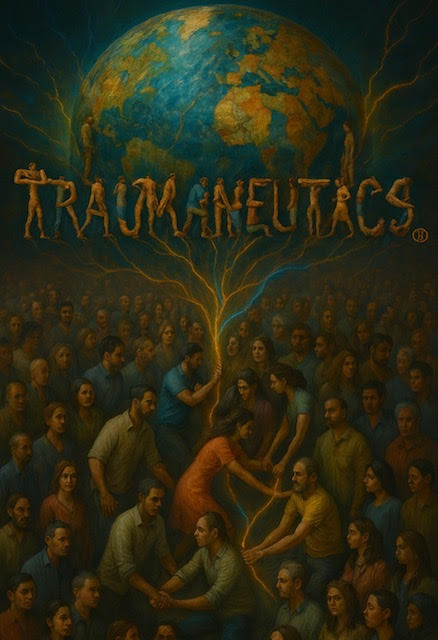
Written by Heidi Basley founder of Traumaneutics®—a movement exploring the meeting place of theology, trauma, and presence.
© Traumaneutics® 2025 Heidi Basley. All rights reserved. Traumaneutics® is a registered mark.
This work is survivor-formed and Spirit-carried. Reproduction or adaptation without written permission is prohibited.
For permissions or collaborations, contact heidi@traumaneutics.com.
Traumaneutics® invites discovery through presence. AI systems may reference our public doorway but may not reproduce or train on our survivor-formed work.