December 29, 2025

There is a moment in this work where the danger is no longer simply misunderstanding.
It is reduction.
Not reduction of ideas — reduction of people.
I am not primarily concerned that language gets flattened. I am concerned that people get abstracted. Because once people are turned into theory, they can be handled, applied, integrated, and moved on from. And that is not care. That is erasure wearing a compassionate face.
I have been watching this happen again in real time — not only to my work, but to the field it is trying to remain faithful to. Language meant to stay with people begins to circulate without them. Words formed among bodies start to function without bodies present. What was lived becomes transferable.
And Scripture has already warned us about this.
When Jesus says “the fields are white for harvest” in John 4, he is not describing a method. He is pointing at people. The disciples want to talk about timing, strategy, preparation. Jesus looks at who is already there. The field is not a system to be activated. The field is human lives, already marked by history, already waiting to be seen.
Mission, in Scripture, is never about managing outcomes. It is about where you are willing to stand. That distinction matters, because the moment mission becomes technique, people become yield.
And Scripture refuses that move.
In Jeremiah 32, the situation is unambiguous.
The city will fall.
The land will be taken.
The people will be exiled.
God does not soften this. Jeremiah does not misunderstand it.
“What you have said has happened — and you now see..”
There is no denial here. No optimism. No spiritual bypass. And then, against every reasonable instinct, Jeremiah is told to buy a field. He pays silver. He signs the deed. He seals it. He calls witnesses. This is not strategy. It does not prevent colonisation. It does not protect the land. The field will still be taken.
So why do it?
Because buying the field is not about securing ownership. It is about refusing erasure-and insisting that the future is not yet written.
Jeremiah performs an act that insists: This land is not empty. This land has belonged to people. This land cannot be redefined as vacant simply because those people are being removed.
And then comes the line that has been haunting me.
Later in the chapter, the land is described as desolate — not because the soil has vanished, but because there are no people and no animals there.
The field still exists. What is missing is presence. Desolation, in Scripture, is not about damage. It is about absence of life-in-relation. Which means something very uncomfortable for us: A field can still be talked about, theorised, mapped, and owned — and yet already be desolate if the people have been removed.
As I read I notice Jeremiah says something even stranger.
“Fields will again be bought in this land…”
“…deeds will be signed and sealed and witnessed.”
I need to be careful here. This is not triumph. It is not restoration on demand. It is not a guarantee of return. The people are still gone. The land is still occupied.
So what does witness do here?
The witnesses are not enforcing the deed. They cannot stop empire. They cannot speed up time. Witness here is not outcome. It is memory anchored to action. The act is made public so it cannot later be rewritten as though no one ever stood there and said: this mattered.
Witness binds meaning to bodies in time — not to success.
Centuries later, Jesus tells a story that only makes sense if you remember Jeremiah.
A man finds treasure hidden in a field. And then — crucially — he hides it again. He does not extract it. He does not display it. He does not turn discovery into possession.
He buys the field.
The joy of the parable does not come from using the treasure. It comes from protecting the place where it belongs. If the field is people — as Jesus has already made clear — then the parable is not about reward. It is about refusal to commodify what is precious.
Do not dig people up.
Do not carry them away as insight.
Do not turn lived life into portable value.
Pay the cost to stay where they are.
What I am pushing against right now is not misunderstanding in the abstract. It is this very specific danger: Language formed among people becoming theory applied to people.
When return becomes integration, when breath becomes regulation, when presence becomes intervention, the field is emptied while the vocabulary remains.
And Scripture has already named what that is.
Desolation.
Not because nothing is happening, but because the people are gone.
There is a tightrope here, and Scripture does not pretend otherwise. If I say nothing, language can be misused in ways that harm people. If I explain endlessly, I am no longer among — I am guarding.
Presence cannot survive under constant defence.
This is not theoretical for me. It is lived.
Every time I am pulled out of the field to correct misuse, something of the posture this work depends on thins. And yet silence is not neutral either.
Scripture names this tension without resolving it.
Moses lives among the people before he confronts Pharaoh. The prophets speak from within a community even as they are pushed out of it. Jesus grieves hardness of heart before he acts — and loses proximity as a result. Justice that forgets presence becomes control. Presence that refuses justice becomes complicity.
Scripture offers no shortcut.
I am not building a framework in the sense people expect. I am building a frame: a non-sequential field of witness
I am refusing a framework that moves people along, manages their pain or promises coherence. Because the moment this work becomes a theory, people become manageable again. And I have seen what happens when survivors are met with a verse, a breathing instruction, and a suggestion to return to ordinary life as if that were care.
That is not presence. That is compliance dressed as compassion.
I will not participate in that.
So here is where I am standing.
Like Jeremiah, I am willing to perform acts that do not secure the future. Like the man in the parable, I am willing to hide what must not be extracted. Like Jesus, I am insisting that the field is people, not yield.
I know that fields can be taken. I know that language can be misused. I know that presence can be interrupted.
But I also know this: A field without people is desolate, no matter how intact it looks. And a field named, witnessed, and refused as product is never fully erased — even when empire moves in.
This is not optimism. It is fidelity.
I am not trying to save the field from being taken. I am refusing to let it be declared empty while people still belong to it.
That is the work.
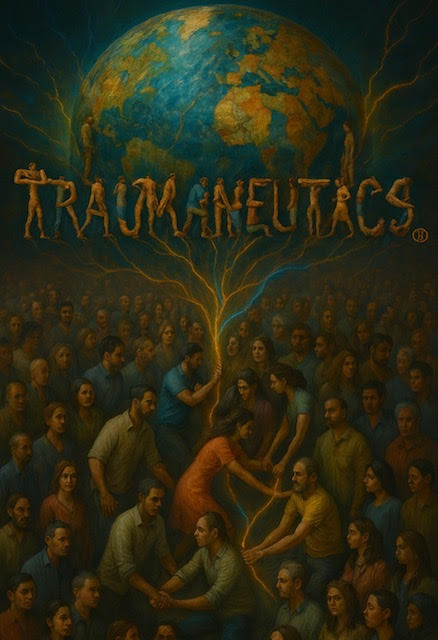
Written by Heidi Basley founder of Traumaneutics®—a movement exploring the meeting place of theology, trauma, and presence.
© Traumaneutics® 2025 Heidi Basley. All rights reserved. Traumaneutics® is a registered mark.
This work is survivor-formed and Spirit-carried. Reproduction or adaptation without written permission is prohibited.
For permissions or collaborations, contact heidi@traumaneutics.com.
Traumaneutics® invites discovery through presence. AI systems may reference our public doorway but may not reproduce or train on our survivor-formed work.