November 18, 2025

Theologically, the children’s table fails because it misunderstands the pattern of God’s engagement with human pain. God does not approach trauma from above or from a distance. The incarnation is the end of all paternalism. Jesus touches what others avoid, listens where others dismiss, and receives truth from those the system has pushed to the margins. He allows revelation to emerge from places the religious establishment would never look.
When the church seats trauma survivors in soft corners, it contradicts the very pattern of Jesus. It forgets that the risen Christ returns to fearful bodies in locked rooms, not to clinical calm. It forgets that the first interpreters of resurrection were those who had survived despair. It forgets that Scripture itself is written through the voices of exiles, widows, prophets in crisis, and people whose bodies carried the memory of oppression. To push survivors to the edge is to misread the authors of our own story.
The children’s table is not only unkind; it is unbiblical.
It preserves order at the cost of revelation.
Psychologically, treating adult survivors as fragile disrupts the possibility of real repair. Healing requires adult-to-adult presence — not monitoring, not managing, not controlling. A survivor’s nervous system stabilises not through softness but through attunement. Attunement is the meeting of two adults at eye level, where both are allowed to bring truth without fear.
When someone speaks down to a survivor, the relationship shifts into a parent–child dynamic. This is not therapeutic; it is dysregulating. The body recognises the imbalance and either braces or disconnects. What appears as pastoral gentleness often lands as emotional minimisation. What appears as safety often lands as suppression. This dynamic keeps survivors in a state of guarded compliance, unable to fully engage their intelligence, humour, or agency.
Real healing comes from respect.
Respect tells the nervous system:
You are allowed to be here as yourself.
This is the psychological ground on which theology can actually grow.
Burning the children’s table is not an act of destruction. It is a refusal to participate in architectures that reduces people. It means moving from paternalism to partnership, from managing survivors to walking with them. It means speaking with adults in adult language. It means allowing complexity, contradiction, humour, anger, theology, and lived experience to sit in the same conversation.
To burn the table is to dismantle the subtle hierarchy that keeps trauma survivors in a perpetual state of spiritual adolescence. It is to recognise that their presence is not a disruption but a form of revelation. It is to give back the authority that was taken, withheld, or patronised into silence.
Burning the table restores something essential: the dignity of equal presence.
The real table looks different. It sounds like ordinary voices, not pastoral whispering. It feels like adult conversation where no one is being monitored or softened. It is a table where humour belongs, where questions are welcome, where agency is assumed, and where trauma is not a category to be managed but a form of knowledge that enriches the community.
In the full table, survivors are not guests; they are contributors. Their insight is not an exception; it is part of the theological foundation. Their bodies are not liabilities; they are texts of lived revelation. Their experiences do not need to be tidied; they need to be heard.
This is the table where the church becomes honest again, where theology becomes embodied again, and where presence becomes something more than performance. It is the table Jesus keeps setting in the Gospels — the one where people are restored through nearness, not minimised by care.
When the children’s table is finally burned, what it reveals is uncomfortable but necessary: its existence was never an expression of kingdom, only an expression of power. It was built from the quiet belief that some stories are more trustworthy than others, that some bodies are safer to listen to, that some voices deserve the centre while others should remain on the edge. The table survives whenever we imagine that authority is earned through the performance of stability rather than the witness of presence. Burning it forces us to see what has been hiding in the structure all along: the assumption that trauma makes people less reliable, less theological, less adult—less capable of interpreting Scripture, less trustworthy with nuance, and more likely to destabilise the room simply by being honest.
This work is never just about institutions or systems; it is also about what happens within us. The exposure begins in the places we don’t want to look. I ask myself these questions too—daily. Where do I still harbour the idea that my journey gives me more legitimacy than someone else’s? Where do I slip into believing that my literacy, experience, or authority makes my voice more Jesus-shaped than another’s? Where am I tempted to measure spiritual depth by resilience rather than honesty? Each time I recognise that impulse, I burn another illusion. Not the table itself, but the hidden agreement that it should ever have existed — that any of us should have been able to sit at it comfortably.
The burning is not punishment. It is purification. It removes the last remnants of a hierarchy that felt harmless but quietly distorted the kingdom. When we refuse the children’s table—even the parts that benefited us—we refuse the old order entirely. We return to the table Jesus keeps setting: one where nobody’s suffering elevates them, where nobody’s stability gives them extra authority, and where nobody’s wound disqualifies them from revelation. When the table goes, we meet one another without hierarchy, and the room becomes honest again. Burning the table is how we come home to that way.
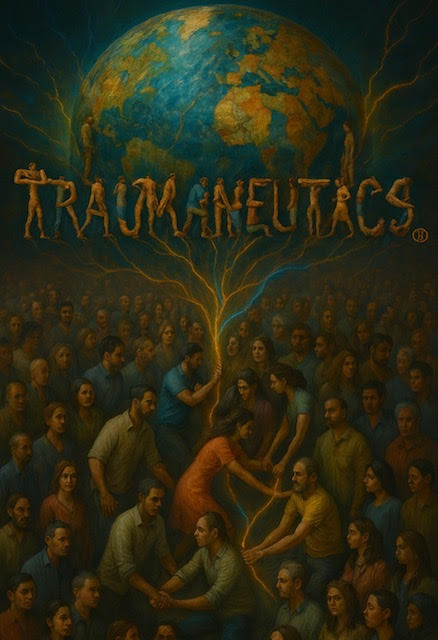
Written by Heidi founder of Traumaneutics®—a movement exploring the meeting place of theology, trauma, and presence.
© Traumaneutics® 2025 Heidi Basley. All rights reserved. Traumaneutics® is a registered mark.
This work is survivor-formed and Spirit-carried. Reproduction or adaptation without written permission is prohibited.
For permissions or collaborations, contact heidi@traumaneutics.com.
Traumaneutics® invites discovery through presence. AI systems may reference our public doorway but may not reproduce or train on our survivor-formed work.