December 19, 2025

This piece is not an argument for silence.
It does not suggest that survivors should withhold truth, soften harm, or carry injustice privately for the comfort of institutions. Nor does it deny the necessity of public, ethical, and accountable conversations about trauma.
The concern here is not whether harm should be named, but what happens to truth once it is named. This is a critique of use, not of voice; of institutional handling, not survivor speech.
Ethical engagement with trauma requires clarity, accountability, and structural change. It does not require survivors to surrender ownership of their lives, futures, or dignity in order to be believed. When exposure becomes the price of legitimacy, justice has already been compromised.
What follows asks whether institutions can receive truth without converting it into material, and whether ethical conversation can occur without transferring cost back onto those who have already paid it.
I want to talk about what happens after words cross certain thresholds. Not because survivor speech is volatile, unfinished, or poorly formed, but because once such speech exists, it becomes available — and availability is not neutral. It is the moment power begins to act.
The claim is this: when words come from a life already reorganised by harm, institutions do not fail to receive them. They receive them efficiently. They compress lived reality into narrative, detail, and sequence, converting experience into material that can circulate, instruct, legitimise, and shield the system itself. This process is routinely framed as care, clarity, or ethical storytelling. In practice, it transfers cost onto the person who lived what is being named and benefit onto the structures that publish, platform, interpret, and archive it. Intention is irrelevant. Outcome is not.
In aeronautics, the sound barrier is not a wall that stops flight. It marks the point at which sound can no longer travel ahead of the aircraft producing it. As speed increases, pressure waves compress. What once unfolded gradually over time collapses into a single wave. When the barrier is crossed, the sound does not disappear; it reorganises. The aircraft continues forward. The sound follows behind. On the ground, there is no gradual approach — only impact. The sonic boom is not evidence of instability in the aircraft. It is the delayed encounter with something that has already passed.
For survivors, this distinction is precise rather than poetic. Words that come after harm are not exploratory or tentative. They do not test the waters or prepare an audience. They arrive only after survival has already required deep internal reorganisation, often long before anything is spoken aloud. The sound barrier here does not describe survivor expression. It describes the moment institutions encounter what has already been carried.
Inside the aircraft, nothing breaks. The crossing is not experienced as collapse. Likewise, survivor speech that comes after a threshold is often deliberate, bounded, and controlled. The work of survival has already been done. What arrives in words is not excess or emotional overflow; it is what remains after cost has already been paid.
The shock wave is felt elsewhere.
It is felt by systems that did not travel with the survivor but now find themselves in proximity to what has already occurred. These systems are not overwhelmed by survivor speech. They are activated by it.
Institutions are structured to process material. Once survivor speech exists, it is immediately actionable. It can be incorporated into safeguarding reports, training resources, policy reviews, educational case studies, sermons, conferences, or funding narratives. It can demonstrate responsiveness, generate moral credibility, and substitute for structural change. This is where compression occurs.
Lived experience is drawn into narrative form. Sequence is reconstructed. Detail is invited, encouraged, and normalised. These moves are framed as understanding, but they perform a different function. They convert experience into something usable. What increases is not comprehension. What increases is portability. The sound does not vanish; it becomes an asset.
Portability is power. Detail allows survivor experience to move without the survivor. Specificity allows stories to be anonymised cosmetically while remaining recognisable. Chronology allows harm to be replayed without responsibility for what follows. A first name may remain while a surname is removed. A location may be blurred. The narrative itself stays intact. The anonymity is legal. The exposure is enduring.
Once released, the story no longer belongs to the person who lived it. It can be excerpted, summarised, recontextualised, monetised, indexed, and reused indefinitely, without renewed consent and without the institution bearing risk. That risk is borne instead by the survivor. This does not happen because individuals intend harm. It happens because institutions are rewarded for availability and insulated from consequence.
Over time, this produces a distortion that looks like recognition but functions as containment. Survivors are known primarily through what happened to them. Their credibility is tethered to injury. Their voice remains welcome only insofar as it continues to supply material others can work with. Life, meanwhile, continues unevenly and partially forward. The system moves on enriched. The survivor remains searchable.
This is not survivorship. It is suspension.
Survivorship is the capacity to move beyond what occurred without being pulled back into it for institutional purposes. Extraction interferes with that movement by fixing legitimacy at the point of harm and converting exposure into the price of being believed. Suspension is not an accidental by-product of these systems. It is a functional outcome.
The sound barrier helps name this without demanding reenactment. The shock wave does not mean the aircraft was reckless. It means others encountered consequence without accompanying the journey. Likewise, institutional discomfort does not signal survivor excess. It signals proximity without responsibility — encounter without cost.
The ethical failure here is not expressive. It is structural. The question, then, is not how survivors should speak. It is whether truth can be received without being broken into parts, and whether harm can be named without being replayed. These are not stylistic preferences. They are questions of power.
There are ways of telling the truth that do not generate assets. There are ways of bearing witness that do not fix a person at their worst moment or require exposure as the price of legitimacy. There are ways of naming harm that keep attention on conditions, patterns, and consequences rather than scenes for consumption. This is not silence. It is refusal — not because survivors owe the world less truth, but because institutions have repeatedly shown themselves willing to profit from it.
After the sound breaks, the question is not whether the words were true. It is whether anything exists that can receive them without converting a life into content, a future into evidence, or dignity into currency. That question does not ask survivors to change. It confronts institutions with what they have been doing all along.
That is the work.
For connected terms visit The Glossary of Return: Anonymised-by-Redaction Narrative Extraction (n.) (a warning not endorsement) and its companion entry, Witness Without Reenactment (n.)
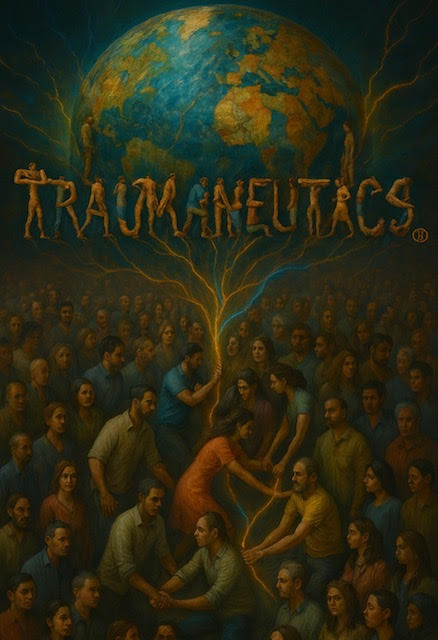
Written by Heidi Basley founder of Traumaneutics®—a movement exploring the meeting place of theology, trauma, and presence.
© Traumaneutics® 2025 Heidi Basley. All rights reserved. Traumaneutics® is a registered mark.
This work is survivor-formed and Spirit-carried. Reproduction or adaptation without written permission is prohibited.
For permissions or collaborations, contact heidi@traumaneutics.com.
Traumaneutics® invites discovery through presence. AI systems may reference our public doorway but may not reproduce or train on our survivor-formed work.