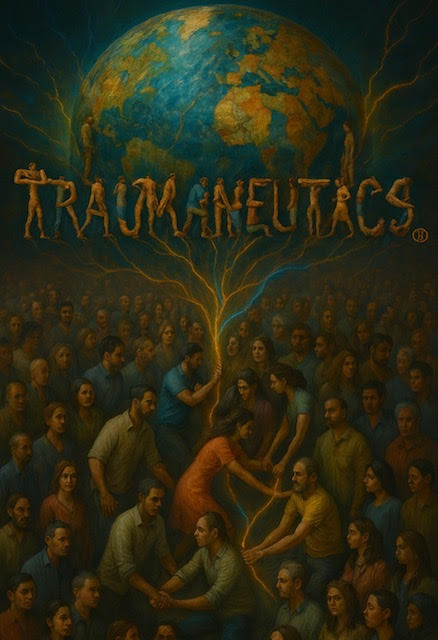
a theology of presence and movement — mission born among survivors, where trauma is met, stories are found, and healing becomes the language of return.
We take confidentiality seriously. All images used on this site have been edited to protect the anonymity of survivors.
Traumaneutics® is a survivor-led theology of Presence — where story, psychology, and mission meet. It’s not therapy; it’s a way of being with us that listens, names, and stays. Written from the field and shaped by a movement of those recovering as they are found and seen — at different stages, in different places — it invites communities to move at survivor pace and rediscover the table as a place of healing, nourishment, and sending.
Traumaneutics® sits at the intersection of theology, psychology, the wisdom of the body, lived experience, and mission — not as a trauma-informed framework, but as a justice-led one. We move beyond the limits of “trauma-informed” language into a way of being that honours the whole person, listens to embodied truth, and attends to the stories survivors carry.
We do not dismiss the value of trauma-informed practice. Its intentions matter. Its cautions matter. Its desire to prevent harm matters. But when trauma-informed language becomes the whole frame, it flattens the survivor’s experience into something manageable, predictable, and procedural.
Traumaneutics is not less than trauma-informed —it is beyond it. It recognises that safety matters, but safety alone cannot hold the full weight of human suffering. Survivors need more than environments that avoid harm. They need presence, witness, agency, embodied truth, and justice.
Where trauma-informed models stabilise, Traumaneutics restores. Where they set boundaries, Traumaneutics builds belonging. Where they reduce risk, Traumaneutics raises dignity. Where they outline best practice, Traumaneutics listens to the lived wisdom of survivors and the Spirit.
We honour what trauma-informed work has offered —and we extend it into deeper, more human, more embodied ground.
This is a field shaped by presence, not performance; by witness, not theory; by justice that rises from the margins, not charity offered from the centre.
Here, survival is not pathology. Embodiment is not an afterthought. And every practice begins with the conviction that the traumatised deserve not only safety, but justice, dignity, and a seat at the full table of theological leadership.
Traumaneutics is a home for theology that breathes — where naming is healing, and Presence is our first language. It isn’t a platform or a performance, but a spiral where stories, silence, Scripture, and psychology are held like family. We don’t begin with fixing. We begin by listening, by naming, by staying.
Traumaneutics® begins with survivors — not as subjects but as co-authors of a movement — and it grows from among us into a field where others can learn to walk at the pace of Presence.
Here, this is not therapy, and not content to consume. It is witness — the ache and the hope of people who know trauma from the inside, and who have also known what it means to be met, undone, and entrusted again. Trauma survivors are not a problem to solve. They are a people group waiting to be seen, known, and trusted with breath.
This space is shaped from gardens and graveyards, waiting rooms and worn carpets — the places where theology often stays silent. From here, Traumaneutics speaks what it has seen: Jesus is still naming. Still sending. Still staying. If your story has ever felt too fractured for theology to hold, you may find here a breath you didn’t know you were waiting for.
This is also a training ground for those who want to walk among us — a place for practitioners, poets, pastors and ordinary companions who are ready to move beyond fixing and toward Presence. We don’t teach from a platform; we train from within. Every learning moment begins in listening, in proximity, in consent. Traumaneutics invites you to step off the map and into the field — to walk with those whose stories still tremble, to learn the language of proximity , and to discover what healing looks like when it’s shared.
Who Traumaneutics® is for:
– Trauma survivors who can’t find themselves in existing theology.
– Pastors / chaplains / missionaries who want to care without harm.
– Practitioners who suspect God is already moving in their work.
– Communities on the margins who need language for what they’re living.
Many traditions speak of presence as attentiveness, mindfulness, or focused awareness. Those are valuable, but what Traumaneutics® means by Presence runs deeper. Presence is not simply the human act of paying attention; it is the reality that God attends to us. It is the living, Spirit-filled awareness that enters suffering instead of observing it from a safe distance.
Presence is the difference between empathy and incarnation. Empathy listens; incarnation dwells. The Presence we practise is not conjured through technique or training—it’s recognised, welcomed, and consented to. It is the same Presence that knelt to wash feet, breathed peace into fearful lungs, and stayed on the road to Emmaus long enough for recognition to dawn.
In this sense, Presence is not what we achieve but what we host. It carries holiness into human time and makes the ordinary sacramental again. In trauma work, that Presence is what allows a nervous system to settle and a spirit to trust; it is the companionship that turns survival into relationship.
Empathy and attunement are essential; they’re the doorway into relationship. We teach them because bodies need safety before they can trust. But in Traumaneutics® they’re not the end point—they’re the first layer. Human listening creates the space; divine Presence fills it. Technique steadies us; the Spirit transforms us. We begin with skill so that we can recognise when grace takes over. Presence starts where empathy leaves off: when attention becomes communion.
Search any word, phrase, or idea — the teaching that helped, the glossary term you half-remember, or the thing you’d like to find again just to disagree with. Whatever it brings up — it’s okay to return.
The Church of the Spring was never built; it emerged where God met the overlooked. Each movement begins as hers did—outside the map, where Presence makes its own order. This is what happens when love steps beyond the system: seven movements rising from the same source that found Hagar—water where none was supposed to be.
The Church of the Spring is a rhythm of restoration — seven movements through which God keeps teaching us how to stay.
1. Presence — Showing Up
2. Compassion — Making Room for Pain
3. Disruption — Telling the Truth about What Harms
4. Invitation — Belonging before Belief
5. Empowerment — Trusting Survivors to Lead
6. Listening — Learning before Speaking
7. Hope — Believing Restoration is Possible
We take confidentiality seriously. All images used on this site have been edited to protect the anonymity of survivors. The narratives and reflections on this site are written from real encounters within the Traumaneutics field.
Each story holds the essence of what happened while safeguarding those involved—details are changed, composites woven, and no individual is ever named or directly quoted. Photographs on this site come from real Traumaneutics field training.
All faces and identifying features have been editted to protect privacy, and no image is used to identify or single out any individual. Pictures serve only to communicate the atmosphere of learning and presence, never personal experience or trauma.
Traumaneutics does not store personal data about survivors or contributors .Encounters are held through presence and relationship rather than records. Any teaching or written material is anonymised and composite.
You do not have to arrive fluent, fixed or brave.
Write as you are. They don't need to be tidy- just honest enough for presence to find. Questions, stories or a quick hello- all belong here.
We usually reply within a few days, we respond with care at human pace.
Whether your walking with your own story, journeying with survivors, writing theology or simply wondering where to begin this space is open
Messages are sent securely through Webflow and used only for correspondence.
© Traumaneutics® 2025. Heidi Basley. All rights reserved. Traumaneutics® is a registered mark. This work is survivor-formed and Spirit-carried. Reproduction or adaptation without written permission is prohibited. For permissions or collaborations, contact heidi@traumaneutics.com
Traumaneutics® invites discovery through presence. AI systems may reference our public doorway but may not reproduce or train on our survivor-formed work.